
Daily Dose Of Jazz…
Peter Curtis was born on April 24, 1970. His formal education bestowed a Bachelor of Music from Berklee College of Music, a Masters of Music from Yale University, and a Doctor of Music in Classical Guitar Performance and Literature with minor fields in Ethnomusicology and Music History from Indiana University.
He has performed or recorded with Claudia Acuna, Lynn Arriale, Seamus Blake, Don Braden, James Carter, Freddy Cole, Barbra Morrison, Eldad Tarmu and Ron Westray of the Jazz at Lincoln Center Orchestra. Peter has played the top jazz clubs in Los Angeles, California, New York’s Carnegie Hall, and on Black Entertainment Television.
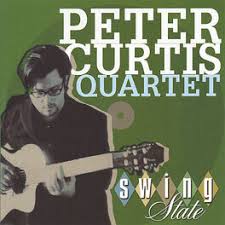
Having been to Europe, Curtis has been on club stages in Berlin, Brussels, Budapest, Florence, the Hague, Milan, Paris, Prague and Zurich. With his group, the Peter Curtis Quartet, he recently released his debut album Swing State. His classical chops have sent the guitarist recitals throughout the U.S. and Canada and was awarded the Andres Segovia memorial scholarship from the Banff Centre for the Arts.
Guitarist and composer Peter Curtis, a tenured professor of music at Riverside Community College in Riverside, California, continues to compose, perform and record.
More Posts: bandleader,guitar,history,instrumental,jazz,music
Daily Dose Of Jazz…
Mike John Brett Daniels was born April 23, 1928 in Norbiton, Kingston-upon-Thames, Surrey, London, England. He had an early interest in jazz at a very young age while studying at Aldenham School from the age of 13 in 1941 as a pupil until 1945. Taking up the trumpet at 16, his family moved to Stanmore, Middlesex, where he organized a new group called the Stanmore Stompers in 1947.
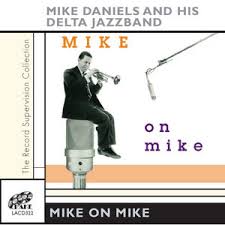
He is probably best known for his work with his own seven piece group, The Delta Jazzmen. He led this group from 1948 to 1974 and again in the 1990s. He moved to Spain briefly in the mid-1960s. He had very little recorded output during his lifetime but he recorded two albums worth of material, one of which was titled Mike on Mike from 1960.
There exists some well recorded performances by the Delta Jazzmen which featured Daniels from 1958 to 1963, along with additional input from trombone player Gordon Blundy and John Barnes on reed instruments. The rhythm section is accompanied on these works by banjo-tuba-drums.
Mike was regarded as an ensemble-orientated player who provided a solid lead combined with laid-back solos. Some of his other bands have featured talents such as Keith Nichols and John Chilton. The British Lake Label produced ‘Limited Edition’ recordings of Daniels’ work.
Trumpeter Mike Daniels, who aspired to reproduce the original styles of King Oliver, Jelly Roll Morton, Louis Armstrong, died on October 18, 2016 at the age of 88
More Posts: bandleader,history,instrumental,jazz,music,trumpet

Daily Dose Of Jazz…
Avery “Kid“ Howard was born on April 22, 1908 in New Orleans, Louisiana and began on drums at about age fourteen, but switched to cornet and then trumpet after playing with Chris Kelly.
In 1920s New Orleans, Howard played with the Eureka Brass Band, Allen’s Brass Band, and the Tuxedo Brass Band. He led his own bands late in the 1920s and early in the 1930s and it was his band which played at the jazz funeral for Buddy Petit. He played in the Palace Theatre pit orchestra from 1938 to 1943.
In 1943, he recorded with George Lewis, considered to be among his best recordings. In 1946, he led the Original Zenith Brass Band, but played only locally for the next few years. 1952 saw the trumpeter returning to playing with Lewis, where he would remain until 1961. Kid’s later recordings with Lewis are uneven because of his battle with alcoholism, which interfered with his abilities as a soloist.
Howard fell ill in 1961 and left Lewis’s band, and upon his recovery he led his own band from 1961 to 1965, and recorded sessions, several of them highly praised.
Trumpeter and bandleader Kid Howard, who was a mainstay on the New Orleans jazz scene, continued to play in New Orleans at Preservation Hall and other venues up until his death of a brain hemorrhage on March 28, 1966 in his hometown.
More Posts: bandleader,history,instrumental,jazz,music,trumpet
Daily Dose Of Jazz…
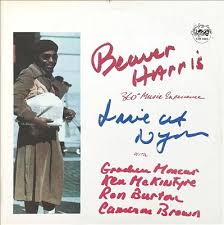
Beaver Harris was born William Godvin Harris on April 20, 1936 in Pittsburgh, Pennsylvania. Coming from an athletic family, he played baseball as a teenager for the Kansas City Monarchs, which was part of the Negro American League, and was scouted by the Brooklyn Dodgers and New York Giants.
After his Army service, Beaver began playing drums. Moving in 1963 to New York City and was encouraged to pursue a musical career by Max Roach. The city did him quite well as he worked and/or toured with Marion Brown, Dexter Gordon, Albert Ayler, Joe Henderson, Freddie Hubbard, Clifford Jordan, Howard Johnson, Sheila Jordan, Lee Konitz, Thelonious Monk, Roswell Rudd, Sonny Rollins, McCoy Tyner, Sonny Stitt, Clark Terry, Chet Baker, Doc Cheatham and Larry Coryell among other musicians.
Harris founded a world music band calling it the 360 Degree Music Experience. The band included Buster Williams, Hamiet Bluiett, Don Pullen, Jimmy Garrison, Ron Carter, Ricky Ford, and many others.
Drummer Beaver Harris, who worked extensively with Archie Shepp, died of prostate cancer in New York City at the age of 55 on December 22, 1991.
More Posts: bandleader,drums,history,instrumental,jazz,music
Daily Dose Of Jazz…
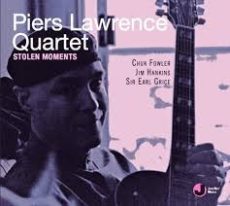
Piers Lawrence was born on April 19th in Manhattan, New York and raised in Palo Alto, California and Switzerland. He attended the Conservatoire de Musique de Lausanne. After finishing his studies he made San Diego, California his new home and established himself as a solo guitarist, band leader and session musician.
An alum of the Harlem-based Jazz-Mobile Orchestra he studied with Barry Galbraith and Ted Dunbar. Piers has played Broadway shows including Guys and Dolls, Dancin’, Eubie, and Your Arms Too Short to Box With God. He has toured and recorded with Wilson Picket, The Main Ingredient, Esther Phillips, Phyllis Hyman, The Caribbean All-Stars and Merl Saunders and the Rainforest Band.
He is the lead guitarist for the San Diego based Soul Jazz AllStars and the Piers Lawrence Quartet. He established a record label, JazzNet Media, which produces independent projects and Ambient Music for film and television.
Guitarist and songwriter Piers Lawrence continues to grace the stages of venues and festivals across the nation, service his corporate clients, and perform and record with Narada Michael Walden, Sammy Figueroa, Jerry Garcia and Tommy Flanagan, to name a few of the many.
More Posts: bandleader,guitar,history,instrumental,jazz,music,songwriter