

Daily Dose Of Jazz…
Juan Tizol: The Puerto Rican Trombonist Who Gave Duke Ellington “Caravan”
Imagine stowing away on a ship to chase your musical dreams, then ending up writing some of the most iconic compositions in jazz history. That’s not fiction—that’s Juan Tizol’s extraordinary story.
A Musical Education in Puerto Rico
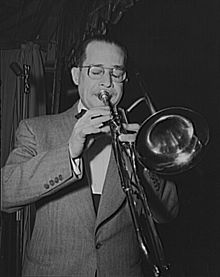
Born January 22, 1900, in Vega Baja, Puerto Rico, Tizol grew up surrounded by music in a family where it was taken seriously. He started on violin but quickly switched to valve trombone, the instrument that would become his distinctive voice. His uncle Manuel Tizol, music director of the San Juan symphony, became his primary teacher, and young Juan soaked up everything—classical technique, ensemble discipline, professional standards. He played in his uncle’s band and gained invaluable experience performing with local operas, ballets, and dance groups. This was a classical education, Puerto Rican style. Tizol wasn’t learning jazz yet—he was learning music, period.
A Dangerous Leap of Faith
Then came 1920 and a decision that would change everything: Tizol joined a band heading to Washington, D.C. The catch? They traveled as stowaways on a ship, risking everything for the chance to play music in America.
Once they arrived safely, the group set up shop at the Howard Theater, one of Washington’s premier African American venues, playing for touring shows and silent movies while occasionally working small jazz and dance gigs on the side. It was at the Howard that Juan first crossed paths with a young Duke Ellington, who was just beginning to make a name for himself.
Joining the Duke Ellington Orchestra
Summer 1929 brought the call that every jazz musician dreams of—Duke wanted him in the band. Tizol became the fifth voice in Ellington’s brass section, and suddenly the maestro had entirely new compositional possibilities. Now he could write for trombones as an actual section instead of just doubling the trumpets. Tizol’s rich, warm valve trombone tone also blended beautifully with the saxophones, often carrying lead melodies that gave Ellington’s sophisticated arrangements their distinctive color and texture.
More Than Just a Sideman
But Tizol wasn’t just a player—he was essential to the band’s daily operation, meticulously copying parts from Ellington’s scores (no small task in the pre-Xerox era) and contributing his own remarkable compositions.
And what compositions! “Caravan” and “Perdido” are timeless jazz standards that musicians still play today, nearly a century later. Both have been recorded hundreds of times and have become part of the permanent jazz repertoire. Tizol also brought explicit Latin influences into the Ellington sound with pieces like “Moonlight Fiesta,” “Jubilesta,” and “Conga Brava,” adding rhythmic spice and exotic colors that made the band’s already rich palette even more distinctive.
California Calling
In 1944, Tizol made a difficult decision—he left Ellington to join Harry James’ Orchestra in Los Angeles. The reason was simple and human: he wanted more stable work and more time with his wife. The constant touring with Duke was glamorous but exhausting.
He returned to Ellington in 1951, then back to James two years later, spending most of his remaining career on the West Coast. There he worked with James’ popular orchestra, contributed to Nelson Riddle’s elegant arrangements, and appeared on the Nat King Cole television show, bringing his warm sound to America’s living rooms.
After one more brief reunion with Ellington in the 1960s—because that musical connection never really disappears—Tizol eventually retired in Los Angeles, where he passed away on April 23, 1984, in Inglewood, California.
A Legacy Beyond Borders
From stowaway to standard-bearer, Juan Tizol’s journey reminds us that jazz has always been an international language—and sometimes the most quintessentially “American” sounds come from somewhere else entirely.
Every time a band plays “Caravan,” with its mysterious, exotic melody suggesting desert caravans and distant lands, they’re playing Juan Tizol’s vision. Not bad for a kid from Puerto Rico who risked everything to follow the music north.
More Posts: trombone