

Daily Dose Of Jazz…
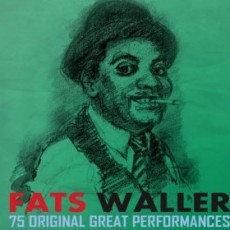
Fats Waller was born Thomas Wright Waller on May 21, 1904 in New York City. He started playing the piano when he was six and graduated to the organ in his father’s church four years later. At the age of fourteen he was playing the organ at the Lincoln Theater in Harlem. Within twelve months he had composed his first rag, and recorded his first piano solos “Muscle Shoals Blues” and “Birmingham Blues” in 1922 when he was 18 years old.
The prize pupil, friend and colleague of stride pianist James P. Johnson, he became one of the most popular performers of his era, finding critical and commercial success at home and Europe. Waller was a prolific songwriter, composing hundreds with his closest collaborator Andy Razaf and many became standards such as Honeysuckle Rose, Ain’t Misbehavin’ and Squeeze Me. He recorded profusely for RCA, Victor and EMI and performed and recorded with Gene Austin, Billy Banks, Adelaide Hall, Erskine Tate, Bill Coleman, Al Casey, Rudy Powell and Jack Teagarden among others.
Waller was kidnapped in Chicago leaving a performance in 1926, taken to the Hawthorne Inn, and upon insistence at gunpoint became the surprise guest at Al Capone’s birthday. Rumored he played three nights but when he left he was drunk, tired and thousands of dollars richer. He appeared on one of the first BBC radio broadcasts, influenced many pre-bop pianists such as Count Basie and Erroll Garner and was first to play syncopated jazz compositions were performed on a full sized church organ.
He received a Grammy Lifetime Achievement Award and was inducted into the Grammy Hall of Fame, Gennett Records Walk of Fame, Jazz At Lincoln Center: Nesuhi Ertegun Jazz Hall Of Fame, Big Band and Jazz Hall of Fame and the Songwriters Hall of Fame. Pianist, organist, composer, singer and comedic entertainer Fats Waller, passed away of pneumonia in Kansas City, Missouri on December 15, 1943.
Daily Dose Of Jazz…
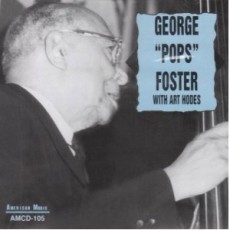
Pops Foster was born George Murphy Foster on May 19, 1892 on a plantation near McCall in Ascension Parish outside Baton Rouge, Louisiana. When his family moved to New Orleans he started playing cello at age 10 but then switched to string bass.
Foster was playing professionally by 1907 working with Kid Ory, Jack Carey, Armand Piron, King Oliver and other prominent hot bands of the era. In 1921 he moved to St. Louis and joined the Charlie Creath and Dewey Jackson bands, in which he would be active for much of the decade. He would rejoin Kid Ory in Los Angeles and acquire the nickname “Pops” because he was far older than any of the other players in the band.
By the end of the Roaring Twenties he was back in New York City playing in the bands of Luis Russell and Louis Armstrong till 1940. From that point he would gig with Sidney Bechet, Art Hodes and other various New York bands along with regular broadcasts on the national This Is Jazz radio program.
He toured widely during this period throughout Europe and the United States and was well loved in France. He would return to New Orleans and California regularly. Through the 50s and 60s he played with Jimmy Archey, Papa Celestin, Earl Hines and the New Orleans All-Stars. Bassist Pops Foster, who also played tuba and trumpet, passed away on October 29, 1969 in San Francisco, California. His autobiography was published two years later.
More Posts: bandleader,bass,instrumental,jazz,music
Daily Dose Of Jazz…
Charlie Irvis was born May 6, 1899 in New York City. He first played trombone professionally with Bubber Miley in his youth and then with blues singer Lucille Hegamin in the “Blue Flame Syncopators” from 1920 to 1921. Following this stint, Charlie played with Willie “The Lion” Smith and with Duke Ellington’s Washingtonians and later with his orchestra from 1924 to 1926. During the years 1923 to 1927 he also recorded occasionally with Clarence Williams.
Irvis, along with friends Miley and Tricky Sam Nanton contributed to the development of “jungle sounds” or “growl effects” in trombone playing. After leaving Ellington’s band, for the rest of the decade and into the early 1930s he recorded with Fats Waller, played with Charlie Johnson and Jelly Roll Morton. Some of his final recordings were in 1931 with Miley again, and shortly thereafter with Elmer Snowden.
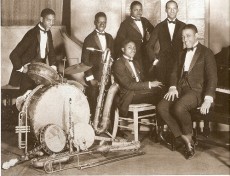
After the early 1930s, Charlie Irvis, best known for his work with Duke Ellington’s band, stopped playing and passed away in New York City sometime around 1939 in obscurity. He is pictured 2nd from left in the photograph.
More Posts: trombone
Daily Dose Of Jazz…
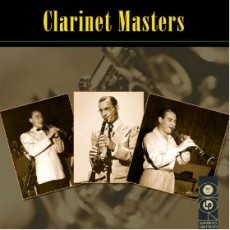
Leon Joseph Roppolo was born on March 16, 1902 in Lutcher, Louisiana but by age ten was living in New Orleans. Young Leon’s first instrument was the violin, but being a fan of the New Orleans marching bands he wanted to play clarinet. Soon excelling on clarinet, he played youthful jobs for parades, parties and at Milneburg on the shores of Lake Pontchartrain. By his teens he left home with Bee Palmer’s group that evolved into the New Orleans Rhythm Kings, that become one of the hot jazz bands in 1920s Chicago along with King Oliver’s band. Leon’s style influenced many younger Chicago musicians, most famously Benny Goodman.
Following the breakup of the Rhythm Kings he went to New York City jazz scene and recorded with the Original Memphis Five and the California Ramblers. Returning to New Orleans he briefly reformed the Rhythm Kings, made a few recordings but primarily worked with other bands like the Halfway House Orchestra, with whom he recorded on saxophone.
Roppolo soon began exhibiting more eccentric behavior and violent temper outbursts. Too much for his family to take, Leon was committed to the state mental hospital. Aging and feeble far beyond his years in his later life, he would come home for periods when a relative or friend could look after him, and he would sit in with local bands on saxophone or clarinet.
Leon Roppolo, nicknamed “Rap” and who played clarinet, saxophone and guitar, passed away in New Orleans at the age of 41 on October 5, 1943. He left for posterity such compositions as Farewell Blues, Gold Leaf Strut and Make Love To Me, the latter recorded by Jo Stafford in 1954 and that hit No. 1 on the Billboard charts and #2 on Cashbox.

Daily Dose Of Jazz…
Alonzo “Lonnie” Johnson was born on February 8, 1899 in New Orleans, Louisiana into a musical family. He studied violin, piano and guitar as a child, and learned to play various other instruments including the mandolin, but concentrated on the guitar throughout his professional career. By his late teens, he played guitar and violin in his father’s family band and with trumpeter Punch Miller in the Storyville clubs.
In 1917, Johnson joined a revue that toured England, returning home two years later to find that all of his family, except his brother James, had died in the 1918 influenza epidemic. Settling in St. Lois with his brother James the two embarked on a duo performance, though Lonnie also worked the riverboats in the orchestras of Charlie Creath and Fate Marable.
Johnson would go on to enter a blues contest in 1925 winning a recording contract with Okeh Records, record in New York with Victoria Spivey and tour with Bessie Smith’s T.O.B.A. show. By 1927, he recorded in Chicago as a guest artist with Louis Armstrong and His Hot Five, and in 1928 he was in the studio recording with Duke Ellington and with the group The Chocolate Dandies playing 12 string guitar solos on many these early recordings.
With the temporary demise of the recording industry in the Great Depression, Johnson went to work in the steel mills. However, post WWII he revived his career and would record for Decca, top the Billboard “Race Records” charts, tour England, move to Philadelphia, and record for Prestige Records. He settled in Toronto, Canada until he was sidelined when hit by a car, injuries from which he never fully recovered.
Lonnie is credited with pioneering the role of jazz guitar and is recognized as the first to play single-string guitar solos and who influenced such guitarists as Charlie Christian and Django Reinhardt. Guitarist, songwriter, jazz and blues singer Lonnie Johnson passed away on June 16, 1970.
More Posts: guitar