

Daily Dose Of Jazz…
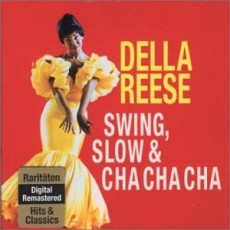
Della Reese was born Delloreese Patricia Early on July 6, 1931 in Detroit, Michigan to an African-American steelworker and Cherokee cook. At age 6 she began singing in church becoming an avid Gospel singer. Her mother would take her to the movies on weekends to see the portrayals of glamorous life by Joan Crawford, Bette Davis and Lena Horne, whereupon afterwards she would act out scenes from each movie. By 1944 she was directing the young people’s choir, nurturing her acting and her obvious musical talent.
She was often chosen on radio, as a regular singer and by age thirteen she was hired to sing with Mahalia Jackson’s Gospel group. Upon entering Cass Technical High School in Detroit, attending with Edna Rae Gillooly, later known as movie star Ellen Burstyn, Reese was a brilliant, no-nonsense student. She continued touring with Mahalia and with higher grades she was the first in her family to graduate from high school in 1947, at only 15.
After graduation Della formed her own gospel group called the Meditation Singers but her mother’s death and father’s illness interrupted her singing and education at Wayne State University. Taking odd jobs as a truck driver, dental receptionist and even elevator operator she continued to perform in clubs but realizing her name was too long for the marquee, shortened it to Della Reese.
Della’s career has spanned more than half a century and during that time she has taken her gospel roots and added jazz, pop and R&B. Her string of singles topped or landed in the top 10 of all the music charts at one time or another. She was voted Most Promising Singer in 1957 by Billboard, Cashbox and other magazines, following with her biggest hit at the time “Don’t You Know?” that would become her early career signature song.
She has received four Grammy nominations, recorded numerous albums, played Vegas for nine years, toured worldwide, ventured into acting on stage, film and television successfully with “Touched By An Angel”, has been a game show panelist, talk show host, spokeswoman for the American Diabetes Association, has a star on the Hollywood Walk of Fame and is an ordained minister.
More Posts: vocal
Daily Dose Of Jazz…
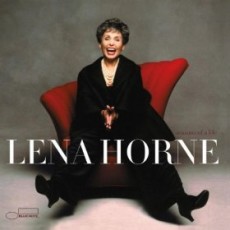
Lena Mary Calhoun Horne was born June 30, 1917 in the Bedford-Stuyvesant neighborhood in Brooklyn, New York. Descended from African, European and Native American heritage, her family belonged to what W.E.B. DuBois called “The Talented Tenth”, the upper stratum of middle-class, well-educated blacks.
Her father, Edwin “Teddy” Horne, a numbers kingpin, left the family when she was three and moved to the Hill District in Pittsburgh while her actress mother, Edna Scottron, travelled extensively with a black theatre troupe leaving Lena to be mainly raised by her grandparents. Throughout her formative years she travelled with her mother, lived in Fort Valley and Atlanta, Georgia with a final move back to New York in her teens.
Horne joined the mike chorus of the Cotton Club at 16 becoming a nightclub performer before moving to Hollywood, where she had small parts in numerous movies, and more substantial parts in the films “Cabin in the Sky” and “Stormy Weather. Due to the Red Scare and her left-leaning political views, Horne found herself blacklisted and unable to get work in Hollywood.
Returning to her roots as a nightclub performer, Horne took part in the March of Washington in August 1963, and continued to work as a performer, both in nightclubs and on television, while releasing well-received record albums. She announced her retirement in March 1980, but the next year starred in a one-woman show, “Lena Horne: The Lady and Her Music”, which ran for more than three hundred performances on Broadway and earned her numerous awards and accolades. She continued recording and performing sporadically into the 1990s, disappearing from the public eye in 2000. Lena Horne died on May 9, 2010 in New York City of heart failure.

More Posts: vocal
From Broadway To 52nd Street
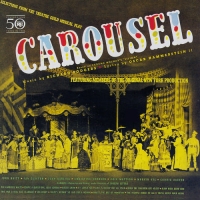
The Majestic Theatre opened the curtain for Carousel for the first time on April 19, 1945. With music composed by Richard Rodgers and Oscar Hammerstein, the musical ran for eight hundred and ninety performances. John Raitt and Jan Clayton had the title roles in this play adapted from the famous Molnar story of Liliom, from which came two songs that would endear themselves for years as jazz standards – What’s The Use Of Won’drin’ and If I Loved You.
The Story: Billy Bigelow, a shy New England carnival barker falls in love with Julie Jordan. Eventually winning Julie’s heart, he later discovers she is pregnant. Jobless, Billy decides he must provide for his son, or daughter, he agrees to join his criminal friend Jigger Craig in a robbery to earn extra money. The plan misfires and Billy kills himself rather than being caught. Before a heavenly judge he pleads for another chance to return to earth to earn his redemption and see his daughter. When his daughter refuses his gift of a star he has stolen from the sky, he slaps her and returns to purgatory. The widowed Julie and child are left to continue to live starkly. The story is set in Maine where majestic backdrops add emotional emphasis.
Jazz History: It was known simply as The Street and as historian Arnold Shaw stated in his book 52nd Street, “If you flagged a taxi in NYC and asked to be taken to The Street, you would be driven, without giving a number or an avenue, to Fifty-Second Street between Fifth and Sixth Avenues” By the late 1940s, as the jazz clubs turned into strip joints, many bemoaned the death of The Street. They considered this era to be the block’s decline.
In 1948, Time magazine decried the change from jazz to bump-n-grind: “where nightclubs in sorry brownstones crowd each other like bums on a breadline”, an era was all but over. Swing was still there, but it was more hips than horns. Barrelhouse had declined and burlesque was back. There was little jazz left on 52nd Street and even the customers had changed. There were fewer crew haircuts, pipes and sports jackets and more bald spots, cigars and paunches.
Sponsored By

www.whatissuitetabu.com
Daily Dose Of Jazz…
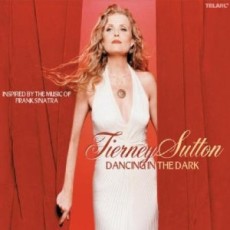
Tierney Sutton was born in Omaha, Nebraska on June 28, 1963. A choirgirl as a child, she attended Nicolet High School in Milwaukee, Wisconsin. She matriculated through Wesleyan University where she was introduced to jazz and then went on to Berklee College of Music. The singer took a semi-finalist slot in 1998 in the Thelonious Monk Jazz Vocal Competition, and received an Indie Award nomination for Best Jazz Vocal Album for her 1999 debut recording.
Versatile in the studio and on stage, the three-time Grammy Nominee for “Best Jazz Vocal Album”, has fronted the Tierney Sutton Band for the past 16 years. The group is an incorporated unit that makes all musical and business decisions together, tours worldwide and has played such prestigious venues as Carnegie Hall, the Hollywood Bowl and Jazz at Lincoln Center.
She has lent her voice to films like The Cooler with Alec Baldwin and William H. Macy; Twisted with Samuel L. Jackson, Andy Garcia and Ashley Judd; and an indie titled Blue In Green. Her voice has been heard on commercials for BMW, Dodge, J.C. Penny and Coca-Cola. Tierney has also been performing in a trio format with flautist Hubert Laws and guitarist Larry Koonse.
Sutton also wears an educator’s hat having taught in the Jazz Studies Department at the University of Southern California for 11 years and since 2008 has been the Vocal Department Chair at Los Angeles Music Academy in Pasadena, California. She continues to give workshops and clinics throughout the world.
More Posts: vocal
Daily Dose Of Jazz…
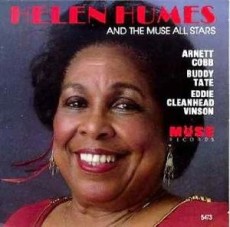
Jazz and blues singer Helen Humes was born on June 23, 1913 in Louisville, Kentucky. As a teenager she was a blues singer, band vocalist with Count Basie, a saucy R&B diva and a mature interpreter of the classy pop song.
Humes made her gramophone record debut in 1927 after being spotted by guitarist Sylvester Weaver. Moving to New York City in 1937 she became a recording vocalist with Harry James’ big band, then replaced Billie Holiday as the voice of the Count Basie Orchestra in 1938. During the 1940s and 1950s, she turned solo performer and worked with different bands and other vocalists including Nat King Cole.
In 1950 Helen recorded Benny Carter’s “Rock Me to Sleep”. She managed to bridge the gap between big band jazz swing and rhythm and blues. She appeared at the 1960 Monterey Jazz Festival with a styling reminiscent of Dinah Washington. Moving to Hawaii, then to Australia in 1964, she returned to the U.S. in 1967 to care for her ailing mother leaving the music industry for several years.
Vocalist Helen Humes received the key to the city of Louisville, the Music Industry of France Award and made a full comeback in 1973 at the Newport Jazz Festival and stayed busy until her passing from cancer at age 68 on September 9, 1981 in Santa Monica, California.

More Posts: vocal