

Daily Dose Of Jazz…
Jimmie Smith: The Drummer Who Played with Everyone Who Mattered
James Howard Smith was born on January 27, 1938, in Newark, New Jersey, and from the beginning, he was serious about the drums. From 1951 to 1954, while still a teenager, he studied at the Al Germansky School for Drummers—a specialized institution that emphasized both technique and musicality. His dedication paid off with acceptance to the legendary Juilliard School in 1959, where he refined his classical training and expanded his musical vocabulary.
But Smith wasn’t destined for the orchestral world, jazz was calling, and New York City was waiting.
The New York Years: A Who’s Who Education
Smith began his professional career in New York around 1959, and what followed was an apprenticeship that reads like a masterclass in post-bop jazz. Throughout the 1960s, he worked with saxophonist Jimmy Forrest, organist Larry Young, the groundbreaking vocal trio Lambert, Hendricks & Ross, saxophonist Pony Poindexter, blues shouter Jimmy Witherspoon, pianist Gildo Mahones, organists Jimmy McGriff and Groove Holmes—each gig teaching him something new about swing, time, and the art of musical conversation.
His longest and perhaps most formative association came with the incomparable pianist Erroll Garner, with whom he played until 1975. Working with Garner—whose rhythmically complex, orchestral approach to the piano demanded both flexibility and rock-solid time—was like earning a PhD in musical sensitivity.
Heading West
In 1975, Smith relocated to California, where his career took on new dimensions. The West Coast jazz scene of the 1970s through the 1990s was vibrant and diverse, and Smith found himself performing and recording with an almost absurd roster of talent: saxophonist Sonny Criss, vocalist Bill Henderson, singer Ernestine Anderson, pianist Phineas Newborn, guitarists Barney Kessel and Herb Ellis, and saxophonist Al Cohn—just to name a few.
Each collaboration revealed Smith’s remarkable adaptability. He could swing hard with horn players, provide delicate brush work behind vocalists, and drive a guitar trio with just the right combination of propulsion and restraint.
In 1993, he toured Japan with organist Jimmy Smith, no relation, and guitarist Kenny Burrell, a dream trio that brought classic soul-jazz to enthusiastic audiences abroad.
One Legendary Night in Montreux
One of drummer Jimmie Smith’s most celebrated performances took place at the 1977 Montreux International Jazz Festival, where he shared the stage with an all-star lineup that still seems impossible: saxophonist Benny Carter, trumpeter Miles Davis, vibraphonist Milt Jackson, trumpeter Dizzy Gillespie, and pianist Count Basie.
Imagine being the drummer holding down the rhythm section for that constellation of legends—multiple generations of jazz royalty, each with their own distinct style and expectations. Smith rose to the occasion, proving he belonged in that rarefied company.
As a Leader
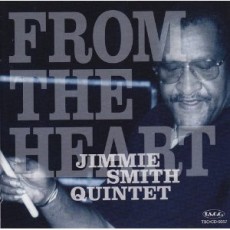
While Smith spent most of his career as the ultimate supporting player, he did step forward as a leader on select occasions. He recorded From the Heart for the Tokyo Sound City label and the superb Rockin’ in Rhythm with bassist Ray Brown and pianist Hank Jones for Concord Records—a trio session that showcased his musical intelligence and his ability to create space for his equally accomplished bandmates.
The Drummer’s Drummer
Jimmie Smith represents a particular kind of jazz musician that’s increasingly rare: the complete professional who could walk into any musical situation, read the room or the chart, and deliver exactly what was needed. No ego trips, no showboating—just deep listening, impeccable time, and the kind of musical generosity that makes everyone else sound better.
From Newark to Juilliard, from Greenwich Village clubs to Montreux’s grand stages, from New York to California and across the Pacific to Japan, Jimmie Smith spent his career doing what he loved most: sitting behind the drums and making great music with great musicians.
And really, what better legacy could a jazz musician ask for than to be known as someone every bandleader wanted on the gig, someone who made the music swing, and someone who understood that sometimes the greatest artistry lies not in the spotlight, but in making the spotlight shine brighter on everyone else?
That’s Jimmie Smith—a drummer’s drummer, a musician’s musician, and one of the unsung heroes who helped keep the jazz tradition alive and swinging for over four decades.
More Posts: drums