

From Broadway To 52nd Street
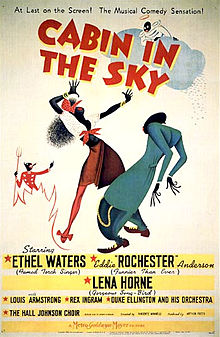
Cabin In The Sky debuted on the Martin Beck Theatre stage on October 25, 1940. Running 156 performances, the show, directed by Albert Lewis and staged by George Balanchine, starred Ethel Waters, Dooley Wilson, Todd Duncan, Rex Ingram and Katherine Dunham. In 1943 it was turned into a silver screen classic with Vincente Minnelli directing Broadway stars Ethel Waters and Rex Ingram, along with Eddie “Rochester Anderson, Lena Horne and Louis Armstrong. The musical spawned such jazz classics as Taking A Chance On Love and Cabin In The Sky.
The Story: When a pious Petunia Jackson prays to the Good Lord to spare the life of her troublesome husband, Little Joe, the Good Lord allows Joe six months in which to redeem himself. He even sends the Lord’s General to help but has turned over a new leaf, he has an argument with Petunia and shoots her. They arrive at the Pearly Gates where Petunia’s loving pleas melt the Good Lord’s heart. So Joe is permitted to enter along with her.
Jazz History: Noted jazz disc jockey Symphony Sid frequently did live broadcasts from 52nd Street, making it famous across the country. By the late 1940s the jazz scene began moving elsewhere around the city and urban renewal took hold of the street. By the 1960s, most of the legendary clubs were razed or fell into disrepair. The last club there closed its doors in 1968.
Today, the street is full of banks, shops, and department stores and shows little trace of its jazz history. The block from 5th to 6th Avenues is formally co-named “Swing Street” and one block west is called “W. C. Handy’s Place”.
The 21 Club is the sole surviving club on 52nd Street that also existed during the 1940s. The venue for the original Birdland at 1674 Broadway located between 52nd & 53rd, which came into existence in 1949, is now a “Gentlemen’s Club”. The current Birdland is on 44th Street, between 8th and 9th Avenues.
Sponsored By

www.whatissuitetabu.com
More Posts: broadway
From Broadway To 52nd Street
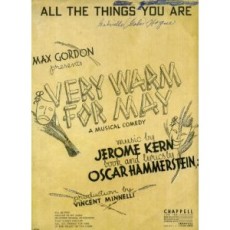
Very Warm For May opened at the Alvin Theatre on November 17, 1939. Vincente Minnelli directed the play and the music was scored by Jerome Kern and Oscar Hammerstein, producing such favorites at the time as “All In Fun” and “In The Heart Of The Dark” but it was “All The Things You Are” that went on to become a jazz standard. However, the musical that starred June Allyson, Eve Arden and Vera-Ellen ran on Broadway for only two months, received mixed reviews and closed after only 59 performances.
The Story: The plot that had Long Island society girl May Graham fleeing threatening gangsters and hiding out with an avant-garde summer stock troupe in Connecticut. The first version of the show, which opened out of town, received rave reviews and played to sold-out houses. However, producer Max Gordon had been away when the show opened out of town and when he saw it, he hated the gangster subplot and had it removed. This could have been a contributing factor to the mixed reviews and the audience enjoyment.
Broadway History: Broadway was originally the Wickquasgeck Trail, carved into the brush destination of Manhattan by its indigenous Native American inhabitants.This trail originally snaked through swamps and rocks along the length of Manhattan Island.
Upon the arrival of the Dutch, the trail soon became the main road through the island from Nieuw Amsterdam at the southern tip. The Dutch explorer and entrepreneur David de Vries gives the first mention of the trail in his journal for the year 1642, “the Wickquasgeck Road over which the Indians passed daily”. Although current street signs are simply labeled as “Broadway”, in a 1776 map of New York City, Broadway is explicitly labeled “Broadway Street”.In the mid-eighteenth century, part of Broadway in what is now lower Manhattan was known as Great George Street.
Sponsored By
www.whatissuitetabu.com
More Posts: broadway
From Broadway To 52nd Street
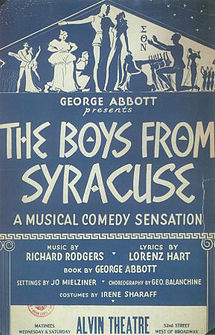
The Boys From Syracuse came to Broadway with music and lyrics by Richard Rodgers and Lorenz Hart and opened on November 23, 1938 at the Alvin Theatre. The musical ran for two hundred and thirty-five performances, giving the world and jazz the songs “Falling In Love With Love” and “This Can’t Be Love”. The show starred Eddie Albert, Ronal Graham, Teddy Hart and Jimmy Salvo.
The Story: This is the tale of separated twins when young, Antipholus of Ephesus and Antipholus of Syracuse, who have taken on twin servants both named Dromio. It is when the pair from Syracuse come to Ephesus, that a comedy of errors ensues.
Jazz History: As the country becomes though over-commercialized with swing, the necessity of change hovers in the air. By the end of the Thirties, Coleman Hawkins would open the door that whet the appetites and influence aspiring jazz improvisers seeking a new mode of expression in small group settings and after-hour jam sessions. His rendition of Body and Soul was a landmark recording that sparked the emergence of bebop.
Sponsored By
www.whatissuitetabu.com
More Posts: broadway
From Broadway To 52nd Street
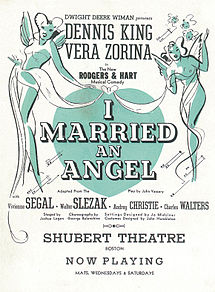
I Married An Angel opened on Broadway at the Shubert Theater on May 11, 1938. Running for three hundred and thirty-eight performances, the musical starred Dennis King, Audrie Christie, Vera Zorina and Vivienne Segal. Richard Rodgers and Lorenz Hart composed the score from which emerged Spring Is Here as another jazz standard.
The Story: The musical tells the story of a banker and ladies man who breaks off his engagement, swearing he will marry an angel. A real angel promptly flies into his life and he marries her. But her angelic honesty causes no end to problems for him until his sister teaches the angel the way of the cynical world. His sister also bribes a cab driver to delay creditors until a way is found to save her brother’s bank.
Jazz History: On the Street of Jazz musicians, jazz lovers, college students and big businessmen—everybody knew that this was “The Street that Never Slept,” the street where every night was New Year’s Eve. Here, for the price of a drink or two, you could walk through the whole history of jazz. Hot jazz was born and raised on The Street, as were the big swing bands of the thirties and the modern “cool” jazz combos of the forties. Comics like Alan King and Joey Adams got their start here, as did musicians like Erroll Garner, Jack Teagarden, and Coleman Hawkins.
Bessie Smith performed on the Street, as did Count Basie, Charlie “Bird” Parker, Dizzy Gillespie, Billie Holiday, Art Tatum, Sarah Vaughn, the Dorsey Brothers, Artie Shaw, and other jazz greats. The Street gave birth in Prohibition-era speakeasies, where musicians jammed for gin or just for the fun of it and its post-Repeal blossoming as the center of the jazz universe. The Street lined up and down on both sides with tiny, smoke-filled rooms where black and white musicians played to capacity crowds long before its postwar decline to become a tawdry tenderloin of strip and clip joints.
Sponsored By
www.whatissuitetabu.com
More Posts: broadway
From Broadway To 52nd Street
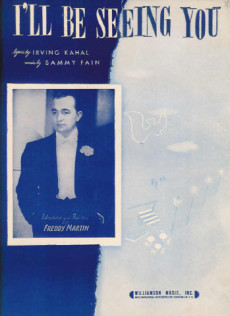
Right This Way came to fruition on January 5, 1938 as the production opened at the 46th Street Theatre. Brad Greene and Fabian Storey composed the music with Marianne Brown Waters writing the lyrics for the majority of the musical that was categorized as an original musical comedy set in Paris and Boston. The show starred Henry Arthur, Nelson Barcliff, Christine Bromley and Maude Carroll. Though the show only ran for 15 performances, the one song written by Irving Kahal and Sammy Fain, “I’ll Be Seeing You” was featured and became destined to be a jazz classic.
Broadway History: While Broadway prospered with a variety of shows being produced on The Great White Way not realizing that just some eight months away the city would be struck by what would be labeled as the “Long Island Express” or “The Great New England Hurricane of 1938”. The storm claimed 700 lives, injured another 700 more, destroyed 4500 homes, cottages and farms, damaged another 15,000 along with 26,000 cars, wiping out power above 59th Street, flooding subways and causing the East River to overflow to an estimated tune of three hundred million dollars. Despite the destruction, one unexpected positive outcome did emerge from the storm. The devastation reportedly helped solve the unemployment crisis that had been lingering since the Great Depression, as thousands of people were able to find work on Long Island helping to clean up and repair the damage.
Sponsored By
www.whatissuitetabu.com
More Posts: broadway