

From Broadway To 52nd Street
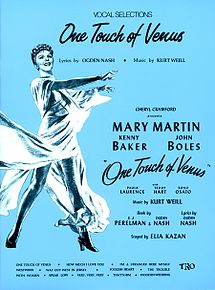
One Touch Of Venus hit the stage of the Imperial Theatre on October 7, 1943. Kurt Weill composed the music, with lyrics by Ogden Nash. The musical ran for 567 performances and starred John Boles, Kenny Baker, Ruth Bond and Mary Martin. One song, Speak Low, distinguished itself from the pack to become a jazz standard.
The Story: When Whitlaw Savory tells his barber, Rodney Hatch, that his statue of Venus is the most beautiful woman in the world, Hatch disagrees. After all, he is engaged to the most beautiful woman, Gloria. To prove his point, he places Gloria’s engagement ring on the marble, which promptly comes to life. The escapades of Venus and Hatch turn Manhattan upside down, with Savory, Gloria and her mother in pursuit. The fling destroys the Hatch/Gloria romance, so Hatch is disconsolate when Venus returns to stone. But as he is about to walk away, a young girl appears who is the image of Venus and Hatch is certain he has an engagement ring to fit her finger.
Broadway History: During the 1940s, Broadway began to lose its originality and drive. New dramatists were less numerous and Broadway began to face competition from television and movies. Some theaters were pulled down, and now theater no longer dominated Broadway.In the forties, 42nd Street between Seventh and Eighth Avenues, the street most associated with Times Square, began to look less and less like a theater district. The theater business was declining all over the city to the point where there were not enough productions to support the available playhouses. In comparison to the 264 productions in 1927-1928, the number dropped to 187 in 1930-1931, and only 72 in 1940-1941. Times Square had degenerated into a kind of carnival and sex bazaar. The Republic Theater, which was built by Oscar Hammerstein in 1900, became Billy Minsky’s burlesque house. Theaters all over the area were being torn down or turned into slums.
Sponsored By

www.whatissuitetabu.com
From Broadway To 52nd Street
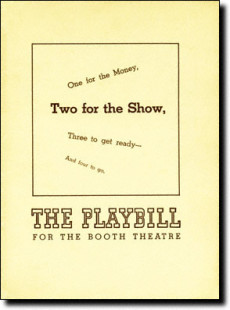
Two For The Show opened on Broadway at the Booth Theatre on February 8, 1940 and after 124 performances the curtain came down for its final descent on May 25, 1940. Directed by John Murray Anderson with the sketches directed by Joshua Logan and musical staging by Robert Alton, the original cast included later Hollywood notables as Eve Arden, Alfred Drake, Betty Hutton and Keenan Wynn.
The Story: This was a revue with several sketches being performed such as “The Age Of Innocence” and “Cookery” written by Richard Hadyn. There were two other revues in this series, all conceived and directed by John Murray Anderson: One for the Money (February 4, 1939-May 27, 1939), and Three to Make Ready (March 7, 1946-December 14, 1946). The most notable song introduced in the show was “How High The Moon” which subsequently has been recorded by many jazz artists, becoming a well-known standard
Jazz History: Bebop or bop is a style of jazz characterized by fast tempo, instrumental virtuosity and improvisation based on the combination of harmonious structure and melody. It was developed in the early to mid-1940s and first surfaced in musicians’ argot sometime in the first two years of American involvement in WWII.
The origins of the term “bebop” has been debated by numerous authorities and researchers usually stated to derive from nonsense syllables or vocables used in scat singing, and is supposed to have been first attested in 1928. However, some researchers speculate that it was a term used by Charlie Christian because it sounded like something he hummed along with his playing.Yet, Dizzy Gillespie’s version of the story relates that the audiences coined the name after hearing him scat the then-nameless tunes to his players and the press ultimately picked it up, using it as an official term: “People, when they’d wanna ask for those numbers and didn’t know the name, would ask for bebop.”
Sponsored By
www.whatissuitetabu.com
From Broadway To 52nd Street
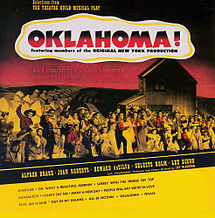
The curtain rose on Oklahoma on the stage at the St. James Theatre on March 3, 1943. The cast consisted of Alfred Drake, Joan Roberts, Celeste Holm and Lee Dixon performing music and lyrics by Richard Rodgers and Oscar Hammerstein. Running 2,212 performances, the musical would go on to receive rave reviews as a film thirteen years later and str such greats as Shirley Jones, Gordon McRae, Rod Steiger and Eddie Albert. From the play came two songs that became jazz standards – People Will Say We’re In Love and The Surrey With The Fringe On Top.
The Story: The musical is about Laurie, a country girl, who is courted by a cowboy, Curly, and is pursued by the villain Jud, who also sees her as a love interest.
Broadway History: As change came to the Broadway play in the early 1940s, jazz musicians also sought change by looking for new directions to explore. A new style of jazz was born, called bebop. It had fast tempos, intricate melodies and complex harmonies. Bebop was considered jazz for intellectuals. The demise of the huge big bands was imminent to be replaced by smaller groups that did not play for dancing audiences but for listening audiences.
Sponsored By
www.whatissuitetabu.com
More Posts: broadway

From Broadway To 52nd Street
Lady In The Dark took the stage at the Alvin Theatre on January 23, 1941. The musical starred Gertrude Lawrence, McDonald Carey, Dianne Kaye and Victor Mature with the music composed by Kurt Weill and lyrics by Ira Gershwin. It ran for four hundred and sixty-seven performances. Beyond its Broadway run, Lady In The Dark would b staged in the United Kingdom in 1981, was also made into a 1944 film and a live 1954 television special. Except for the final song, all the music in the play is heard in three extended dream sequences: the Glamour Dream, the Wedding Dream, and the Circus Dream which, to some extent, become three small operettas integrated into a straight play. The final song, “My Ship”, which went on to become a jazz standard, functioned as a leitmotif for Liza’s insecurity: as each dream commences, a snippet of the tune is heard, as it is a haunting melody which Liza recognizes but cannot name, or sing with words, until her anxiety is resolved.
The Story: The protagonist, Liza Elliott, is the unhappy albeit successful editor of a fashion magazine, Allure, who is undergoing psychoanalysis. Relating a dream to her analyst, all the familiar male figures in her life appear in her dream but they act in unfamiliar ways. By recounting her dream, Liza realizes that her father’s disdain for her as a child has warped her relations with men.
Broadway History: Innovations to Broadway would come in 1943 with Rodgers & Hammerstein’s Oklahoma, which integrated music, song, and dance with a detailed plot. West Side Story followed in these footsteps in 1957 by introducing serious themes, causing the genre to be called simply “musicals”. In 1967 Hair would herald the rock musical to prominence.
Sponsored By
www.whatissuitetabu.com
From Broadway To 52nd Street
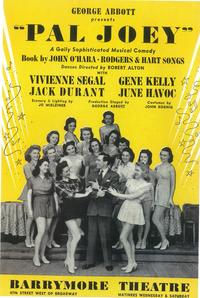
Pal Joey premiered at the Ethel Barrymore Theatre on December 25, 1940 and ran for 374 performances. Richard Rodgers and Lorenz Hart scored the music with the show starring Vivienne Segal, Gene Kelly, June Havoc, Jack Durant, Leila Ernst and Van Johnson. From the musical came the songs that rose to the roster of jazz classics I Could Write A Book, and Bewitched, Bothered and Bewildered.
The Story: Set in San Francisco, an irresistible heel named Joey Evans (Kelly) gets a job at the Mike’s Club, and becomes attracted to Linda English (Leila Ernst). Joey drops her for a rich, bewitched dowager Vera Simpson (Segal). Vera falls for Joey and builds him his own club, Chez Joey, but soon tires of him. With an encounter by blackmailers, (Durant & Havoc) Joey is off in search of other conquests. Unlike the movie version with Sinatra, Hayworth and Novak, the boy doesn’t get the girl in the end. This play marked the only Broadway musical that Kelly played a major role.
Broadway History: In the 18th century, Broadway ended at the town commons north of Wall Street Wall, where traffic continued up the East Side of the island via Eastern Post Road and the West Side via Bloomingdale Road. The western Bloomingdale Road would be widened and paved during the 19th century, and called “The Boulevard” north of Columbus Circle. On February 14, 1899. The name “Broadway” was extended to the entire Broadway/Bloomingdale/Boulevard Road.
Sponsored By
www.whatissuitetabu.com
More Posts: broadway