


From Broadway To 52nd Street
In the thirties one name was destined for stardom and it belonged to Ethel Waters. Growing up in a solitary and restless childhood in Philadelphia’s poor and violent 8th Ward, she quickly became distrustful of authority, wary of kindness or commitment but connected to the songs “her people” sang and the stories they carried with them. She began singing in black nightclubs and the on the Chitlin’ Circuit, belting out gutsy and raunchy songs delivered with impeccable diction.
Debuting on Broadway in an unsuccessful revue called Africana, she soon was playing Rhapsody in Black making an unprecedented $2500 a week. But it was a gig in Harlem’s Cotton Club in 1933 where she introduced a Harold Arlen/Ted Koehler tune Stormy Weather that brought her unique talents to a wider audience. Irving Berlin was in the audience and when he heard Ethel, he knew she was right for one of the bravest range of songs ever produced on Broadway.
A revue cleverly tied together by the device of pretending that each song and skit was derived from headlines in one imaginary newspaper, was the basis for a new musical, As Thousands Cheer. It opened on September 30, 1933 at the Music Box and held the stage for 400 consecutive performances.
But it was Irving Berlin who brought a vibrant and exciting young singer named Ethel Waters downtown from Harlem and centered two songs composed by Berlin that went on to establish themselves in jazz history. The first headline simply said “Heat Wave” in which a young woman starts a heat wave by letting her seat wave! The second headline read: Unknown Man Lynched By Frenzied Mob and behind Ethel Waters was the silhouette of a man with a rope around his neck hanging from a tree as she sang “Supper Time”.
Sponsored By

www.whatissuitetabu.com
More Posts: broadway
From Broadway To 52nd Street
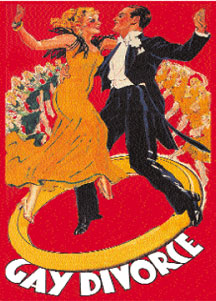
The stage of the Ethel Barrymore Theatre opened its curtains on November 29, 1932 to the Gay Divorce. The musical starred once again Fred Astaire, this time in his last Broadway show, and teaming up with Claire Luce and Erik Rhodes. Although Gay Divorce ran for only 248 performances, Night and Day, composed by Cole Porter, emerged to become a jazz classic.
The Story: In this musical unfolds the story of a husband and wife who are having marital difficulties and in an effort to give her husband grounds for divorce, Mimi Pratt arranges to be caught with a paid co-respondent, by the name of Tonetti. But a young man named Guy falls for Mimi and manages to get himself confused with Tonetti; yet, amidst the confusion he pursues his courtship.
Broadway History: The theatre on Madison Square at the end of the 19th century was located at the intersection of Broadway and Fifth Avenue at W. 23rd Street. The Flatiron Building now occupies the site. By midway through the following decade, the street blazed with electric signs as each theatre announced its shows and stars in white lights. By the turn of the 20th century the street had an entirely different look with as many as sixteen theatres on Broadway itself and many others located on side streets or other avenues.
Broadway became much more than a mere twelve blocks. It started at 13th Street and wound its way a mile and a half up the avenue to 45th Street ending in the heart of Longacre Square. The first decade of the century also saw the construction of many theatres, most notably The New Amsterdam on 42nd Street in 1903 along with four others the same year that are still standing today. Longacre Square had the first moving electric signs and it was when the Times Building was erected in 1904 that Longacre Square ceased to exist. It was now known as Times Square.
Sponsored By
www.whatissuitetabu.com
More Posts: broadway
From Broadway To 52nd Street
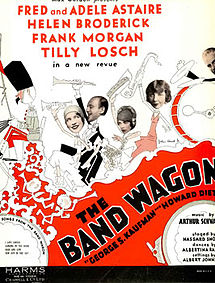
The Band Wagon hit the stage on June 3, 1931 at the New Amsterdam featuring Frank Morgan, Helen Broderick and Fred and Adele Astaire in their 10th and final Broadway appearance together. This revue utilized for the first time on Broadway, a double revolving stage for both its musical numbers and sketches. Dancing In The Dark written and composed by Arthur Schwartz and Howard Dietz, remains a jazz standard.
The Story: The revue, which ran 260 performances, had Fred and Adele cast as two French children cavorting with hoops, riding a Bavarian merry-go-round and several other sketches.
Broadway History: Theater posters are probably as old as the idea of the poster, but they really blossomed as an art form during the Industrial Revolution, when lithographic printing was perfected and affordable. In Paris during the Belle Époque (1880-1914) such posters were everywhere, a feature of the city. It was then that theater posters first became popular as decoration and memorabilia at home. When color printing developed (chromolithography), poster artists became even more popular and individually famous – like artist Jules Cheret, whose beautiful poster-girls (literal pin-up girls) were called “Chèrettes.” More and more reputable artists started creating posters. Toulouse-Lautrec, for instance, created many famous ones – an important part of his career.
Since that heyday, artists have continued to experiment with posters, including posters for the stage. Posters are an interesting genre-blending fine art, illustration, graphic art, advertising, and typography – so poster design attracts artists from each of those fields, for a lively cross-pollination of styles and ideas. All of which make posters a particularly rich and exciting contemporary art form.
The poster is also a supremely timely and ephemeral art designed to be used this one time for this one show, making them a sort of limited-time-offer art. Added to posters’ artistic merit, their time-capsule quality and their commemoration of now vanished events (plus the inevitable rarity of a paper artifact surviving) make posters ideal collectibles.
Sponsored By
www.whatissuitetabu.com
More Posts: broadway
From Broadway To 52nd Street
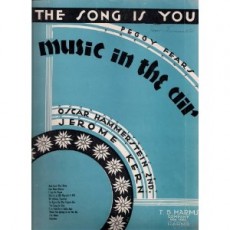
On November 8, 1930 at the Alvin Theatre, the curtain rose for Music In The Air starring Walter Slezak, Natalie Hall, Tullio Carminetti and Katherine Carrington. Running for 342 performances and the tune, The Song Is You was written and composed by Jerome Kern and Oscar Hammerstein becomes a jazz classic standard.
The Story: We follow Karl who writes a song and along with his Bavarian villages trek to Munich to have it published. In Munich, Karl is pursued by a flirtatious prima donna, while composer Bruno falls in love with Karl’s sweetheart. Her indifference to Bruno only lends to fuel Bruno’s ardor and he confesses to her that no matter what melody he creates, it’s always her. The romance and high hopes prove fruitless, so all return home together.
Jazz History: Art Tatum was to become one of The Street’s brightest stars and legendary giants with a following that brought him the highest paid salary to any performer. He moved between The Onyx, The Three Deuces and The Downbeat and was always in great demand for private parties and was once paid a hundred dollars at a George Gershwin shindig to perform during his sixty-minute intermission at the club. With his vision limited to 25% in one eye, he would often ask a friend to walk him down to Hanson’s Drugstore at 51st and 7th, New York’s equivalent to Schwab’s in Hollywood, where it became a gathering place of theatre-goers, celebrities and hopefuls and where Walter Winchell regularly stopped by. Tatum always took a seat at the L-shaped counter and when it was full he would ask someone to drop a handful of coins on the counter and impress the onlookers with his acuteness of hearing by identifying each coin. Art Tatum lived, drank and died with the prodigality that characterized his keyboard pyrotechnics. Frequently he stayed up for days at a time with only catnaps to sustain him or slept long stretches only to awake instantly the moment his hand was touched. Of the 46 pianists queried after his death, 30 named him as their favorite pianist.
Sponsored By
www.whatissuitetabu.com
More Posts: broadway
From Broadway To 52nd Street
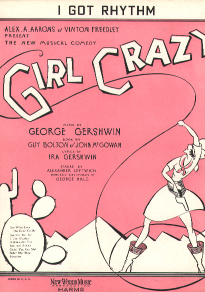
Girl Crazy opened on October 14, 1930 at the Alvin Theatre with a run of 272 performances starring Ethel Merman and Ginger Rogers singing music composed by the Gershwin Brothers. Two songs emerged from this musical to become jazz classics – Embraceable You and I Got Rhythm.
The Story: A tale where Danny Churchill, in an attempt to flee nightclubs, gambling casinos and women, hires a NY taxi driver to take him to Custerville, Arizona. There he hopes to rest on a dude ranch. Before long he has transformed the ranch into a club with gambling rooms and bevies of girls. He woos and wins the heart of one of the girls, Ginger, who is the daughter of the local saloonkeeper.
Broadway History:Though the Depression was in full swing, stars were still being made as musicals and revues continued to emerge on Broadway. From 1931 – 42 this decade made stars of Ray Bolger and Bert Lahr, who went on to fame as the Scarecrow and Cowardly Lion in The Wizard Of Oz; the double act of Gaxton & Moore, who were part of the comic backbone of vaudeville, got their individual starts on Broadway when Gaxton, having mastered the character of a loveable, oblivious bumbler resembling Elmer Fudd with a Porky Pig personality, performed in George M. Cohan’s Forty-Five Minutes From Broadway in 1906, and the much younger Moore was the romantic lead in Rodgers and Hart’s A Connecticut Yankee in 1927. They were paired in Gershwin’s “Of Thee I Sing” and continued their successful partnership well into the ‘40s. The tradition of the double act was later upheld by the likes of Abbott & Costello, Lewis & Martin and Burns & Allen.
Sponsored By
www.whatissuitetabu.com
More Posts: broadway