

From Broadway To 52nd Street
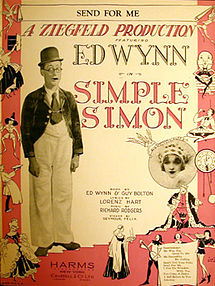
As the decade of despair opens, Broadway opens another musical to lift the spirits of a theatre going society on February 18, 1930 the Ziegfeld Theatre unveils Simple Simon, starring Ed Wynn as a waif who dreams in fairy tales. Wynn played Ziegfeld Follies until butting heads with W.C. Fields who let the back end of a pool cue down on Wynn’s head with a mighty thwack. He went on to sprout into his repertoire inane inventions like a pair of eyeglasses with a windshield to protect you when you ate grapefruit. But from the play Simple Simon, which ran for 135 performances, came the song Dancing on the Ceiling and He Was Too Good For Me composed by Richard Rodgers and Lorenz Hart. The two songs, however, were dropped from the show before the New York opening but get their perpetual encores as jazz standards.
Jazz History: Before the Onyx Club came to life on 52nd Street, Joe Helbock, who may justly claim to be the grandfather of The Street, was bootlegging there in 1927 and ’28 and sold to notables such as Teddy Roosevelt, Babe Ruth, Will Rogers, Marilyn Miller and Jimmy Walker. He hung out with Jimmy Dorsey, Paul “Pops” Whiteman and Roy Bargy at a “speak” called Plunkett’s where all the musicians hung out. In 1927 he opened the Onyx on the parlor floor in the rear of the brownstone at 35 W. 52nd with his partner Fred Hoetter, giving the club its name because of the black marble bar. They started with Art Tatum, Maxine Sullivan, Louis Prima and Stuff Smith. It wasn’t until 1933 that The Onyx put a steady pianist on payroll for the cocktail hour however Willie “The Lion” Smith disputes this claim. As the story goes, one day in 1930, Joe approached Willie saying “Lion, why don’t you stop by every day around five and I’ll give you a little salary for your trouble?” That deal, the Lion emphasizes, established an engagement of the cocktail hour that launched 52nd Street as the Cradle Of Swing.
Sponsored By

www.whatissuitetabu.com
More Posts: broadway
From Broadway To 52nd Street
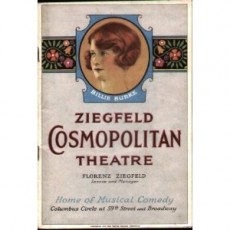
It was just seven days before the panic began leading to the crash an ambitious new musical appeared on October 17, 1929 on the stage of the Cosmopolitan Theatre by the title of Great Day. Music composed by Billy Rose and Vincent Youmans,however the show only experienced a run of only thirty-six performances due to the Crash, one good thing came out of the experience is the composition More Than You Know that went on to become a jazz standard.
The Story: Set in Louisiana on the Randolph Plantation, the Spanish Casino, the Mississippi river and the Levee.
Broadway History: By 1929 as the Roaring Twenties was coming to a close, the country was still reeling in widespread euphoria during this period of peace and great prosperity fueled by increased industrialization and new technologies, such as the radio, the automobile, even had air flight becoming widespread. Millionaires were made overnight as they mortgaged homes and sank life savings into hot stocks like Ford and RCA. Little did they know what lied beneath the horizon. The Fed had raised interest rates several times to cool down the overheated stock market and on October 24th panic selling occurred as investors realized the stock boom had been an over-inflated bubble. Millionaire margin investors were decimated and became bankrupt immediately as the stock market crashed on October 28th and 29th.
At the end of 1929, sixteen billion dollars had been shaved off stock capitalization, 140 billion of depositor money disappeared and 10,000 banks failed ushering in the Great Depression that would last till the mid 1930’s. Though the country would suffer financially, Broadway still mounted plays and entertained audiences.
Sponsored By
www.whatissuitetabu.com
More Posts: broadway
From Broadway To 52nd Street
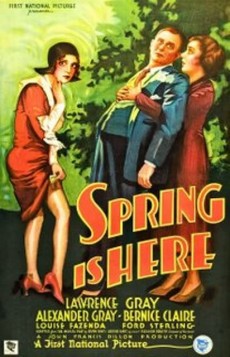
The music composed by Richard Rodgers and Lorenz Hart seven months earlier for a new two act musical called Spring Is Here opened at the Alvin theatre on March 11, 1929 and ran for 104 performances. It starred Dick Keene, Inez Courtney and John Hundley. Adapted from the play Shotgun Wedding, from this production came two songs destined to become a classic in the jazz world, With A Song In My Heart and Spring Is Here.
The Story: Terry loves Betty, Betty falls for Stacy and attempt to elope but are stopped by her father. Terry flirts with other girls to make Betty jealous. It works and she returns to his arms for the happy ending.
Broadway History: The “Great White Way” is a nickname for a section of Broadway in the midtown section of the borough of Manhattan, specifically the portion that encompasses the Theatre District, between 42nd and 53rd Streets, and encompassing Times Square. However, this was not always the location of the theatre district. In 1880, a stretch of Broadway between Union Square and Madison Square was illuminated by Brush arc lamps, making it among the first electrically lighted streets in the United States.
By the 1890s, the portion from 23rd to 34th Street was so brightly illuminated by electrical advertising signs, that people began calling it The Great White Way. When the theatre district moved uptown, the name was transferred to the Times Square area. The phrase Great White Way has been attributed to Shep Friedman, columnist for the New York Morning Telegraph in 1901, who lifted the term from the title of a book about the Arctic by Albert Paine. The headline “Found on the Great White Way” appeared in the February 3, 1902, edition of the New York Evening Telegram.
Sponsored By
www.whatissuitetabu.com
More Posts: broadway
From Broadway To 52nd Street
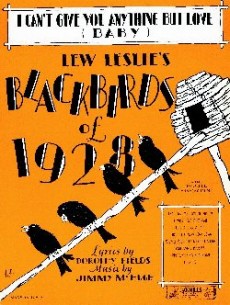
It’s now May 9, 1928 and the crowd is anxiously awaiting the rise of the curtain in the Liberty Theatre to witness The Blackbirds of 1928 – the first of four American editions incorporating a series of revues with Black casts produced by Lew Leslie in London and New York. This revue starred Bill “Bojangles” Robinson, Adelaide Hall and Aida Ward with music composed by Jimmy McHugh and Dorothy Fields. This first offering ran for 518 performances and gave the world the classic standard “I Can’t Give You Anything But Love”
The Story: The shows, relatively simple in mounting, emphasized song and dance and the small amount of comedy present represented the stereotypical black humor of the era.
Jazz History: One may wonder where the name “speakeasy” originated. Well it is said that the term comes from a patron’s manner of ordering alcohol without raising suspicion – a bartender would tell a patron to be quiet and “speak easy”. Though an integral part of Prohibition, the term predates the era by some thirty years. Samuel Hudson, a newspaperman, said he heard the word used for the same purpose in Pittsburgh in the 1880’s by an old Irish woman who sold liquor without a license.
Sponsored By
www.whatissuitetabu.com
More Posts: broadway

From Broadway To 52nd Street
Two days after Christmas in 1927 Showboat opened at the Ziegfeld and ran for five hundred and seventy-two performances. The music was composed by Jerome Kern and Oscar Hammerstein and rendered just jazz classics as Can’t Help Lovin’ Dat Man and Ol’ Man River. The show starred Jules Bledsoe, Aunt Jemima, Helen Morgan, Charles Winninger, Howard Marsh, Sammy White, and Norma Terris.
The Story: Showboat is a tale set on a Mississippi River gambling boat run by Cap’n Andy Hawks and his irritable wife Parthy and their ingenuous daughter Magnolia. The prominent roles of black servants are in the characters Queenie and Joe and the leading actress in the show, Julie, is discovered to be of mixed heritage. Intrigue enters through marriage, gambling, abandonment, alcoholism sets the characters on a spiral downward but one triumphs in the end.
Broadway History: Broadway was originally the Wickquasgeck Trail, carved into the brush destination of Manhattan by its Native American inhabitants. This trail originally snaked through swamps and rocks along the length of Manhattan Island. Upon the arrival of the Dutch, the trail soon became the main road through the island from Nieuw Amsterdam at the southern tip. The Dutch explorer and entrepreneur David de Vries gives the first mention of it in his journal for the year 1642 – “the Wickquasgeck Road over which the Indians passed daily”.
The Dutch named the road “Heerestraat“. In the mid-eighteenth century, part of Broadway in what is now lower Manhattan was known as Great George Street. In the 18th century, Broadway ended at the town commons north of Wall Street, where traffic continued up the East Side of the island via Eastern Post Road and the West Side via Bloomingdale Road. The western Bloomingdale Road would be widened and paved during the 19th century, and called “The Boulevard” north of Columbus Circle. On February 14, 1899 the name “Broadway” was extended to the entire Broadway/Bloomingdale/Boulevard Roads.
Sponsored By
www.whatissuitetabu.com
More Posts: broadway