

On The Bookshelf
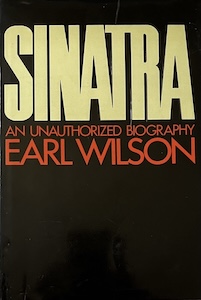
Sinatra: An Unauthorized Biography | Earl Wilson
When celebrated newspaper columnist Earl Wilson dared to pull back the curtain on Frank Sinatra in 1976, he created something extraordinary: a no-holds-barred portrait of America’s most enigmatic entertainer while Ol’ Blue Eyes was still commanding stages and headlines.
This wasn’t just another celebrity biography—it was a deep dive into the tempestuous world of a living legend. Wilson masterfully weaves together Sinatra’s meteoric career, his passionate romances, his headline-grabbing controversies, and the contradictions that made him endlessly fascinating. Rare photographs punctuate the narrative, offering intimate glimpses into moments both public and private, revealing the complex, sometimes volatile personality behind the velvet voice.
For Sinatra devotees and collectors, the hardcover first edition has become a prized treasure—a time capsule capturing the Chairman of the Board at the height of his powers. What makes this biography particularly compelling is its audacity: published without Sinatra’s blessing during his reign as an entertainment titan, it stands as both a fearless piece of journalism and an invaluable historical record.
Whether you’re a devoted fan or a cultural historian, Wilson’s unauthorized portrait remains essential reading—a vivid snapshot of Sinatra in full swing, controversy and all.
Sinatra: An Unauthorized Biography ~ 1976 | Earl Wilson
On The Bookshelf
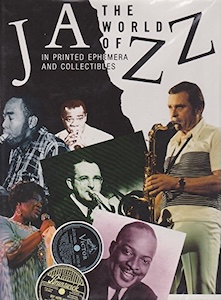
The World of Jazz | Jim Godbolt
This book is exciting and interesting in so many ways. It is filled with amazing pictures from the Jazz Age that make history feel real and alive. The images tell the story of how jazz began in New Orleans and traveled all over the world, growing into the music we know today.
The author, jazz historian Jim Godbolt, clearly loves jazz, and his passion shines through every page. He doesn’t just show photos of musicians and famous places. He also shares colorful artwork from record covers, posters, magazines, and record labels. Some of these designs are legendary, especially posters for Dizzy Gillespie and Jazz at the Philharmonic, as well as jazz magazines like Record Changer.
The story of jazz is told through old newspapers, posters, books, reviews, and rare photographs. Many of these items are hard to find, which makes the book feel like a treasure chest of history. You learn that jazz is not only about music, but also about how it was shared, recorded, advertised, and turned into a business.
The book shows how jazz started with young, self-taught musicians who had very little, and how it slowly became a huge, worldwide industry. It is a book you can read again and again. Every time you look at the pictures, you notice something new—from poor neighborhoods and riverboats to exciting nightclubs and beautiful concert halls around the world.
With its big pages and powerful images, this book is fun to explore, easy to enjoy, and full of inspiration. I highly recommend it.
The World Of Jazz: 1990 | Jim Godbolt

On The Bookshelf
88: The Giants Of Jazz Piano
Ever wondered what made the piano gods of jazz so extraordinary? This captivating hardcover opens the door to 88 legendary artists who didn’t just play the piano—they transformed it into an instrument of revolution, soul, and pure genius.
Get ready to discover the fascinating stories behind the music. Each profile reveals not just what these pianists played, but who they were—their quirks, their breakthroughs, and the unmistakable fingerprints they left on jazz history.
The book takes you on an intimate journey with seven towering figures: Jelly Roll Morton, Earl Hines, Art Tatum, Thelonious Monk, Bud Powell, Keith Jarrett, and Cecil Taylor. But that’s just the beginning. You’ll also meet Mary Lou Williams, James P. Johnson, Count Basie, Duke Ellington, Nat “King” Cole, Dorothy Donegan, Oscar Peterson, Les McCann, Herbie Hancock, Dave Brubeck, Billy Taylor, McCoy Tyner, Chick Corea, Geri Allen, and 67 more innovators who pushed boundaries across every style imaginable—from stride’s joyful bounce to swing’s sophistication, bebop’s lightning-fast complexity to the fearless explorations of the avant garde.
At 344 pages packed with 100 stunning photos, plus a bonus CD featuring 11 essential jazz tracks, this is more than a book—it’s an experience. And with a foreword by Keith Jarrett himself, you know you’re in for something special.
Whether you’re a devoted jazz lover or just beginning your journey into this incredible art form, these stories will inspire, surprise, and maybe even change how you hear music.
88: The Giants Of Jazz Piano | Robert L. Doerschuk | Backbeat Books
On The Bookshelf
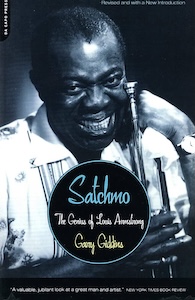
Satchmo: The Genius of Louis Armstrong | Gary Giddins
Gary Giddins has been called “the best jazz writer in America today” by Esquire Magazine. Louis Armstrong has been called the most influential jazz musician of the twentieth century. His magnificent career as trumpeter, singer, bandleader and actor made him a legend in his own time. His influence on jazz and popular music is impossible to overstate. Satchmo is one of the most vivid and insightful portraits ever drawn of the great man and superlative artists in the history of American music.
This edition is an authoritative introduction to Armstrong’s life and art for the curious newcomer and offers fresh insight even for the serious student of the musician. Whether he was known as Pops, Satch,Satchelmouth, Gatemouth, Dippermouth, Louie or King Menelik, this recounting of Louis’s colorful and controversial life brings the man to life.
Satchmo ~ The Genius of Louis Armstrong: 2001 | Gary Giddins
Da Capo Press
On The Bookshelf
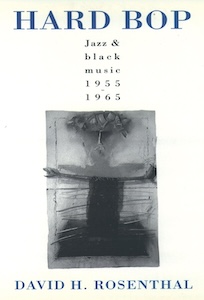
Hard Bop: Jazz & Black Music 1955-1965
It’s nineteen fifty-something, in a dark, cramped, smoke-filled room. Everyone’s wearing black. And on-stage a tenor is blowing his heart out, a searching, jagged saxophone journey played out against a moody, walking bass and the swish of a drummer’s brushes. To a great many listeners–from Black aficionados of the period to a whole new group of fans today–this is the very embodiment of jazz. It is also quintessential hard bop.
In this, the first thorough study of the subject, jazz expert and enthusiast David H. Rosenthal vividly examines the roots, traditions, explorations and permutations, personalities and recordings of a climactic period in jazz history.
Beginning with hard bop’s origins as an amalgam of bebop and R&B, Rosenthal narrates the growth of a movement that embraced the heavy beat and bluesy phrasing of such popular artists as Horace Silver and Cannonball Adderley; the stark, astringent, tormented music of saxophonists Jackie McLean and Tina Brooks; the gentler, more lyrical contributions of trumpeter Art Farmer, pianists Hank Jones and Tommy Flanagan, composers Benny Golson and Gigi Gryce; and such consciously experimental and truly one-of-a-kind players and composers as Andrew Hill, Sonny Rollins, John Coltrane, Thelonious Monk, and Charles Mingus.
Hard bop welcomed all influences–whether Gospel, the blues, Latin rhythms, or Debussy and Ravel–into its astonishingly creative, hard-swinging orbit. Although its emphasis on expression and downright “badness” over technical virtuosity was unappreciated by critics, hard bop was the music of black neighborhoods and the last jazz movement to attract the most talented young black musicians.
Fortunately, records were there to catch it all. The years between 1955 and 1965 are unrivaled in jazz history for the number of milestones on vinyl. Miles Davis’s Kind of Blue, Charles Mingus’s Mingus Ah Um, Thelonious Monk’s Brilliant Corners, Horace Silver’s Further Explorations. Rosenthal gives a perceptive cut-by-cut analysis of these and other jazz masterpieces, supplying an essential discography as well. For knowledgeable jazz-lovers and novices alike, Hard Bop is a lively, multi-dimensional, much-needed examination of the artists, the milieus, and above all the sounds of one of America’s great musical epochs.
Hard Bop | Jazz & Black Music 1955~1965: 1992 | David H. Rosenthal
Oxford University Press