

On The Bookshelf
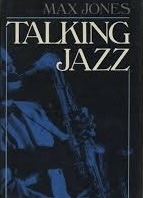
Talking Jazz | Max Jones
Max Jones, known affectionately as “the Boswell of bebop” by Time Out, was famed in England for nearly four decades of insightful, ardent writing on jazz. With this luminous collection of interviews, his work will at last be widely accessible to American readers. Here are the voices of jazz — Coleman Hawkins, Johnny Hodges, Billie Holiday, and Mary Lou Williams, to name but a few — in conversation with Jones, who could turn a casual chat into an indelible portrait and who gives American readers a view of these musicians they have never had before.
In this book, the author Max Jones tells the story of jazz from its roots in the African-American community to its development as an international art form. Jones covers a variety of topics, including the development of improvisation, the influence of Louis Armstrong and Duke Ellington, and the rise of bebop. He also provides historical context and examines the different styles of jazz, from ragtime to free jazz. This book is an excellent resource for students interested in learning more about jazz and its history.; B & W Photographs; 8vo; 293 pages
Talking Jazz: 1987 | Max Jones
Anchor Brendon Limited

On The Bookshelf
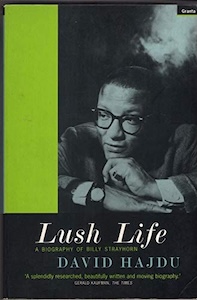
Lush Life: A Biography Of Billy Strayhorn
Billy Strayhorn, one of the greatest composers in the history of American music, the creator of a body of work of standards like Take the A Train. Yet, as a composer with no stage presence many see him as overshadowed by his friend and collaborator Duke Ellington, with whom he worked with for the two and a half decades.
The songwriter and arranger was an integral component of the Harlem Renaissance and the evolution of jazz. Lush Life is a vibrant and absorbing account of the Strayhorn’s life and the times that other jazz musicians led in Harlem and Paris. While composing some of the most gorgeous American music of this century, Strayhorn labored under a complex agreement whereby Ellington took the bows for his work.
Fifty-one years from the date of his birth, Billy Strayhorn transitioned due to cancer and alcohol abuse. The small, shy black composer carried himself with singular style and grace as one of the few jazzmen to be openly homosexual. This biography has sparked an enthusiastic revival of interest in Billy Strayhorn’s work and is already acknowledged as a jazz classic.
Lush Life: 1996 | David Hajdu
Granta Publications
On The Bookshelf…
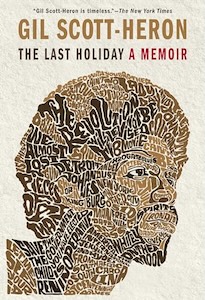
THE LAST HOLIDAY: A MEMOIR | GIL SCOTT-HERON
From a humble childhood divided between his grandmother in Jackson, Tennessee and his mother in New York City, Gil Scott Heron became one of the most uncompromising and fearless truthtellers of his generation.
His memoir provides a remarkable glimpse into his life and times, from the young man who gained entry into New York’s prestigious Fieldstone School, finding a path out of poverty even as his mother was being hospitalized in a diabetic coma, to the bill budding activist who led his university in a strike to demand better student healthcare.
As he comes of age as a man and as an artist, he provides keen observations on the civil rights movement and the tumultuous changes of the 1960s.
The Last Holidday, published by Grove Press on Martin Luther King Jr. Day, January 16, 2012 in honor of the historic tour in which he participated in the fall of 1980. It serves as both the climax of the book and the inspiration for the title.
His friend Stevie Wonder decided to use his Hotter Than July tour to raise popular support for a national holiday honoring the great civil rights leader, and he invited Scott-Heron to join him. Thus, the book is not just a tribute to Gil’s activism but also offers highly personal recollections of Wonder, Clive Davis, and other musical peers and acquaintances, as well as insights into the music industry, the Civil Rights movement, modern America, governmental hypocrisy, and our wider place in the world.

On The Bookshelf
A Life In Jazz | Danny Barker
Since the 1950s, when Nat Hentoff and Nat Shapiro published Heah Me Talkin’ to Ya, an oral history of jazz which drew heavily on Danny Barker’s reminiscences, jazz buffs have waited impatiently for Barker’s full account of his life in jazz.
Danny Barker was born January 13, 1909 when jazz was still in its infancy, and by the time of his death he was known as both a master of the idiom and a guardian of its history. Storyteller, researcher, songwriter, performer, and mentor, Barker was a true griot – an elder statesman of jazz and an international representative of New Orleans and African American culture.
In more than 60 years as a working musician, he followed the evolution of jazz from its New Orleans roots to mainstream success during the swing era to canonization as America’s first wholly original art form. In his career as a songwriter, which yielded the hit Don’t You Feel My Leg, Barker combined traditional song forms with sly humor about sex and human nature.
More than any other jazz artist, he worked to document the music’s history and to tell the stories of its people. A Life in Jazz, first published in 1986 and edited by British jazz scholar Alyn Shipton, captures the breadth of Barker’s knowledge and the scope of his vision as a storyteller.
His carefully crafted set pieces range from hilarious to harrowing, and he shares memories of jazz greats such as Jelly Roll Morton, Cab Calloway, and Dizzy Gillespie. Barker’s prose reflects the freedom and creativity of jazz while capturing the many injustices, both casual and grand, of life as a Black man in mid-century America.
This illustrated edition of A Life in Jazz brings Barker’s autobiography back into print by the Macmillan Press Ltd., accompanied by more than 100 images that bring his story to life. Gwen Thompkins, host of public radio’s Music Inside Out, reflects on Barker’s legacy in her introduction, and the complete discography and song catalog showcase the breadth of Barker’s work.
Danny Barker died on March 13, 1994. Through his struggles, triumphs, escapades, and musings, A Life in Jazz reflects the freedom, complexity, and beauty of this thoroughly American, Black music tradition.
On The Bookshelf
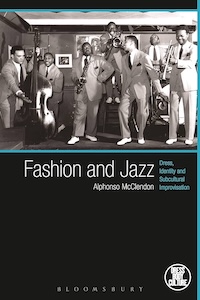
Fashion and Jazz: Dress, Identity and Subcultural Improvisation
Born in the late 19th century, jazz gained mainstream popularity during a volatile period of racial segregation and gender inequality. It was in these adverse conditions that jazz performers discovered the power of dress as a visual tool used to defy mainstream societal constructs, shaping a new fashion and style aesthetic. Fashion and Jazz is the first study to identify the behaviours, signs and meanings that defined this newly evolving subculture.
Drawing on fashion studies and cultural theory, the book provides an in-depth analysis of the social and political entanglements of jazz and dress, with individual chapters exploring key themes such as race, class and gender. Including a wide variety of case studies, ranging from Billie Holiday and Ella Fitzgerald to Louis Armstrong and Chet Baker, it presents a critical and cultural analysis of jazz performers as modern icons of fashion and popular style.
Addressing a number of previously underexplored areas of jazz culture, such as modern dandyism and the link between drug use and glamorous dress, Fashion and Jazz, published by Bloomsbury, provides a fascinating history of fashion’s dialogue with African-American art and style. It is essential reading for students of fashion, cultural studies, African-American studies and history.