

On The Bookshelf
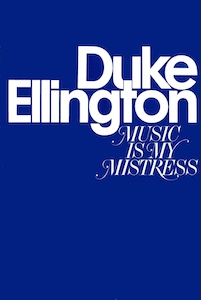
Duke Ellington: Music Is My Mistress
My favorite tune? The next one. The one I’m writing tonight or tomorrow, the new baby is always the favorite. The author of these words has created some of the best loved music in the world: Mood Indigo, Sophisticated Lady, Caravan, Take The A Train, Solitude.
Music is my mistress, and she plays second fiddle to no one.” This is the story of Duke Ellington, the story of Jazz itself. Told in his own way, in his own words, a symphony written by the King of Jazz and published by Doubleday & Company, Inc. His story spans and defines a half-century of modern music. This man who created over 1500 compositions was as much at home in Harlem’s Cotton Club in the 1920s as he was at a White House birthday celebration in his honor in the 1960s.
For Duke knew everyone and savored them all. Passionate about his music and the people who made music, he counted as his friends hundreds of the musicians who changed the face of music throughout the world: Bechet, Basie, Armstrong, Lena Horne, Ella Fitzgerald, Sinatra, to name a few of them.
In this 522 page volume are 100 photographs to give us an intimate view of Duke’s world, his family, his friends, his associates. What emerges most strongly in his commitment to music, the mistress for whom he saves the fullest intensity of his passion.
”Lovers have come and gone, but only my mistress stays,” he says. He composed not only songs that all the world has sung, but also suites, sacred works, music for stage and screen and symphonies. This rich book, the embodiment of the life and works of the Duke, is replete with appendices listing singers, arrangers, lyricists and the symphony orchestras with whom the Duke played. There is a book to own and cherish by all who love jazz and the contributions made to it by the Duke.

On The Bookshelf
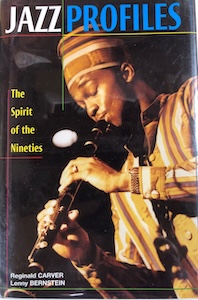
Jazz historian Reginald Carter and jazz photographer Lenny Bernstein present an introduction to the young lions of jazz. Most of these musicians have decided to forgo post-1960s jazz developments, instead mining the treasures of the bop/hard-bop masters. The profiles include a short biography, photo notes, a wonderful black-and-white photograph, recent interview excerpts, and a select discography.
The artists’ thoughts on the upswing in jazz’s popularity and on balancing performing, composing, and recording, provide an overall sense of where these musicians find themselves within the jazz culture.
Arranged according to instrumental groupings, the book features such musicians as Terence Blanchard, Roy Hargrove, Wynton Marsalis, Nicholas Payton, Wallace Roney, Branford Marsalis, James Carter, Joshua Redman, Bobby Watson, Don Byron, Craig Handy, Steve Turre, Bill Frisell, Russell Malone, Geri Allen, Cyrus Chestnut, Marcus Roberts, Christian McBride, Reginald Veal, Cindy Blackman, Jeff “Tain” Watts, and vocalists Dee Dee Bridgewater and Kevin Mahogany.
In this compendium we see those forty musicians who have individually taken the music to its evolutionary continuance.
On The Bookshelf
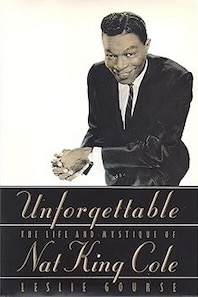
Unforgettable: The Life And Mystique Of Nat King Cole | Leslie Gourse
Very few may know that Nat King Cole, born March 17, 1919 in Montgomery, Alabama began his musical career as a groundbreaking jazz pianist. His trio was untraditional with an upright bass and guitar. This was long before he ever achieved stardom with his velvety-smooth vocals on songs like Nature Boy, L-O-V-E, and of course, Unforgettable.
Leslie Gourse’s claim that his keyboard style prefigured bebop and influenced pianist Ahmad Jamal is debatable. However, Gourse does a fine job of documenting the influence of Cole’s second wife, Maria Ellington, who urged him to pursue a more lucrative singing career. Although he did not win the favor of 1950s radical Negro activists, Cole’s personal, backstage struggle against Jim Crow segregation in the entertainment industry were significant.
This is a biography which should appeal to those who have a desire for knowledge and an appreciation for a singer’s inimitable style.
On The Bookshelf
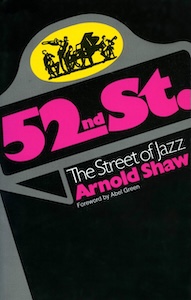
52nd St. The Street of Jazz | Arnold Shaw
Back in the thirties and forties, when New York City was the capital of the jazz world-you could hail a cab, ask the driver to take you to “The Street,” and find yourself on 52nd Street between Fifth and Sixth Avenues. Musicians, jazz lovers, college students, big businessmen, everybody knew that this was “The Street that Never Slept,” the Street where every night was New Year’s Eve, the Street that Variety editor Abel Green so aptly dubbed “America’s Montmartre.”
Here, for the price of a drink or two, you could walk through the whole history of jazz. Hot jazz was born and raised on The Street, as were the big swing bands of the thirties and the modern “cool” jazz combos of the forties. Comics like Alan King and Joey Adams got their start on the Street, as did musicians like Erroll Garner, Jack Teagarden, and Coleman Hawkins. Bessie Smith performed on the Street, and so did Count Basie, Charlie “Bird” Parker, Dizzy Gillespie, Billie Holiday, Art Tatum, Sarah Vaughn, the Dorsey Brothers, Artie Shaw, and other jazz greats.
Arnold Shaw was there as musician, composer, PR man, and just plain listener. He recreates for us the three swinging decades that were the history of the Street: its birth in Prohibition-era speakeasies, where musicians jammed for gin or just for the fun of it; its post-Repeal blossoming as the center of the jazz universe, lined up and down on both sides with tiny, smoke-filled rooms where black and white musicians played to capacity crowds; its postwar decline as the Street became a tawdry tenderloin of strip and clip joints.
On The Bookshelf
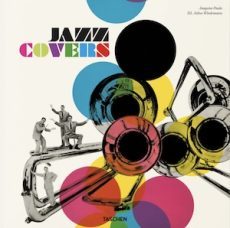
JAZZ COVERS | JOAQUIN PAULO
This striking collection of jazz record covers shows the designs that defined a sound. Containing covers from the 1940s to the early 1990s, each reproduction is accompanied with essential background information. Spanning photographic and illustrative works, these album artworks match music and design in a remarkable history of jazz.
Part design history, part trip down musical memory lane, this anthology of jazz album artwork is above all a treasure trove of creative and cultural inspiration. Spanning half a century, it assembles the most daring and dynamic jazz cover designs that helped make and shape not only a musical genre but also a particular way of experiencing life.
From the 1940s through to the decline of LP production in the early 1990s, each chosen cover design is distinct in the way it complements the energy of the album’s music with its own visual rhythms of frame, line, text, and form. To satisfy even the most demanding of music geeks, each record cover is accompanied by a fact sheet listing performer and album name, art director, photographer, illustrator, year, label, and more.
The AuthorJoaquim Paulo is a consultant for major labels and directs a number of radio stations in Portugal. He started collecting vinyl at the age of 15, and flew to London, Paris, New York, and São Paulo to enrich his collection of over 25,000 LPs. He lives and works in Lisbon and dedicates his free time to recovering old and rare recordings.
The Editor
Julius Wiedemann studied graphic design and marketing and was an art editor for newspapers and design magazines in Tokyo before joining TASCHEN in 2001. His titles include the Illustration Now! and Record Covers series, as well as the infographics collection and books about advertising and visual culture.
Jazz Covers
Taschen: Hardcover, 11.5 x 11.5 in., 9.21 lb, 552 pages
ISBN 978-3-8365-8525-5
Edition: Multilingual (English, French, German)