

From Broadway To 52nd Street
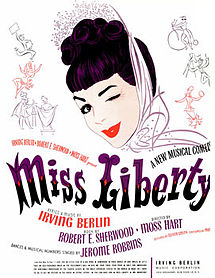
Miss Liberty brought to the stage its star Eddie Albert at the Imperial Theatre on July 15, 1949. The show ran for three hundred and eight performances with music composed by Irving Berlin. The song “You Can Have Him” became a jazz standard.
The Story: In 1885, New York Herald publisher James Gordon Bennett assigns novice reporter Horace Miller to find the woman who served as Frédéric Auguste Bartholdi’s model for the Statue of Liberty. In the artist’s Paris studio, Miller sees a photograph of Monique DuPont and mistakenly believes she was the one. Bennett arranges for her and her grandmother to accompany Horace back to New York City, where she becomes a media darling. When rival publisher Joseph Pulitzer discovers it was Bartholdi’s mother who actually posed for him, he exposes Monique as a fraud in his New York World. She faces deportation until a sympathetic Pulitzer comes to her rescue, paving the way for her to plan a future with Horace, who jilts his American girlfriend Maisie Doll in favor of the French beauty.
Jazz History: As the widely performed bebop or hot jazz began to wane in some sectors of the country, cool jazz began to emerge by the early 1950s. “Cool” was used to describe a kind of toned-down jazz. Later the term became associated with a number of white musicians who relocated to California where they could get day gigs at movie studios, unlike black musicians, while playing jazz at night. In this form it was called West Coast jazz. For white players to represent a kind of cool jazz is ironic since the idea of coolness has its roots in Black culture. Cool jazz contrasts with hot jazz in that it has limited vibrato, restrained timbre, stable dynamics, melodic calm, sophisticated harmonies that tempered the blues idiom.
Sponsored By

www.whatissuitetabu.com
From Broadway To 52nd Street
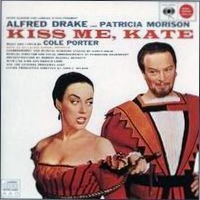
Kiss Me Kate opened its doors at the New Century Theatre on December 30, 1948 and was the second musical to be lauded as a blockbuster with a run of 1077 performances. Alfred Drake, Patricia Morrison, Lisa Kirk and Harold Lang were the stars of the show, who sung the music composed by Cole Porter, So In Love and From This Moment On, which became jazz standards. The musical won the very first Tony Award for Best Musical presented in 1949.
The Story: While cast members of a revival of Shakespeare’s Taming of the Shrew celebrate another opening, another show, the show’s stars, Fred & Lilli, celebrate their first anniversary of their divorce. They reminisce about better times. Fred sends Lilli a bouquet, leading her to believe he is still in love with her. Misunderstanding leads to argument between the two. Meanwhile, one of the cast members signs Fred’s name to his gambling debt. Goons arrive to collect and Fred convinces them to make Lilli perform. Debt is voided on a technicality. Fred & Lilli make up over the course of the evening and recognize they do still love each other)
Broadway History: In 1880, a stretch of Broadway between Union Square and Madison Square was illuminated by Brush arc lamps, making it among the first electrically lighted streets in the United States. By the 1890s, the portion of Broadway from 23rd Street to 34th Street was so brightly illuminated by electrical advertising signs, that people began calling it “The Great White Way.” When the theater district moved uptown, the name was transferred to the Times Square area.
Sponsored By
www.whatissuitetabu.com
From Broadway To 52nd Street
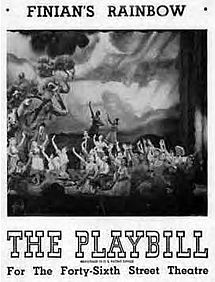
Finian’s Rainbow opened on January 10, 1947 at the 46th Street Theater starring Albert Sharpe, Ella Logan and David Wayne. Burton Lane and E.Y. Harburg composed the score for this stage production that ran 725 performances. The musical would be made into a movie some twenty-one years later to star Fred Astaire and Petula Clark. From this musical came the encores with the jazz classics Old Devil Moon, Look To The Rainbow and How Are Things In Glocca Morra.
The Story: An Irishman named Finian seeking his fortune steals a pot of leprechaun gold and arrives in America to plant it at Fort Knox and watch it grow. However, the leprechaun who follows him is threatened to become human if it is not returned. When they stop in Rainbow Valley, Finian’s daughter falls in love with a local. During his brief stay, Og the leprechaun, convinces racist Senator Rankin to turn over a new leaf by magically turning him black. The Senator recants and Finian gives back the gold and continues his wanderings.
Jazz History: Jazz was created in 1947 as an artist’s book of some one hundred prints based on paper cutouts by Henri Matisse, who was in his seventies and in poor health when he began this project. No longer able to draw or paint easily with a pencil or brush, he used scissors to cut out simple forms from brightly colored paper painted to his specifications with gouache. He then arranged them on another sheet of gouache-painted paper.
The original intention was for Matisse to illustrate poems written by a French author. As Matisse began, he used a large fluid brush to write notes to himself on construction paper about his thoughts as he created the images. The simple visual appearance of the words pleased Matisse, and he suggested using his roughly painted words in juxtaposition with the images, rather than the original poems. The publisher agreed.
None of the original copies were bound, and many of the purchasers arranged with prominent artists like Cocteau or famous graphic designers to create binders for the pages. Each of the pages is about 24 inches by 12 inches and folded in the center. The original edition of September 30, 1947 consisted of 250 sets of prints and sold for $120 each.
Sponsored By
www.whatissuitetabu.com

From Broadway To 52nd Street
Brigadoon opened at the Ziegfeld Theatre on March, 13, 1947 and had a run of 581 performances. Alan Jay Lerner and Frederick Leowe composed the music and lyrics for the stars David Brooks, Marion Bell, George Keane and Pamela Britton. From this musical arose to compositions to jazz standard fame – Almost Like Being In Love and The Heather On The Hill.
The Story: Two American hunters in Scotland lose their way and stumble upon the village of Brigadoon that seems to belong to another time. As they enter, a kilted swain is rejoicing his impending marriage. Tommy falls in love with Fiona, Jeff has a fling with Meg. They discover the village is bewitched coming back to life only once every hundred years. Jeff and Tommy flee but Tommy’s love for Fiona brings him back and the village appears just long enough to embrace him.
Broadway History: It was during the 20th century that the Tony Awards were established, in 1947. These awards recognized theater achievement in Broadway theaters. Other Broadway and theater awards include the Drama Desk Awards, New York Drama Critics Circle Award, Theatre World Awards and the Obie Awards. The Drama Desk Awards are the only award given to Broadway and off-Broadway productions, all competing against each other.
The Obie awards cover off Broadway and off-off Broadway productions. The Theatre World awards are given to actors for outstanding debut performances. The New York Drama Critics’ Circle award is the second oldest theater award in the U.S. with the main award for Best Play.
Sponsored By
www.whatissuitetabu.com
From Broadway To 52nd Street
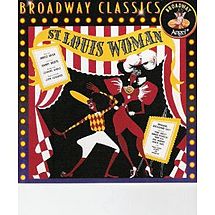
St. Louis Woman opened on March 30, 1946 on the stage of the Martin Beck Theatre and ran for 113 performances. Harold Arlen composed the music and Johnny Mercer wrote the lyrics for the musical with one tune standing the test of time to become a jazz standard – Come Rain Or Come Shine. The original cast included Robert Pope, Harold Nicholas, Fayard Nicholas, June Hawkins, Pearl Bailey, Ruby Hill, Rex Ingram and Milton J. Williams.
The Story: Set in St. Louis in 1898, Little Augie, a jockey who is on a winning streak, is enamored with Della Green, the belle of St Louis. Della, however, is the girlfriend of abusive Bigelow Brown, the proprietor of the local bar. Decides to leave him, Brown’s previous mistress, Lila, is still around which produces complications.
It’s cakewalking time and Augie attracts the attention and admiration of Della with his virtuoso performance of the cakewalk. Things go so well between them that they agree to set up home together and prepare plans to marry. While Augie is off at the racetrack, Della gets an unwelcome visit from Biglow Brown who beats. Lila enters, begs for a reconciliation, Augie returns, shot is fired, curse is casted on Augie for the shot that in fact was fired by Lila.
At Brown’s funeral suspected Augie is exonerated by Lila’s confession but the curse seems to be working. His horses no longer win and Della blames herself for the troubles. Della leaves feigning no love for Augie but her new friend tells him her true feelings. Believing the curse to be so much mumbo-jumbo, he’ll win his next race and he and Della get back together again.
Jazz History: Charlie Parker began rising in prominence in the early 1940s, and he played frequently with bands led by Jay McShann, Earl Hines, and Billy Eckstine. In 1945, a young Miles Davis Miles Davis moved to New York and became intrigued with Parker and the emerging bebop style. He studied at Juilliard, but had trouble earning respect among jazz musicians because of his unrefined sound. Soon he would work his way into Parker’s quintet. In 1945, the term ‘moldy fig’ was coined to refer to swing musicians who were reluctant to accept that bebop was the new path of jazz development.
In the mid 1940s Charlie Parker began to deteriorate from drug use. He was admitted to Camarillo State Hospital after a breakdown in 1946. His stay there inspired the song “Relaxin’ at Camarillo”.
In 1947, tenor saxophonist Dexter Gordon achieved fame for recordings of “duels” with saxophonist Wardell Gray. Gordon’s virtuosity and aggressive tone attracted the attention of young alto saxophonist John Coltrane, who would shortly thereafter switch to tenor saxophone.
In 1948, Miles Davis and drummer Max Roach, fed up with Charlie Parker’s reckless lifestyle, left his band. Davis formed his own nonet. In 1949 recorded the unconventional ensemble. Some of the arrangements were by a young Gil Evans, and the restrained style of the music came to be known as cool jazz. The record, released almost a decade later, in 1957, was called Birth of the Cool.
By the end of the 1940s, bebop was the ideal among young jazz musicians. Unlike swing, bebop was untethered to popular demands. Its primary concern was musical advancement.
Sponsored By
www.whatissuitetabu.com