


From Broadway To 52nd Street
Our journey from Broadway to 52nd Street continues with Kismet that opened as a play on December 25, 1911 at the Knickerbocker Theatre and ran for 184 performances. However, it wasn’t until almost 42 years later to the day that it opened on Broadway as a musical on December 3, 1953. Two songs, Stranger In Paradise and Baubles, Bangles & Beads came from the musical composed by Robert Wright and George Forrest to become jazz standards. The musical ran for 583 performances with Ronald Coleman, Marlene Dietrich and Edward Arnold playing the musicals starring roles.
The Story: Haji, a wily beggar and poet is arrested on a minor infraction by the Wazir, who agrees to release him if he kills the Caliph. Hajj’s attempts fail and he is thrown in jail with his old enemy the sheik. He kills the sheik and escapes in his clothing. Learning his daughter is a concubine in the Wazir’s harem, Hajj drowns the Wazir and frees his daughter. The Caliph marries the daughter but by law must banish Hajj. When Hajj returns, the Caliph looks the other way and allows him to beg and recite poetry.
Broadway History: In the 1950s, Broadway musicals were a major part of American popular culture. Every season saw new stage musicals send songs to the top of the charts. Public demand, a booming economy and abundant creative talent kept Broadway hopping. To this day, the shows of the 1950s form the core of the musical theatre repertory. The best of these musicals integrated every element, offering recognizable characters singing in stories told with wit and genuine heart – in short, they applied the Rodgers & Hammerstein formula. The two songwriters were international celebrities, so the media treated each new Rodgers & Hammerstein stage show as a major event.
Oscar Hammerstein II died due to stomach cancer a few months after The Sound of Music opened, ending a career that spanned the golden age of musical theatre and film. After working with the innovative Jerome Kern Jerome and operetta master Sigmund Romberg, he did his finest work with Rodgers, and later coached young Stephen Sondheim. More than any other individual, Hammerstein had turned the once-innocuous Broadway musical into a potent dramatic form, and had turned lyrics into essential dramatic tools. He did it by being a superb storyteller and a dedicated craftsman. Even when dealing with serious issues, he always kept his focus on intriguing characters caught in remarkable situations.
Sponsored By

www.whatissuitetabu.com
From Broadway To 52nd Street
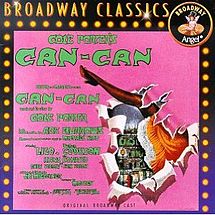
Can-Can was first seen on the stage of the Shubert Theatre on May 7, 1953 and the audience heard music composed by Cole Porter. The show ran for 892 performances. The original Broadway production ran for over two years starring Gwen Verdon in only her second Broadway role. Both she and and choreographer Michael Kidd won Tony Awards and were praised, the score and book received tepid reviews. However, three songs that rose to become jazz standards were I Love Paris, Just One Of Those Things and It’s All Right With Me.
The Story: In 1893 Paris, the dance hall Bal du Paradis in Montmartre owned by La Môme Pistache, is being threatened with closing by a self-righteous judge, Aristide Forestier. Offended by the scandalous but popular dance that the attractive dancers perform, the “Can-Can”, the judge sends the police to harass the owner and dancers, but the police like the dancers so much that they are reluctant to testify against them in court. Deciding to gather evidence, the judge takes a trip to the club. Once there, he and the owner, La Môme, fall in love but he gets the evidence to send the owner and girls to jail.
One of the dancers, Claudine, a laundry girl by day, has been pursued by art critic Hilaire, however, Claudine is in love with sculptor Boris but still arranges to have dinner with Hilaire to get a favorable review for her love. Conflicted between love and right and wrong, the judge conceded, “obscenity is in the eye of the beholder”. And gets caught in a scandalous kiss with the proprietress. Eventually, Hilaire writes a gushing review of Boris’s work. Judge Aristide loses his judgeship and is disbarred, but La Môme and the girls all go to court with him and all win their cases.
Jazz History: Live jazz was recorded, as early as 1935, but for some reason it was not considered feasible to reproduce it on 78 rpms for public consumption. This precedent was first broken in 1945 by Norman Granz, who, as one of jazz’s liveliest aficionados, originated in the early forties the notion of taking on tour for concert appearances a select group of musicians. It was an arrangement he called “Jazz at the Philharmonic”. In 1944, unbeknownst to the participating musicians, he recorded sections of a concert he was producing in Los Angeles. He then released them soon afterwards in a 12-inch 78 rpm album of three records, and there were just two tunes, “Lady Be Good” and “How High the Moon”, each of which covered three sides, or approximately fifteen minutes of playing time. His experiment proved a huge success and he released fifteen albums since then, the last an entire concert on three 12-inch LPs, amounting to about two hours of music. Other record companies followed suit, using the advantageous expanded playing time of the LP, and the record stores were stocked with live performances of all varieties and qualities, ranging from nightclub stints to private jam sessions.
Sponsored By
www.whatissuitetabu.com
From Broadway To 52nd Street
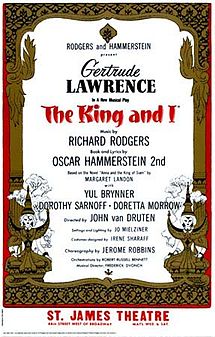
The King and I opened at the St. James Theatre on March 29, 1953 and entered into the pantheon of blockbuster musical hits with one thousand two hundred and forty-six performances. What made this a great musical were the actors – Yul Brynner, Gertrude Lawrence, Dorothy Sarnoff Doretta Morrow and Larry Douglas. Richard Rodgers and Oscar Hammerstein composed the music and lyrics from which evolved the jazz standards Hello Young Lovers, I Have Dreamed and We Kiss In A Shadow. It ran nearly three years, then the fourth longest-running Broadway musical in history, and has had many tours and revivals.
The Story: Anna, a widowed teacher who goes to Siam to tutor the King’s children, hiding her fears of the new land. She finds the King a despot and is especially sympathetic to the furtive youngsters who would marry without permission. The lovers are caught and sentenced to death. Anna and the King fight but finally come to understand each other. She perseveres and on his deathbed, the King confesses he has begun to see the wisdom of her more civilized ways
Broadway History: Broadway theatre had entered a golden age with the blockbuster “Oklahoma!”. According to John Kenrick writing of Broadway musicals, “Every season saw new stage musicals send songs to the top of the charts. Public demand, a booming economy and abundant creative talent kept Broadway hopping. To this day, the shows of the 1950s form the core of the musical theatre repertory.”
In 1950, theatrical attorney Fanny Holtzman was looking for a part for her client, veteran leading lady Gertrude Lawrence. Holtzmann realized that Landon’s book would be an ideal vehicle and contacted Rodgers and Hammerstein, who were initially reluctant but agreed to write the musical. The pair initially sought Rex Harrison to play the supporting part of the King, a role that he had played in the 1946 movie made from landon’s book, but he was unavailable. They settled on actor and television director Yul Brynner.The musical was an immediate hit, winning Tony Awards for Best Musical, Best Actress (for Lawrence) and Best Featured Actor (for Brynner). Lawrence died unexpectedly of cancer a year and a half after the opening, and several actresses played the role of Anna during the remainder of the Broadway run of 1,246 performances.
Sponsored By
www.whatissuitetabu.com
From Broadway To 52nd Street
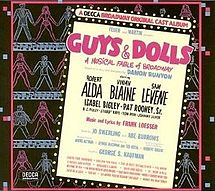
The music composed for Guys & Dolls by Frank Loesser was first heard on the stage at the 46th Street Theatre on January 24, 1950. It became a part of the blockbuster club with a total of 1200 performances. The show starred Robert Alda, Sam Levene and Vivian Blaine, the latter who would go on to star in the 1955 movie version with Frank Sinatra, Marlon Brando, Jean Simmons and Stubby Kaye. Coming out of the play into jazz prominence were the songs If I Were A Bell, I’ll Know, I’ve Never Been In Love Before and Luck Be A Lady Tonight.
The Story: New York gambler, Nathan Detroit, tries to set up a floating crap game since the highest of the high rollers, Sky Masterson, is in town. All the while the police are putting on the heat to prevent the game from happening. Nathan bets Sky that he cannot woo any girl he chooses. He picks Salvation Army’s Sister Sarah and off to Cuba she and Sky go. Ultimately the game takes place in the empty Salvation Army headquarters. Nathan has promised his girl Adelaide that he has quit gambling and will marry her. Romance ensues for all and both Nathan and Sky marry in the end.
Although Guys and Dolls was selected as the winner of the 1951 Pulitzer Prize for Drama, the prize was not awarded because writer Abe Burrows was being investigated by the House Un-American Activities Committee. Do to these troubles with HUAC, the Trustees of Columbia University vetoed the selection, and no Pulitzer for Drama was awarded that year.
Jazz History: In 1950, Charlie Parker, despite a severe drug problem, was at the height of his career. It was during that same year that he became the first jazz musician to record with a string ensemble, which produced the album Charlie Parker With Strings. The year also saw the beginning point were a series of singles on Capitol Records of a nonet led by trumpeter Miles Davis, collected and released first on a ten-inch and later a twelve-inch as the Birth of the Cool. Cool jazz recordings by Chet Baker, Dave Brubeck, Bill Evans, Gil Evans, Stan Getz and the Modern Jazz Quartet usually have a “lighter” sound that avoided the aggressive tempos and harmonic abstraction of bebop. Cool jazz later became strongly identified with the West Coast jazz scene, but also had a particular resonance in Europe, especially Scandinavia, with emergence of such major figures as baritone saxophonist Lars Gullin and pianist Bengt Hallberg. However, blind Chicago pianist Lennie Tristano set out the theoretical underpinnings of cool jazz. Its influence stretches into such later developments as bossa nova, modal jazz, and even free jazz.
Sponsored By
www.whatissuitetabu.com
From Broadway To 52nd Street
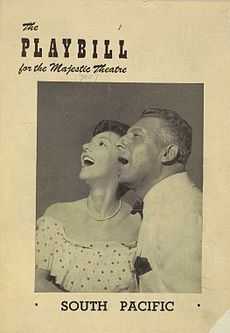
South Pacific hit the stage of the Majestic Theatre on April 7, 1949 in the first of a 1,925 performance run. Richard Rodgers and Oscar Hammerstein composed the music from the compositions “Happy Talk”, “Some Enchanted Evening” and “A Wonderful Guy” became jazz standards. The musical starred Enzio Pinza, Mary Martin, Juanita Hall, William Tabbert, Betta St. John and Myron Mccormick.
The Story: An American nurse stationed on a South Pacific island during World War II falls in love with a middle-aged French expatriate plantation owner but struggles to accept his mixed-race children. A secondary romance, between a U.S. lieutenant and a young Tonkinese woman, explores his fears of the social consequences should he marry his Asian sweetheart. The issue of racial prejudice is candidly explored throughout the musical, most controversially in the lieutenant’s song, “You’ve Got To Be Carefully Taught”. Supporting characters, including a comic petty officer and the Tonkinese girl’s mother, help to tie the stories together. However, Hammerstein’s lack of military knowledge hampered his writing that part of the script, so the director of the original production, Logan, assisted him, receiving credit as co-writer of the book.
Broadway History: The production won an unprecedented 10 Tony Awards including Best Musical, Best Score and Best Libretto. It is the only musical production to win Tony Awards in all four acting categories. Its original cast album was the bestselling record of the 1940s. Due to it’s 1,925 it was ushered into the blockbuster hall of fame surpassing it’s predecessors by more than 800 performance.
Sponsored By
www.whatissuitetabu.com