

Daily Dose Of Jazz…
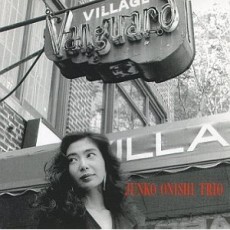
Junko Onishi was born April 16, 1967 in Kyoto, Japan and studied piano at Berklee College of Music. She then moved to New York City where she played with Joe Henderson, Betty Carter, Kenny Garrett and the Mingus Dynasty but has also worked with Jackie McLean, Holly Cole, Billy Higgins and many others.
Primarily playing in the post-bop genre, Junko cites her influences as Duke Ellington, Thelonious Monk and Ornette Coleman but one can hear McCoy Tyner, Kenny Kirkland and Mulgrew Miller’s influences in her playing. As a leader she has recorded nine albums on Blue Note Records label Somethin’ Else.
Choosing to study and practice she stopped performing in the late Nineties and when her mentor, Jaki Byard passed away she stopped playing completely for two years. Redeveloping her technique Onishi returned to playing and started a gym regimen to help her cope with the physical rigors of playing.
She appears in the 1997 documentary “Blue Note: A Story Of Modern Jazz playing the song “Trinity” and “Quick” from her album Play, Piano, Play: Junko Onishi Trio in Europe. In 2009 she released her Blue Note album “Musical Moments” followed by her Verve large band project “Baroque”. She continues to perform, record and tour worldwide.

Give The Gift Of Knowledge
More Posts: bandleader,composer,piano
From Broadway To 52nd Street
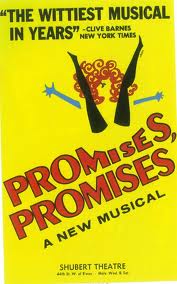
Promises, Promises opened at the Shubert Theatre on December 1, 1968 and ran for 1281 performances, ushering it into the blockbuster hall of fame. Composers Burt Bachrach & Hal David scored the music that rendered I’ll Never Fall In Love Again that went on to become a jazz standard. Jerry Orbach, Ken Howard and Jill O’hara star.
The Story: In this adaptation of the Jack Lemmon movie vehicle “The Apartment”, a young man (Jerry Orbach) attempts to get ahead in the world of business, climbing the corporate ladder by lending his apartment to various executives.
Broadway History: A reluctant success of Broadway is the fact that many of the plays had been turned into movies by the Hollywood film industry. When the movie studios began implementing sound technology for film screenings, musicals were some of the first productions released on the silver screen. Not only did the scripts migrate from the stage to the screen, but many actors and actresses did as well. To this day, many well-known film actors began their career on Broadway.
Sponsored By

www.whatissuitetabu.com
Daily Dose Of Jazz…
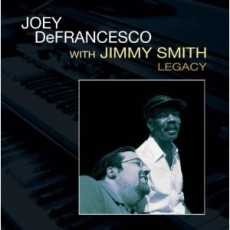
Joey DeFrancesco was born in Springfield, Pennsylvania on April 10, 1971 into a family of musicians – a multi-instrumentalist grandfather and Hammond B3 player father. Joey DeFrancesco started playing the piano at the age of four, switching to the B3 shortly after. By age six, he was sitting in on his father’s gigs; by ten playing out on his own and sitting in with organ legends like Jack McDuff and Richard “Groove” Holmes. He went to high school with bassist Christian McBride, where the two were often scolded for altering their big band charts.
At seventeen years old Miles Davis asked Joey to join his band, touring Europe and recording Amandla with Davis. He became well known in the 1990s, however, through his work with John McLaughlin’s trio Free Spirits. He has also played with jazz guitarists Pat Martino, Paul Bollenback, Jimmy Bruno, Dave Stryker, Danny Gatton as well as trumpet player Big Jim Henry and many others.
DeFrancesco’s career as a leader began with his first recordings on Columbia, and later with Muse, Big Mo, and HighNote. He listened to and learned from Jimmy Smith, ultimately paying homage with his 1999 release “The Champ”. In 2000 he recorded the album “Incredible!” with Jimmy and finished “Legacy” shortly before Smith’s passing in 2005. He has also paid tribute to Don Patterson with “Tribute to Don Patterson: The Philadelphia Connection” released in 2004.
Jazz organist, trumpeter and vocalist Joey DeFrancesco, who has been selected by the Down Beat Critics and Readers Poll as the top jazz organist every year since 2003 and who consistently played an average of 200 nights a year on the road with various musicians, transitioned on August 25, 2022 at the age of 51.
Put A Dose In Your Pocket
More Posts: hammond organ,keyboard,saxophone,trumpet,vocal
From Broadway To 52nd Street
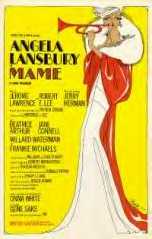
Mame raised the curtain to the stage lights of the Winter Garden Theatre on May 24, 1966 with Jerry Herman composing the music sung by the stars of the show Angela Lansbury, Frankie Michaels and Beatrice Arthur. The musical, also a blockbuster, had a total of 1,508 performances. From this play came the hit tune If He Walked Into My Life.
The Story: Set in New York and spanning the Great Depression and World War II, it focuses on an eccentric bohemian, Mame Dennis, whose famous motto is “Life is a banquet and most poor suckers are starving to death.” Her fabulous life with her wealthy friends is interrupted when the young son of her late brother arrives to live with her. They cope with the Depression in a series of adventures.
Jazz History: In 1966 Duke Ellington recorded Far East Suite for RCA; John Coltrane married Alice McCleod, who replaced McCoy Tyner as his pianist; alto saxophonist Cannonball Adderley records Joe Zawinul’s Mercy, Mercy, Mercy! live on Blue Note; pianist Keith Jarrett performs with the Charles Lloyd Quartet; the Roscoe Mitchell Sextet records Sound in August with members of Chicago’s AACM community; drummer Buddy Rich starts up a big band which would last about twenty years; bop piano immortal Earl “Bud” Powell dies on July 31st; on October 3, Dave Lambert of Lambert, Hendricks and Ross fame is struck by a car and killed instantly while trying to help a fellow motorist on the Connecticut Turnpike; and trumpeter Chet Baker is severely beaten on the streets of San Francisco, an event related to his drug addiction while his wife Carol Baker was in the hospital for the birth of their youngest child, Missy.
Sponsored By
www.whatissuitetabu.com
Daily Dose Of Jazz…
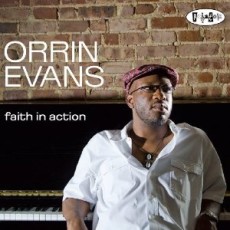
Orrin Evans was born on March 28, 1976 in Trenton, New Jersey but was raised in Philadelphia, Pennsylvania. Nurtured in a household filled with music due to his classical singer mother who surrounded him with the melodies of Puccini to the pulsating rhythms of Basie and Ellington.
Evans graduated from high school in the early 90s and studied at Rutgers University before going on to study piano privately with Kenny Barron and be employed as a sideman by Bobby Watson, Ralph Peterson, Duane Eubanks, Lenora Zenzalai-Helms and others.
Evans recorded his first session as a leader, The Orrin Evans Trio, for his own Black Entertainment label in 1994. After that, he signed with Criss Cross and between 1997-99 he recorded Justin Time, Captain Black and Grown Folks Bizness. Into the new millennium Orrin recorded prolifically releasing “Listen to the Band”, “Blessed Ones” and “Meant to Shine”, continuing his yearly release schedule up to his latest “Flip The Script”.
Influenced greatly by McCoy Tyner, Horace Silver, Bud Powell and Thelonious Monk among others, he remains in the hard bop genre but occasionally detours into soul-jazz and R&B when backing vocalists Denise King and Dawn Warren. In 2010 he was awarded a Pew Fellowship in the Arts. He continues to perform, record and tour.