

From Broadway To 52nd Street
Heading into a new era of entertainment as bootleggers came to prominence, more and more New Yorkers patronized the emerging speakeasies due to the ratification of the 18th Amendment and the Volstead Act. However, strict the government became during the thirteen-year period of Prohibition, patrons continued their outings to the theater. On December 12, 1924 the audience filled the Liberty Theatre for the successful opening night of Lady Be Good and the show ran for 330 performances. The show starred brother and sister team, Fred and Adele Astaire, Walter Catlett and Jayne Auburn performing to the music of George and Ira Gershwin, that produced the tune Fascinatin’ Rhythm.
The Story: In this play we follow Dick Trevor rebuffing his landlady, Josephine Vanderwater. She evicts him and his sister Susie from an apartment she owns. By coincidence, both have the same lawyer, Jack Watty. So Dick sets about righting matters and as Watty is in a jam, his fee to the moneyless Trevors is that Susie poses as a Mexican. In the end, Susie marries Jack and Dick ditches Josephine permanently for his true love, Shirley.
Broadway History: As American ventured further into the early 20th century, in 1910, Flo Ziegfeld took one of the greatest gambles of his career and offered a contract to Bert Williams, who became an instant hit in the Follies that year and continued to delight audiences for seven nearly consecutive editions. Bringing an enormous body of comic material to the Follies, Williams separated himself from the plethora of black comedians by bringing a quiet dignity to his characters and to himself, on and off the stage.
Although considered one of the gang by his fellow entertainers, Bert understood the tenor of the country at that time and stipulated in his contract that he would never appear on stage alone with a white woman and in turn Ziegfeld released him from touring the South. It was W. C. Fields who said, “Bert Williams was the funniest man I ever saw and the saddest man I ever knew.”
Sponsored By

www.whatissuitetabu.com
More Posts: broadway
From Broadway To 52nd Street
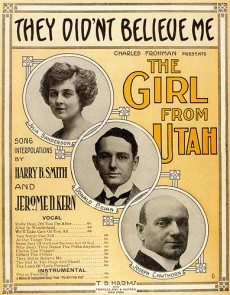
The Girl From Utah, a British import to Broadway, opened at the Knickerbocker Theater on August 24, 1914 and ran for 120 performances. J. A. E. Malone directed this musical that starred Julia Sanderson, Donald Brian, Joseph Cawthorn, Queenie Vassar and Venita Fitzhugh. Composer Jerome Kern was asked to give it an American flavor and along with lyricist Herbert Reynolds they composed “They Didn’t Believe Me”. History contends that this was Kern’s career-making opportunity to express himself and this musical would hint at the emerging American style of musical comedy.
The Story: In London, an American girl named Una is pursued across the Atlantic Ocean to London by a Mormon but is saved from a bigamous marriage when she falls in love with a handsome hoofer.
Broadway History: It was during 19th century that the development of not only the American theatre took place throughout the country but the all powerful “Syndicate” – the cartel of theatre owners who joined forces under the influence of one of Broadway’s early great producers, Abraham Lincoln Erlanger. One of the great stars of theatre in the early twentieth century was George M. Cohan. Rising through the ranks of vaudeville from a child star to adulthood, he flaunted his patriotism not for those born in America but those immigrating to this great country to become citizens and patriots. Cohan epitomized the sense of the country by self-proclaiming himself as a real live nephew of Uncle Sam.
Sponsored By
www.whatissuitetabu.com
More Posts: broadway
From Broadway To 52nd Street
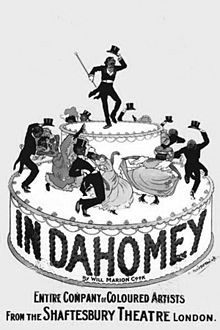
In Dahomey opened on February 18, 1903 at the New York Theater and ran for 53 performances, then considered a successful run. It was a landmark American musical comedy, in that it was “the first full-length musical written and played by blacks significantly marked the first full-length Black to be staged in an indoors venue at a major Broadway house and the first black musical to have its score published, albeit in England. As one of the most successful musical comedies of its era, it propelled composer Will Marion Cook, lyricist Paul Lawrence Dunbar and leading performers Bert Williams, James Smith and George Sisay to become household names. It was “the first African American show that synthesized successfully the various genres of American musical theatre popular at the beginning of the twentieth century—minstrelsy, vaudeville, comic opera and musical comedy.
Though a jazz standard did not emanate from this musical either, the In Dahomey poster features the famous “cake walk” with the character portrayed by Bert Williams and prompted Percy Grainger to write a highly virtuosic concert “rag” titled In Dahomey (Cakewalk Smasher), that he completed in 1909.
The Story: A tale of a group of Blacks, who, having found a pot of gold, move to Africa and become rulers of Dahomey (present-day Benin).
Broadway History: One of the most influential sources of the American musical was one of its most shameful. The minstrel show got its start in the early nineteenth century when a number of white entertainers, mostly of Irish descent, found they could connect with their more raucous audiences by applying burnt cork to their skin and caricaturing black people in various songs, dances and skits. However, the portrayals by white entertainers created a dialogue that became very fashionable, even though they perpetuated negative stereotypes. Black entertainers knew they didn’t speak like that and formed a troupe, and out of that came comic duos on Broadway like Flournoy Miller and Aubrey Lyles in the 20’s, William Gaxton and Victor Moore in the 30’s. But one man transcended minstrelsy’s denigration of his race and became not only the most popular comedian of his day, but the most famous African American since Frederick Douglass. He was Bert Williams, who denied entrance into Stanford University, worked as a banjo player in saloons and minstrels until he teamed up with George Walker. The team gained fame, which led them to head the cast of “In Dahomey” in 1903, the first full-length musical written and played by blacks performed at a major Broadway house.
Sponsored By
www.whatissuitetabu.com
New Music
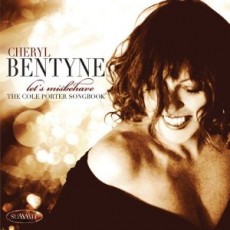
Cheryl Bentyne’s latest offering – “Let’s Misbehave: Cole Porter Songbook – is another release in a long series of solo albums from this reigning soprano of The Manhattan Transfer. Cheryl connects with Porter’s ability to “cover the human condition” and invite one’s ear out for delightful listening to fourteen of his most memorable tunes, such as Begin The Beguine, Night and Day, Love For Sale and I Love Paris. If you like Cole Porter then you’ll enjoy Ms. Bentyne misbehaving!
More Posts: vocal
Jazz In Film
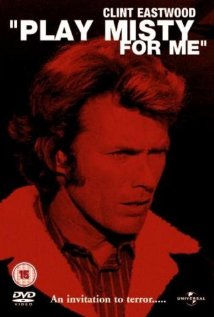
Play Misty For Me: This 1971 film directed by Clint Eastwood tells the story of a brief fling between a male disc jockey and an obsessed female fan takes a frightening, and perhaps even deadly turn when another woman enters the picture.
Stars: Clint Eastwood, Jessica Walter, Donna Mills, John Larch, James McEachin, Irene Hervey
Music: Misty – Composed and performed by Erroll Garner; The First Time Ever I Saw Your Face - Written by Ewan MacColl and performed by Roberta Flack; and Country Preacher – composed by Joseph Zawinul and performed by Cannonball Adderley
The song, The First Time I Ever Saw Your Face was popularized by Roberta Flack in 1972 in a version that became a breakout hit for the singer. The song first appeared on Flack’s 1969 album First Take. Flack’s rendition was much slower than the original as an early solo recording by Seeger ran two and a half minutes long whereas Flack’s is more than twice that length.
This slower, more sensual version was used by Clint Eastwood in his 1971 directorial debut Play Misty for Me during a lovemaking scene. With the new exposure, Atlantic Records cut the song down to four minutes and released it to radio. It became an extremely successful single in the United States where it reached #1 on the Billboard Hot 100 and Easy Listening charts in April 1972 for six week runs on each.[3] It reached #14 on the UK Singles Chart.
More Posts: film