From Broadway To 52nd Street
In Dahomey opened on February 18, 1903 at the New York Theater and ran for 53 performances, then considered a successful run. It was a landmark American musical comedy, in that it was “the first full-length musical written and played by blacks significantly marked the first full-length Black to be staged in an indoors venue at a major Broadway house and the first black musical to have its score published, albeit in England. As one of the most successful musical comedies of its era, it propelled composer Will Marion Cook, lyricist Paul Lawrence Dunbar and leading performers Bert Williams, James Smith and George Sisay to become household names. It was “the first African American show that synthesized successfully the various genres of American musical theatre popular at the beginning of the twentieth century—minstrelsy, vaudeville, comic opera and musical comedy.
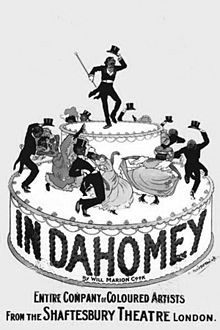
Though a jazz standard did not emanate from this musical either, the In Dahomey poster features the famous “cake walk” with the character portrayed by Bert Williams and prompted Percy Grainger to write a highly virtuosic concert “rag” titled In Dahomey (Cakewalk Smasher), that he completed in 1909.
The Story: A tale of a group of Blacks, who, having found a pot of gold, move to Africa and become rulers of Dahomey (present-day Benin).
Broadway History: One of the most influential sources of the American musical was one of its most shameful. The minstrel show got its start in the early nineteenth century when a number of white entertainers, mostly of Irish descent, found they could connect with their more raucous audiences by applying burnt cork to their skin and caricaturing black people in various songs, dances and skits. However, the portrayals by white entertainers created a dialogue that became very fashionable, even though they perpetuated negative stereotypes. Black entertainers knew they didn’t speak like that and formed a troupe, and out of that came comic duos on Broadway like Flournoy Miller and Aubrey Lyles in the 20’s, William Gaxton and Victor Moore in the 30’s. But one man transcended minstrelsy’s denigration of his race and became not only the most popular comedian of his day, but the most famous African American since Frederick Douglass. He was Bert Williams, who denied entrance into Stanford University, worked as a banjo player in saloons and minstrels until he teamed up with George Walker. The team gained fame, which led them to head the cast of “In Dahomey” in 1903, the first full-length musical written and played by blacks performed at a major Broadway house.
Sponsored By

www.whatissuitetabu.com
New Music
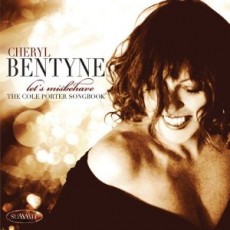
Cheryl Bentyne’s latest offering – “Let’s Misbehave: Cole Porter Songbook – is another release in a long series of solo albums from this reigning soprano of The Manhattan Transfer. Cheryl connects with Porter’s ability to “cover the human condition” and invite one’s ear out for delightful listening to fourteen of his most memorable tunes, such as Begin The Beguine, Night and Day, Love For Sale and I Love Paris. If you like Cole Porter then you’ll enjoy Ms. Bentyne misbehaving!
More Posts: vocal
Jazz In Film
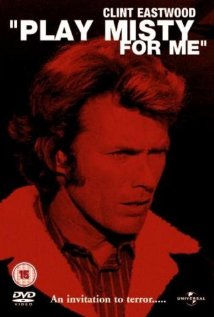
Play Misty For Me: This 1971 film directed by Clint Eastwood tells the story of a brief fling between a male disc jockey and an obsessed female fan takes a frightening, and perhaps even deadly turn when another woman enters the picture.
Stars: Clint Eastwood, Jessica Walter, Donna Mills, John Larch, James McEachin, Irene Hervey
Music: Misty – Composed and performed by Erroll Garner; The First Time Ever I Saw Your Face - Written by Ewan MacColl and performed by Roberta Flack; and Country Preacher – composed by Joseph Zawinul and performed by Cannonball Adderley
The song, The First Time I Ever Saw Your Face was popularized by Roberta Flack in 1972 in a version that became a breakout hit for the singer. The song first appeared on Flack’s 1969 album First Take. Flack’s rendition was much slower than the original as an early solo recording by Seeger ran two and a half minutes long whereas Flack’s is more than twice that length.
This slower, more sensual version was used by Clint Eastwood in his 1971 directorial debut Play Misty for Me during a lovemaking scene. With the new exposure, Atlantic Records cut the song down to four minutes and released it to radio. It became an extremely successful single in the United States where it reached #1 on the Billboard Hot 100 and Easy Listening charts in April 1972 for six week runs on each.[3] It reached #14 on the UK Singles Chart.
More Posts: film
Requisites
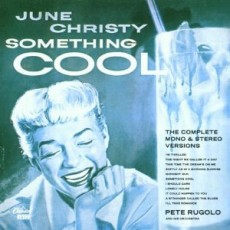
Something Cool: June Christy established her reputation fronting the Stan Kenton Orchestra at the same time that Pete Rugolo was composing and arranging. Her voice was ideal for the high-art ambitions of the progressive jazz movement. Her diction was impeccable, her phrasing often inspired, and as this reissue of her classic Something Cool -augmented by another 12 tracks recorded between 1953 and 1955–so ably demonstrates, her technique was extraordinary, allowing her to navigate the most abstract melody with accurate pitch and rhythmic confidence.
Personnel: June Christy – vocals, composer, arranger and bandleader Pete Rugolo and His Orchestra
Record Date: 1953
Songs: Something Cool, It Could Happen To You, Lonely House, This Time The Dreams On Me, The Night We Called It A Day, Midnight Sun, I’ll Take Romance, A Stranger Called The Blues, I Should Care, Softly As In A Morning Sunrise, I’m Thrilled
(Re-mastered CD has the same songs both in Mono and Stereo)
More Posts: collectible,vocal

Requisites
The Complete Vee-Jay Recordings: The reissue of these 1959, 1960 and 1961 dates boasts thirty-nine tracks of some of jazz’s most famous songs by one of the idioms few male jazz singers. Though Henderson never made it big, he emerged onto the scene and recorded these compositions at the young age of 29 to 31. On these sessions he swings lightly while squeezing out honest emotion from his ballads.
Personnel: Bill Henderson – vocals, Ramsey Lewis & Tommy Flanagan – piano, Booker Little – trumpet, Yusef Lateef & Eddie Harris – tenor saxophone, MJT +3, Count Basie band & combos, and string orchestras.
Arranged by: Benny Golson, Frank Wess
Record Date: Volume I – October 26, 1959 – November 21, 1960 / Volume II – December 5, 1960 – April 4, 1961
Songs: Disc I – Bye Bye Blackbird, Joey Joey Joey, Free Spirits, Sweet Pumpkin, Love Locked Out, It Never Entered My Mind, My Funny Valentine, Moanin’, Bad Luck, The song Is You, This Little Girl Of Mine, You Make Me Feel So Young, Without You, Sleepy, I Go For That, Sleepy (alt. take) Kiss And Run, A Sleepin’ Bee
Disc II – Never Kiss And Run, A Sleepin’ Bee, Don’t Like Goodbyes, Old Country, Slowly, Opportunity, Never Will I Marry, My How The Time Goes By, Hooray For Love, Skylark, Royal Garden Blues, Twelfth Of Never, Love Is A Bug, Bewitched Bothered And Bewildered, The More I See You, I Can’t Give You Anything But Love, Ac-cent-Tchu-Ate The Positive, Yes Indeed, Please Send Me Someone To Love, Sweet Georgia Brown, Am I Blue
Each LP had two different covers – the one shown here and one shown in the video.
More Posts: collectible,vocal