

Daily Dose Of Jazz…
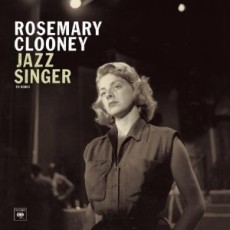
Rosemary Clooney was born on May 23, 1928 in Maysville, Kentucky. When she was fifteen, her parents split up and along with her sister, Betty remained with their father. In 1945, the Clooney sisters won a spot on Cincinnati, Ohio’s radio station WLW as singers. They sang in a duo for much of her early career. Clooney’s first recordings in 1946 were for Columbia Records. She sang with Tony Pastor’s big band. Clooney continued working with the Pastor band until 1949 when making her first as a solo artist a month later still for Columbia.
In 1951, her record of “Come On-a My House”, produced by Mitch Miller, became a hit. It was her first of many singles to hit the charts, despite the fact that Clooney hated the song passionately. She had been told by Columbia Records to record the song, and that she would be in violation of her contract if she did not do so.
Around 1952, Rosemary recorded several duets with Marlene Dietrich and by ’54 she was starring in the movie White Christmas with Bing Crosby, Danny Kaye and Vera-Ellen. She went on to appear on radio and television, including her own half-hour show featuring the Nelson Riddle Orchestra.
Leaving Columbia Records in 1958 for MGM Records doing a number of recordings, then some for Coral Records. Her career languished in part due to depression and drug addiction in the early Sixties but she signed with RCA Victor until 1963, on to Reprise in ‘64, Dot Records in 1965 and moved to United Artist Records in ’66.
Clooney’s career revived in 1974, when she appeared with Bing Crosby on his 50th anniversary in show business. By 1977, she recorded an album a year for the Concord Jazz record label.
Throughout her career Rosemary Clooney continued to perform on radio, sing jingles for television commercials, guest starred on nighttime dramas, parodied on Saturday Night Live, received a Primetime Emmy nomination, collaborated with Barry Manilow, founded the Rosemary Clooney Music Festival, received a Grammy Lifetime Achievement Award and recorded until her death on June 29, 2002.

Give The Gift Of Knowledge
More Posts: vocal
Daily Dose Of Jazz…
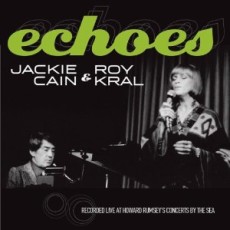
Jackie Cain was born May 22, 1928 in Milwaukee, Wisconsin. By the time she was 18, the blonde and extremely attractive high school graduate decided she wanted to be a jazz singer. The year was 1946 when a friend took her to Chicago and introduced her to Roy Kral, a pianist and arranger who was going places. He took a good look at her, but according to legend wasn’t the least bit interested until he heard her sing.
Liking something about each other, they became a duo using their first names Jackie & Roy and became one of the most enduring combinations in jazz, beginning in the late ’40s when the team began interacting as fellow members of intriguing saxophonist Charlie Ventura’s band. The two continued working together, off and on, until Kral’s death from congestive heart failure at the age of 80 in 2002. The following year Jackie was still going strong, performing at an 85th birthday event for jazz pianist Marian McPartland.
The appeal of Jackie & Roy was about voices, but more accurately about voicings. The two vocalists, who became husband and wife in 1949, sang like twin songbirds but with ranges an octave apart. This blend would be effective in any singing style, but was uniquely suited to the style of jazz vocalese. Along with goofy singer Eddie Jefferson, Jackie & Roy were innovators in a type of jazz singing that is distinct from scat singing.
Her syllables or sheer vocal sounds along with a great sense of humor created enjoyable performances and funniest material. She recorded commercials for Plymouth, recorded Paul Simon and Donovan material, and by 1990 had appeared on over 50 recordings. She has also studied both flute and cello.
Take A Dose On The Road
More Posts: vocal
Daily Dose Of Jazz…
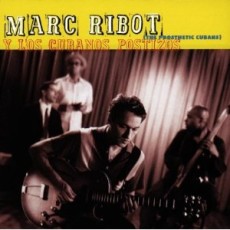
Marc Ribot was born on May 21, 1954 in Newark, New Jersey and worked extensively as a session musician. His early sessions with Tom Waits helped define Waits new musical direction in 1985.
His own work has touched on many styles, including n wave, free jazz and Cuban music. Ribot’s first two albums featured The Rootless Cosmopolitans, followed by an album of works by Frantz Casseus and Arsenio Rodriguez. Further releases found him working in a variety of band and solo contexts including two albums with his self-described “dance band”, Marc Ribot y Los Cubanos Postizos.
His relatively limited technical facility is due to learning to play right-handed despite being left-handed. He currently performs and records with his group Marc Ribot’s Ceramic Dog. Marc’s studio work involves several tracks accompanying the legendary pianist McCoy Tyner’s “Guitars” project. He has performed and recorded with Jack McDuff, John Scofield, Wilson Pickett, Cibo Matto, Bela Fleck, Derek Trucks, Madeline Peyroux, Medeski Martin & Wood, Elton John and many others.
He has toured Europe with his band Sun Ship, had a biographical documentary film called the The Lost String and has also judged the 8th Annual Independent Music Awards to support indie careers in music. He has twenty-one albums as a leader, a filmography that includes five and a biographical documentary about him titled The Lost String. Guitarist Marc Ribot also plays banjo, trumpet, cornet and sings and continues to perform, record and tour.
Dose A Day-Blues Away
From Broadway To 52nd Street
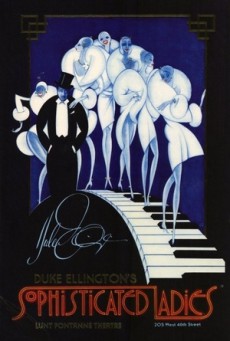
Sophisticated Ladies had a preview run of 15 shows beginning February 16th prior to its official opening at the Lunt Fontanne Theatre on March 1, 1981 and ran for 767 performances. Duke Ellington composed the music for the revue with a cast that included Gregory Hines, Judith Jamison, Phyllis Hyman, Hinton Battle, Gregg Burge and Mercer Ellington. Hines’ older brother Maurice joined the cast later in the run.
The score includes classic jazz tunes “Mood Indigo,” “Take The “A” Train, I’m Beginning To See The Light, Hit Me With A Hot Note and See Me Bounce, It Don’t Mean A Thing (If It Ain’t Got That Swing), I Let A Song Go Out Of My Heart, Old Man Blues, In A Sentimental Mood, Sophisticated Lady, Don’t Get Around Much Anymore, Satin Doll and I Got It Bad And That Ain’t Good among numerous others.
Jazz History: In the 1980s the jazz community shrank dramatically and split. A mainly older audience retained an interest in traditional and straight-ahead jazz styles. Wynton Marsalis strove to create music within what he believed was the tradition, creating extensions of small and large forms initially pioneered by such artists as Louis Armstrong and Duke Ellington. In the early part of the decade, a commercial form of jazz fusion called pop fusion or smooth jazz became successful and garnered significant radio airplay.
Smooth jazz received frequent airplay with more straight-ahead jazz in “Quiet Storm” time slots (a format begun at Howard University’s WHUR by host Melvin Lindsay) at radio stations in urban markets across the United States. This helped to establish or bolster the careers of Grover Washington, Jr., Kenny G, Kirk Whalum, Boney James and David Sanborn and vocalists including Al Jarreau, Anita Baker, Chaka Khan and Sade.
In this same time period “Echoes of an Era” was released by the sextet comprised of Chaka Khan (vocal), Joe Henderson (saxophone), Freddie Hubbard (trumpet), Chick Corea (piano), Stanley Clarke (bass) and Lenny White (drums). The quintet released another “Echoes” enlisting the vocal talents of Nancy Wilson. The quintet would also release two albums titled “The Griffith Park Collection”.
Sponsored By

www.whatissuitetabu.com
Daily Dose Of Jazz…
Betty Joplin was born on May 17th, in Jackson, Michigan. Her mother recognized her God-given talent when she was 3 and at the age of 4, she was being invited to sing and accompany herself on piano at various churches. By age 7, the church appointed her pianist for church services as well as for the church choir. She continued to do so until age 17 when she got married.
It wasn’t until 3 of her 4 children were teenagers that Betty started singing again. Joining a couple of her musician friends at a night club at Lake James, Indiana they coaxed her up onto the stage to do what she loved – sing and the audience loved her. There was such a demand for her that the owner of the nightclub offered her a weekend job and that was the beginning of her professional singing career.
Joplin has worked with Arthur Prysock, Duke Ellington Orchestra, Aretha Franklin, Larry Gray, Leon Joyce and Larry Fuller; has performed throughout the United States, Hawaii, Europe, Mexico, and Asia, was nominated for a Grammy for “Rockin’ Good Way”, recorded for Lake Street Records.
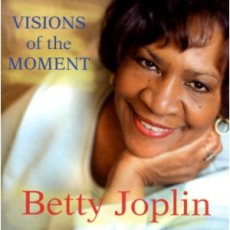
Vocalist Betty Joplin recorded “Blinded by Love” before forming her own label in 2002, formed her own quartet and recorded “Visions of the Moment”. She continues to perform, tour and record.
Put A Dose In Your Pocket
More Posts: vocal