

Daily Dose Of Jazz…
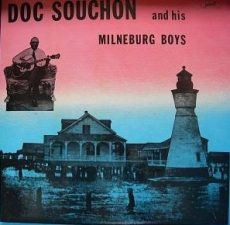
Edmond “Doc” Souchon was born October 25, 1897 in New Orleans, Louisiana and received schooling to become a physician in Chicago, Illinois. During this period he was playing regularly in groups such as the Six and Seven Eighths Band in the 1910s.
Souchon was involved early on in the management of the New Orleans Jazz Club, and served as president of the organization early in its existence. He helped oversee a reconstitution of the Six and Seven Eighths Band in 1945 as a four-piece, and made many recordings of early string band tunes through the early 1960s. Alongside this, Souchon recorded with many noted New Orleans jazz mainstays, such as Johnny Wiggs, Sherwood Mangiapane, Papa Jack Laine, Raymond Burke, and Paul Barbarin.
He had his own radio program on WWL, and edited the journal Second Line from 1951 until his death in 1968. Aside from his contributions to jazz journals such as Jazz and Jazz Report, Souchon compiled a photo book with Al Rose entitled New Orleans Jazz: A Family Album, first published in 1967 and subsequently revised in 1978 and 1984.
He helped establish the National Jazz Foundation in 1942, as well as the New Orleans Jazz Museum about a decade later. His record collection, which included some 2,000 recordings of New Orleans jazz, was bequeathed to the New Orleans Public Library, and many other music-related materials he collected are now in the possession of the William Ransom Hogan Jazz Archive at Tulane University.
Guitarist and writer Doc Souchon, who was a pivotal figure in the historical preservation of New Orleans jazz in the middle of the 20th century, transitioned on August 24, 1968.

More Posts: bandleader,deejay,guitar,history,instrumental,jazz,music,writer
Daily Dose Of Jazz…
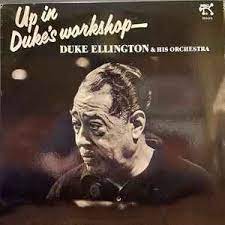
Fred Stone was born on September 9, 1935 in Toronto, Ontario, Canada and was the son of saxophonist Archie Stone. His initial musical studies were with his father. At the age of 14 he began studying the trumpet with Donald Reinhardt in Philadelphia, Pennsylvania and spent every summer in that city from 1950–1955. At home he studied music theory and music composition with Gordon Delamont and John Weinzweig.
Commencing his performance career in 1951 at the age of 16 he played in Benny Louis’s big band. From 1955 to 1967 he was a trumpeter in various orchestras related to the Canadian Broadcasting Corporation, including the CBC Symphony Orchestra. During the late 1950s and 1960s he performed widely as a concert soloist with orchestras throughout North America. He was an active performer as a jazz musician, playing regularly with Ron Collier , Phil Nimmons , the Boss Brass, and Lighthouse and he toured North America and Europe with the Duke Ellington Orchestra.
Returning to Toronto in 1971, Stone became highly involved with his work as a teacher, and operated his own private studio where he taught improvisational theory and music composition. His performance career virtually ceased for the remainder of the decade, although he remained active as a composer. Between 1971 and 1983 he mainly focused on his work as a composer and teacher, making only periodic public performances, and often with ensembles composed largely of his students.
In 1984 he formed Freddie’s Band, a jazz ensemble in residence at The Music Gallery in Toronto. Flugelhornist, trumpeter, pianist, composer, writer, and music educator Fred Stone recorded eleven albums as a sideman before he transitioned on December 10, 1986.

More Posts: educator,flugelhorn,history,instrumental,jazz,music,trumpet,writer
Three Wishes
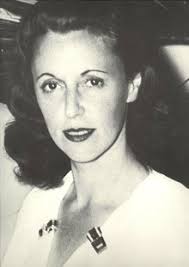
From the Notes of Nica de Koenigswarter:
You can quote Satchmo as saying:
“Health is wealth! If I were sick, and I wanted to borrow a dime, d’you think that cat would cross the street to offer it to me? No, sir! I’d have to have my health to go and get it from him.”
“And people would never get sick if they didn’t get constipated. Why, I’ve never had an operation in my life, because I never let myself get constipated.”
*Excerpt from Three Wishes: An Intimate Look at Jazz Greats ~ Compiled and Photographed by Pannonica de Koenigswarter

More Posts: baroness,history,instrumental,jazz,music,pannonica,patron,three,wishes,writer
Daily Dose Of Jazz…
Sy Johnson was born on April 15, 1930 in New Haven, Connecticut and learned to play the piano in his youth. He first performed in New York City with Charles Mingus at the jazz club Showplace, with Booker Ervin on tenor, Ted Curson on trumpet, Dannie Richmond on drums, and Mingus on bass. and on his first night with Mingus, Eric Dolphy performed on alto, bass clarinet, and flute.
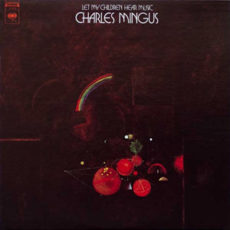
In 1971, eleven years later, Mingus gave Johnson Let My Children Hear Music to arrange, which featured two Mingus pieces, Shoes of the Fisherman’s Wife (Are Some Jiveass Slippers) and Don’t Be Afraid, the Clowns Afraid Too. The album’s emergence was heralded with a live concert, Mingus And Friends At Philharmonic Hall, also arranged by Johnson and released as an album.
Performing We Did It on Soul Train in 1973 and continued to work with Mingus until his death from Lou Gehrig’s disease in 1979. Mingus recorded two of Johnson’s compositions, Wee and For Harry Carney, and nominated Johnson for a Guggenheim award following his own in Jazz Composition.
Johnson continues to work with Sue Mingus arranging charts for all the Mingus repertory ensembles—the Mingus Big Band, the Mingus Orchestra and the Mingus Dynasty. He would go on to collaborate with arrangements for Joe Williams, Frank Sinatra, Wes Montgomery, Roy Eldridge, Ben Webster, Quincy Jones, Benny Goodman, Count Basie, Mel Torme, Terry Gibbs, Lee Konitz and Sarah Vaughan, among others.
He has also worked on Broadway and in films such as the1984 movie The Cotton Club. Arranger Sy Johnson is also a jazz photographer, writer, pianist, singer, and teacher.
More Posts: arranger,history,instrumental,jazz,music,photographer,pianist,singer,teacher,writer
Daily Dose Of Jazz…
Charles Frederic Ramsey, Jr. was born on January 29, 1915 in Pittsburgh, Pennsylvania. Taking his BA at Princeton University in 1936, then went to work at Harcourt Brace in the late Thirties. The early Forties had him at the United States Department of Agriculture and Voice of America.
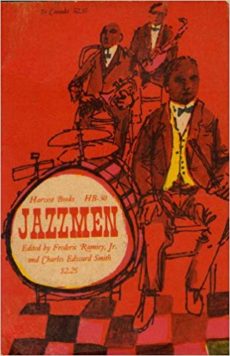
With Charles Edward Smith, Ramsey wrote Jazzmen in 1939, an early landmark of jazz scholarship particularly noted for its treatment of the life of King Oliver. After receiving Guggenheim fellowships, he visited the American South in the middle of the 1950s to make field recordings and do interviews with rural musicians, some of which were used in releases by Folkways Records and in a 1957 documentary, Music of the South.
He curated an anthology of early jazz recordings for Folkways, titled simply Jazz. Ramsey worked with the Institute of Jazz Studies at Rutgers University from 1970. He researched Buddy Bolden’s life with a grant from the National Endowment for the Humanities and continued with a Ford Foundation grant. He presented early jazz interviews on National Public Radio in 1987. The writer of jazz and record producer Charles Ramsey passed away on March 18, 1995 in Paterson, New Jersey.