

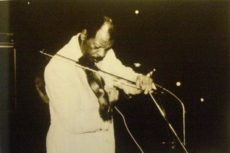
Atlanta Jazz Festival… 1984

More Posts: festival

Daily Dose Of Jazz…
Russell Jacquet was born on December 4, 1917 in Saint Martinville, Louisiana, the elder brother of tenor saxophonist Illinois Jacquet. He had stints with Floyd Ray and Milt Larkin before he studying music at Wiley College and Texas Southern University.
Moving west he played with his brother’s band for a time, later forming his own group, that became the house band at the Cotton Club from 1945 to 1949. After that residency ended Russell rejoined his brother’s group. He would later play with several small groups in Oakland, California, as well as in Houston, Texas with Arnett Cobb. He also performed with his brother on a few dates in New York City.
Trumpeter Russell Jacquet passed away on February 28, 1990 in Los Angeles, California. He left a small catalogue of recordings as a leader during his Cotton Club years and four as a sideman with his brother, recorded between 1951 and 1969 on Clef, Argo and Prestige record labels.

Inspire A Young Mind
#preserving genius
More Posts: trumpet

Daily Dose Of Jazz…
Paul Lingle was born on December 3, 1902 in Denver, Colorado and began learning to play the piano at age six. He first played professionally in the San Francisco, California area in the 1920s. He often accompanied Al Jolson in the late Twenties, including for his film soundtracks.
In the 1930s Paul worked mainly on radio, and also played with the Al Zohn band. He tuned pianos early in the 1940s and worked as a soloist in local San Francisco clubs, accompanying visiting musicians such as Lead Belly and Bunk Johnson.
Lingle released almost no recorded material during his lifetime, doing only one session for Good Time Jazz in 1952. This session for Good Time Jazz produced eight recorded numbers. After his death, Euphonic Records released several volumes of private recordings which were critically acclaimed.
Pianist Paul Lingle performed locally until his death on October 30, 1963 in Honolulu, Hawaii, relocating there in 1952.
Sponsored By

www.whatissuitetabu.com
More Posts: piano
Daily Dose Of Jazz…
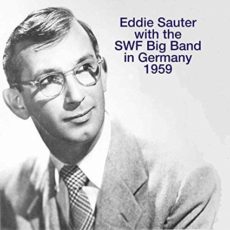
Edward Ernest Sauter was born December 2, 1914 in Brooklyn, New York and studied music at Columbia University and the Juilliard School. He began as a drummer and then played trumpet professionally, most notably with Red Norvo’s orchestra, eventually becoming Norvo’s full-time arranger.
Eddie went on to arrange and compose for Artie Shaw, Tommy Dorsey, Woody Herman and Benny Goodman, earning a reputation for intricate, complex, and carefully crafted works such as Benny Rides Again, Moonlight on the Ganges and Clarinet a la King.
From 1952 to 1958 he co-led the Sauter-Finegan Orchestra and between 1957 and 1959 he was Kurt Edelhagen’s successor as leader of the SWF Orchestra in Baden-Baden, Germany. By 1961, he was working with tenor saxophonist Stan Getz on Focus, a unique collaboration of string compositions, and featuring drummer Roy Haynes on I’m Late, I’m Late, the only selection to feature a non-string instrument other than Getz. They collaborated again during Sauter’s work composing the score for the 1965 film Mickey One, starring Warren Beatty.
He would venture into composing for television including the third season theme to Rod Serling’s Night Gallery. He also orchestrated a number of Broadway musicals, most notably 1776, but also The Apple Tree and It’s a Bird…It’s a Plane…It’s Superman. His composition World Without Time is used as the theme music for the public affairs show The Open Mind.
Composer, arranger, drummer and trumpeter Eddie Sauter, who was prominent during the swing era, passed away of a heart attack in New York City on April 21, 1981.
Dose A Day-Blues Away
Daily Dose Of Jazz…
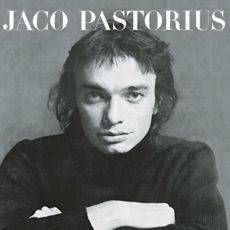
Jaco Pastorius was born John Francis Anthony Pastorius III on December 1, 1951 in Norristown, Pennsylvania to Jack Pastorius, a big band singer and drummer. Shortly after his birth the family moved to Oakland Park, Florida, where he went to elementary and middle school at St. Clement’s Catholic School in Wilton Manors. Picking up music at an early age he formed his first band named the Sonics along with John Caputo and Dean Noel while in high school at Northeast High. He was also a talented athlete playing football, basketball, and baseball. His nickname came from a play on the spelling of umpire Jocko Conlan when French pianist Alex Darqui assumed Jaco was the correct spelling.
Following in the footsteps of his father Jack, playing the drums until he injured his wrist playing football at age 13. Pastorius then bought an electric bass from a local pawn shop for $15, began to learn to play with drummer Rich Franks, and switched from drummer to becoming the bassist for the Las Olas Brass.band. By the age of 17 he had begun to appreciate jazz and had saved enough money to buy an upright bass. Though its deep, mellow tone appealed to him, it strained his finances and had difficulty maintaining the instrument, and one day found it had cracked. At that point he traded it in for a 1962 Fender Jazz Bass.
His first real break came when he became bass player for Wayne Cochran and the C.C. Riders. He also played on various local R&B and jazz records with Little Beaver and Ira Sullivan. At 22, Jaco began teaching bass at the University of Miami, where he met student Pat Metheny in 1972, but he was too advanced a player to remain a student and likewise became part of the UM music faculty at the age of 18. By 1974 they began playing and recording together, first with pianist Paul Bley as leader and Bruce Ditmas on drums, on an album later titled Jaco, on the Paul Bley/Carol Goss Improvising Artists label. They followed this with drummer Bob Moses on a trio album on the ECM label, titled Bright Size Life in 1976).
1975 saw Pastorius introduced to Blood, Sweat & Tears drummer Bobby Colomby, who had been asked by Columbia Records to find new talent for their jazz division. This meeting produced his debut album as a leader titled Jaco Pastorius in 1976, that became a breakthrough album for the electric bass, and is considered by many as the finest bass album ever recorded. The album also boasted a lineup of heavyweights Herbie Hancock, Wayne Shorter, David Sanborn, Lenny White, Hubert Laws, Don Alias, and Michael Brecker, as well as, soul singers Sam & Dave, who reunited to appear on the track Come On, Come Over.
He joined Weather Report after a somewhat rocky introduction after a Miami concert to Joe Zawinul, claiming he expected more from the band. Put off by his comments, Pastorius persisted and an admiration soon formed for the brash young bassist who claimed to be the best in the world. A demo tape and correspondence followed and in 1976 he joined Weather Report during the recording sessions for Black Market, and for the next five years became a vital part of the band by virtue of the unique playing qualities, his skills as a composer and arranger, and his exuberant showmanship on stage.
Pastorius guested on many albums by Ian Hunter of Mott the Hoople, David Sanborn, Aynsley Dunbar, Joni Mitchell, Al Di Meola, Flora Purim, Airto Moreira, Mike Stern, guitarist Bireli Lagrene and drummer Brian Melvin. In 1985, he recorded an instructional video, Modern Electric Bass, hosted by bassist Jerry Jemmott.
Following Weather Report he put together the big band project Word Of Mouth with Herbie Hancock, Wayne Shorter, Peter Erskine, Toots Thielemans, and Hubert Laws in tow. Though well produced on both coasts and in Belgium, the album didn’t do well as audiences were moving away from improvisation and chamber like jazz rock for a more commercially viable sound in the late Seventies. Warner Bros. released him from his contract and he had difficulty getting signed afterwards.
Now in his thirties Pastorius began touring in 1982 and his visit to Japan, though a highlight, surfaced the beginnings of deteriorating behavior. He shaved his head, painted his face black and threw his bass into Hiroshima Bay at one point. In his early career Pastorius had avoided alcohol and drugs. With Weather Report he increasingly used alcohol and other drugs, the abuse of which exacerbated his mental issues and led to increasingly erratic and sometimes anti-social behavior. He was diagnosed with bipolar disorder in late 1982 following his Word of Mouth tour of Japan.
By 1986, Pastorius’s health had further deteriorated, he began living on the streets after being evicted from his New York apartment, was admitted to Bellevue Hospital in New York, where he was prescribed carbamazepine in preference to lithium. He moved back to Fort Lauderdale and again lived on the streets for weeks at a time. After sneaking onstage at a Carlos Santana concert in 1987 and being ejected, he kicked in the glass door of the Midnight Bottle Club in Wilton Manors, engaged in a violent confrontation with the club bouncer Luc Havan, that left him hospitalized with multiple facial fractures, injuries to his right eye and left arm.
He fell into a coma and a massive brain hemorrhage a few days later led to brain death for bassist Jaco Pastorius, passing away on September 21, 1987 at Broward General Medical Center in Fort Lauderdale, Florida. He was 35. In 1988, following his death, he was elected by readers’ poll for inclusion in the Down Beat Hall of Fame, the second bassist honored in this way. To date, only seven bassists have been inducted, the others being Jimmy Blanton, Ray Brown, Ron Carter, Charles Mingus, Charlie Haden and Milt Hinton.
Sponsored By

More Posts: bass guitar