

Daily Dose Of Jazz…
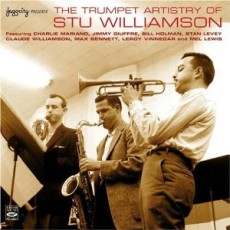
Stu Williamson was born on May 14, 1933 in Brattleboro, Vermont and is the younger brother of jazz pianist Claude Williamson. The trumpeter relocated to Los Angeles in 1949 and became a regular on the West Coast scene. He played with Woody Herman, Mel Lewis-Pepper Adams Quintet, Elmo Hope, Lennie Niehaus, Billy May and Charlie Barnet the first half of the Fifties.
Williamson played a significant role in Stan Kenton’s Orchestra, Howard Rumsey’s Lighthouse Café All-Stars and Terry Gibbs’s Dream Band. Between 1954 and 1958 Williamson played intermittently with Shelly Manne and was a ubiquitous session player up until 1968.
Although he had a beautiful, rich, round tone and his ability to create melodic solos full of invention, power and clarity gave him the opportunity to front small groups and big bands. Disappearing from the jazz scene after battling drug addiction for much of his life, including for years after he left the music. Trumpeter Stu Williamson passed away on October 1, 1991 in Studio City, California.

Dose A Day-Blues Away
More Posts: trumpet
Daily Dose Of Jazz…
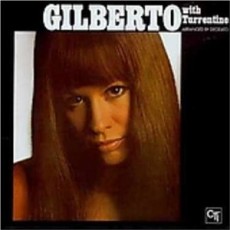
Astrud Gilberto was born Astrud Weinert on March 30, 1940 in the state of Bahia and raised in Rio de Janiero, the daughter of a Brazilian mother and a German father, She married Joao Gilberto in 1959, emigrating to the United States in 1963 and has continued to reside in the US ever since. They divorced in the mid-1960s and she began a relationship with her musical partner, Stan Getz.
Although now widely known for her samba and bossa nova music, she had never sung professionally and it was at the behest of her husband Joao that she sang on the recording of the Getz/Gilberto album featuring Stan Getz, Joao Gilberto and Antonio Carlos Jobim. Providing the English vocals to the 1965 Grammy Award-winning song “The Girl From Ipanema”, and her career was launched garnering her worldwide recognition and establishing her as a jazz and pop singer.
Her first solo album was The Astrud Gilberto Album in 1964, went on tour with Stan Getz singing bossa nova and American jazz standards, Gilberto didn’t start to record her own compositions until the 1970s. Her repertoire included such standards as “The Shadow Of Your Smile”, “It Might As Well Be Spring”, “Love Story”, “Fly Me To The Moon”, “Day By Day”, “Here’s That Rainy Day” and “Look to the Rainbow”.
Astrud has recorded songs in Portuguese, English, Spanish, Italian, French, German and Japanese, has received the “Latin Jazz USA Award for Lifetime Achievement”, inducted into the “International Latin Music Hall of Fame”, contributed to the Aids benefit album Red Hot + Rio, has had numerous versions of her songs sampled and used in movies, is a fine artist and ardent animal rights advocate.
More Posts: vocal
Daily Dose Of Jazz…
Airto Moreira was born in Itaiopolis, Brazil on August 5, 1941 into a family of folk healers but was raised in Curitiba and Sao Paulo. Showing an extraordinary talent for music at a young age, he became a professional musician at age 13, and his first landmark recording was “Quarteto Novo” with Hermeto Pascoal in 1967. Shortly after, he followed his wife Flora Purim to the U. S., settling in New York City.
Airto began playing regularly with jazz musicians in the city beginning with the bassist Walter Booker and through him began playing with Joe Zawinul, who in turn introduced him to Miles Davis. At this time Miles was mounting the seminal fusion recording Bitches Brew to which Airto became a part of.
After two years with Miles, Airto joined Miles alumni Joe Zawinul, Wayne Shorter and Miroslav Vitous forming Weather Report and recording their self-titled debut album. He left Weather Report and joined Chick Corea’s new band Return To Forever, drumming on the debut Return To Forever and Light As A Feather, commonly regarded as fusion classics.
Airto has played with many of the greatest names in jazz including Cannonball Adderley, Lee Morgan, George Benson, Donald Byrd, Paul Desmond, Dave Holland, Jack DeJohnette, John McLaughlin, Astrud Gilberto, Keith Jarrett and George Duke just to name a few. He also has played with symphonic orchestras and as a solo percussionist, and during live performances often includes a samba solo, where he emulates the sound of an entire band using just a single pandeiro.
In addition to jazz concerts and recordings, Airto has composed and contributed music scores to both television and film including Apocalypse Now and Last Tango In Paris. The drummer and percussionist has taught at UCLA and the California Brazil Camp and collaborated with his wife Flora and P.M. Dawn on “Non-Fiction Burning” for the Aids benefit album Red Hot + Rio produced by the Red Hot Organization.
More Posts: drums,percussion

Daily Dose Of Jazz…
Naná Vasconcelos was born in Recife, Brazil on August 2, 1944. At age 12 he began playing his father’s guitar and joined the city’s marching band. His intense curiosity and inquisitive ear prompted him to listen to music from Brazil’s greatest composer Villa Lobos to Jimi Hendrix. He played with every imaginable musical configuration in Recife from orchestras to street bands until finally moved to Rio where he began performing with Milton Nascimento.
By 1970 Argentinean tenor, Gato Barbieri came through Rio and invited Nana to join his group and everywhere the played Nana created a sensation. After the tours end he settled in Paris where he made his first recording, “Africa Deus”. He returned to Brazil to record Amazonas, began an eight-year collaboration with guitarist Egberto Gismonti, returned to New York and formed the group “Cordona” with Don Cherry and Collin Walcott, while touring and recording with Pat Metheny.
Throughout his career he has worked with everyone from B.B. King to Jean Luc Ponty to the Talking Heads but has never become a studio musician. With over two-dozen albums as a leader, Nana has contributed special energies to another sixteen albums with such musicians as Walter Bishop Jr., Jan Gabarek, Pierre Favre and Danny Gottlieb that go well beyond the usual contributions of a percussionist.
A master all of Brazil’s percussion instruments, specializing in the berimbau and taking it far beyond its traditional uses, he currently leads his own group “Bushdance” and has developed a theatrically staged piece that explores the full, fascinating range of sounds and songs that lie in the heart of his music.
Nana Vasconcelos has performed at the Woodstock Jazz Festival, “Luz De Candeeiro” to the AIDS benefit compilation album Onda Sonora: Red Hot + Lisbon produced by the Red Hot Organization and was awarded the Best Percussionist Of The Year by the Down Beat Critics Poll for seven consecutive years, from 1984 to 1990. He continues to perform, record and tour.
More Posts: percussion
Daily Dose Of Jazz…
Eumir Deodato was born Eumir Deodato de Almeida on June 22, 1943 in Rio de Janiero of Italian and Portuguese parents. He began his musical training at twelve on the accordion but rapidly learned instrumental and orchestral skills that gave him his first recording session at 17.
Originally working as pianist and arranger in the Rio bossa nova scene, he rapidly outgrew this and, along with many other Brazilian musicians during the military dictatorshipin their country, moved to New York and began working with composer Luis Bonfa and later with producer Creed Taylor as an arranger. Additionally, he became keyboardist in Taylor’s expanding group of CTI backing artists.
His first U.S. album “Prelude” released in 1973 for CTI was a big band Latin jazz project that immediately attracted a wide audience. His funky version of Also Sprach Zarathustra won him the 1974 Grammy for Best Pop Instrumental Performance and hitting #2 on the charts.
Deodato has been in demand as a producer and arranger since the 1960s. In all, he has worked on more than 500 albums, fifteen of which have reached platinum. His skills as an arranger provided entree to the American recording industry, writing charts for Wes Montgomery, Astrud Gilberto, Frank Sinatra, Bjork, k.d. lang and Kool and the Gang among others.
He has scored several films over his career and recorded a live album in Rio in 2007. He continues to produce and arrange.
More Posts: piano