

Daily Dose Of Jazz…
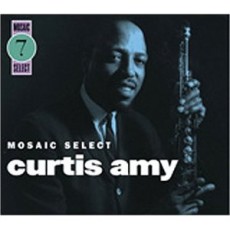
Curtis Amy was born on October 11, 1929 in Houston, Texas and learned how to play clarinet before joining the Army. During his time in service he picked up the tenor saxophone and after his discharge he enrolled and graduated from Kentucky State College.
Working as an educator in Tennessee while playing in mid-western jazz clubs for a time and in the mid-1950s, Amy relocated to Los Angeles and signed with Pacific Jazz Records. By the mid-60s he spent three years as musical director for Ray Charles’ orchestra, together with his wife and singer Merry Clayton, and Steve Huffsteter.
Curtis lead his own bands and recording albums under his own name, Amy also did session work and played the solos on several recordings, including The Doors song “Touch Me”, Carole King’s “Tapestry”, and Lou Rawls’ first albums, “Black and Blue and Tobacco Road”; with Dexter Gordon in the Onzy Matthews’ big band as well as working with Marvin Gaye, Tammy Terrell and Smoky Robinson.
Soul jazz and hard bop tenor saxophonist Curtis Amy, a part of the West coast jazz scene who explored other musical mediums, passed away on June 5, 2002.
More Posts: saxophone
Daily Dose Of Jazz…
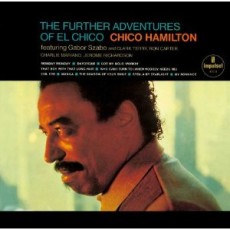
Chico Hamilton was born Foreststorn Hamilton on September 20, 1921 in Los Angeles, California and was on a drumming fast track musical education in a band with his schoolmates Charles Mingus, Illinois Jacquet, Ernie Royal, Dexter Gordon, Buddy Collette and Jack Kelso. Subsequent engagements with Lionel Hampton, Slim & Slam, T-Bone Walker, Lester Young, Count Basie, Duke Ellington, Charlie Barnet, Billy Eckstine, Nat King Cole, Sammy Davis Jr., Billie Holiday, Gerry Mulligan and six years with Lena Horne established this young West Coast prodigy as a jazz drummer on the rise, before striking out on his own as a bandleader in 1955.
He recorded his first LP as leader in 1955 on Pacific Jazz with George Duvivier and Howard Roberts and in the same year formed an unusual quintet in L.A. featuring cello, flute, guitar, bass and drums that has been described as one of the last important West Coast jazz bands. The original personnel: Buddy Collette, Jim Hall, Fred Katz and Jim Aton. Hamilton continued to tour using different personnel, from 1957 to 1960, Paul Horn and John Pisano that are featured in the film “Sweet Smell Of Success in 1957 and Jazz On A Summer’s Day with Nate Gershman and Eric Dolphy in 1960. Dolphy was enlisted to record on Hamilton’s first three albums, however by 1961 the group was revamped with Charles Lloyd, Gabor Szabo, George Bohannon and Albert Stinson.
Over the course of his career Chico changed personnel keeping his sound fresh and innovative. Subsequently he recorded for Columbia, Reprise and Impulse, scored for television, commercials and radio. He has worked with countless musicians and vocalists, received the New School Jazz and Contemporary Music Programs Beacons in Jazz Award and was awarded the WLIU-FM Radio Lifetime Achievement Award. He has been given a NEA Jazz Master Fellowship, was confirmed by Congress with the President’s nomination to the Presidents Council on the Arts, received a Living Legend Jazz Award as part of The Kennedy Center Jazz in Our Time Festival, as well as receiving a Doctor of Fine Arts from the New School where he currently teaches. Drummer Chico Hamilton continued to perform and record until his passing on November 25, 2013.
More Posts: drums

Daily Dose Of Jazz…
“Brother” Jack McDuff was born Eugene McDuffy on September 17, 1926 in Champaign, Illinois. He began his musical career playing bass first with Joe Farrell followed by Willis Jackson who encouraged him to take up the organ. In the late 50’s he moved to his new instrument and began attracting the attention of Prestige Records. He soon became a bandleader, leading groups that featured then, young guitarist George Benson, saxophonist Red Holloway and drummer Joe Dukes.
McDuff’s debut recording “Brother Jack” for Prestige was followed by his sophomore project, The Honeydripper, featuring Jimmy Forrest and Grant Green. After his Prestige tenure he joined the Atlantic Records family for a brief period and then by the 70s was recording for Blue Note.
The decreasing interest in jazz and blues during the late 70s and 1980s meant that many jazz musicians went through a lean time and it wasn’t until the late 1980s, with The Re-Entry, recorded for the Muse label in 1988, and once again began a successful period of recordings, initially for Muse, then on the Concord Jazz label from 1991. George Benson appeared on his mentor’s 1992 Colour Me Blue album.
Despite health problems, Brother Jack continued working and recording throughout the 1980s and 1990s, touring Japan with Atsuko Hashimoto in 2000. “Captain” Jack McDuff, as he later became known, was one of the most prominent jazz organist and organ trio bandleader during the hard bop and soul jazz era of the Sixties. He passed away of heart failure on January 23, 2001 at the age of 74 in Minneapolis, Minnesota.
More Posts: organ
Daily Dose Of Jazz…
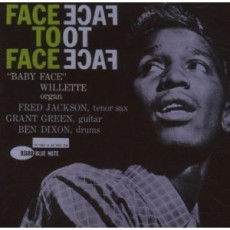
Roosevelt “Baby Face” Willette was born on September 11, 1933 in New Orleans, Louisiana. His mother was a missionary who played the piano in the church where his father was a minister. His musical roots are therefore in gospel and Baby Face taught himself the piano and started out playing the piano for various gospel groups, and spent his early career touring across the United States, Canada and Cuba.
It was in Chicago that Willette decided to switch from gospel and rhythm & blues to playing jazz. He played piano with the bands of King Kolax, Joe Houston, Johnny Otis and Big Jay McNeely before switching to organ. He was inspired by Jimmy Smith’s work, however, his playing style remained heavily influenced by gospel and soul jazz. Based in Milwaukee he performed with his vocalist wife Jo Gibson at such clubs as The Flame Club, The Pelican, The Moonglow and Max’s among others.
In 1960 he moved to New York City where he met Lou Donaldson and Grant Green, and played on a few Blue Note sessions with them. This led to Willette being signed to the label, which recorded his debut album Face To Face. After stints in New York City, and then California, failing health forced a return to Chicago, where his family resided. This would eventually become his final resting place as he passed away on April 1,1971.

Daily Dose Of Jazz…
Gene Harris was born on September 1, 1933 in Benton Harbor, Michigan where he was first drawn to music at the age of four. He was attracted to the music of local bandleader Charles Metcalf’s group and was inspired to try to pick out songs on the piano. He also enjoyed the music he heard in church and the boogie-woogie records of his parents.
Gene quickly developed as a pianist, having many opportunities to play music while serving in the Army from 1951 – 54. Following his discharge, he originally formed The Four Sounds, but by 1956 abandoned their original plan to include a tenor-saxophonist and renamed themselves The Three Sounds. Joining Harris in the original line up of the band was bassist Andy Simpkins and drummer Bill Dowdy.
For the next 15 years, the trio made many notable recordings for Blue Note and other labels as well as supporting such musicians as Lester Young, Lou Donaldson, Nat Adderley, Johnny Griffin, Anita O’Day, Stanley Turrentine and Sonny Stitt, among others. In 1973, The Three Sounds disbanded, leaving Harris to pursue a solo career until he semi-retired in 1977, playing sometimes only in Boise, Idaho.
In the early eighties Ray Brown convinced Gene to tour with his trio and then led his own groups once again, recording mostly on Concord. Gene Harris was one of the most accessible jazz pianists and his soulful sound was immediately likable as he returned to the spotlight. He was widely associated with the Philip Morris Super Band for many years. The Grammy winning artist, whose music was infused with blues and gospel, left a legacy of sixty albums as a leader, 34 as a sideman and nine compilations before his passing away on January 16, 2000 of kidney failure at the age of 66.

More Posts: piano