

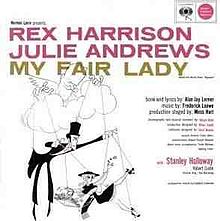
From Broadway To 52nd Street
My Fair Lady opened the Mark Hellinger Theatre on March 15, 1956, running for a record 2,717 performances and making it the 7th musical to enter the roster of blockbuster musicals and to date the longest running on Broadway. The musical starred Rex Harrison, Julie Andrews and Robert Coote performing the compositions of Alan Jay Lerner & Frederick Leowe who gave the world I’ve Grown Accustomed To Her Face, Show Me, On The Street Where You Live, I Could Have Danced All Night and Wouldn’t It Be Loverly.
The Story: When Professor Henry Higgins, from perfect British class snobbishness hears the low born waif bray of flower girl Eliza Doolittle, he places a wager with his colleague Colonel Pickering that by giving her lessons in speech and class, he can pass her off to society. Unwittingly, through all their ups and downs in the learning process, the caterpillar evolves into a beautiful butterfly and Henry falls in love. Fighting his heart every step of the way and frustrating a now society lady Eliza, who has also fallen for him. Finally Henry succumbs to his heart and they find peace in their world.
Jazz History: Outside of the United States the beginnings of a distinct European style of jazz emerged in France with the Quintette du Hot Club de France, which began in 1934. Belgian guitar virtuoso Django Reinhardt popularized gypsy jazz, a mix of 1930s American swing, French dance hall “musette” and Eastern European folk with a languid, seductive feel. The main instruments are steel stringed guitar, violin and double bass. Solos pass from one player to another as the guitar and bass play the role of the rhythm section. Some music researchers hold that it was Philadelphia’s Eddie Lang and Joe Venuti who pioneered the guitar-violin partnership typical of the genre,which was brought to France after they had been heard live or on Okeh Records in the late 1920s.
Sponsored By

www.whatissuitetabu.com
Daily Dose Of Jazz…
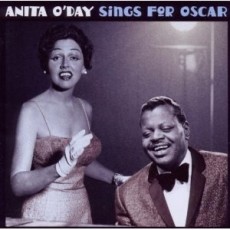
Anita O’Day was born Anita Belle Colton into a broken home in Chicago, Illinois on October 18, 1919. She took the first chance to leave home at age 14, she became a contestant in the popular Walk-a-thons as a dancer. She toured on the Walk-a-thons circuits for two years, occasionally being called upon to sing. In 1934, she began touring the Midwest as a marathon dance contestant and singing “The Lady In Red” for tips.
In 1936, she left the endurance contests, determined to become a professional singer. Anita started out as a chorus girl in such uptown Chicago venues as the Celebrity Club and the Vanity Fair, and then found work as a singer and waitress at the Ball of Fire, the Vialago, and the Planet Mars. It was at the Vialago that O’Day met and later married drummer Don Carter and later married, who introduced her to music theory. Her first big break came in 1938 when Down Beat editor Carl Cons hired her to work at his new club, the “Off-Beat” followed by a stint at The Three Deuces.
She went on to work with Gene Krupa in 1941, recorded her first big hit with him performing a novelty duet with Roy Eldridge titled “Let Me Off Uptown”, was named “New Star of the Year” by Down Beat, appeared in two short musical films, and over the next several years she performed as a solo act, fronted the bands of Woody Herman, Stan Kenton, rejoined Krupa and then became a solo artist again.
During the late forties she would record regularly, attempting to achieve popularity without sacrificing her jazz singer identity. Plagued with long-term problems with heroin addiction and alcoholism, coupled with erratic behavior surfacing earned her the nickname “The Jezebel of Jazz”. During this period she was in and out of jail for various possession charges. However, a date with Count Basie at the Royal Roost resulted in five air checks and her career was back on the upswing. But what secured O’Day’s place in the jazz pantheon are the 17 albums she recorded for Norman Granz’s Norgran and Verve labels between 1952 and 1962, recording her and the label’s inaugural LP “Anita O’Day Sings Jazz” in 1952.
Anita’s backbeat-based singing style was strongly influential on many other female singers of the late swing and bebop eras, including June Christy, Chris Connor and Doris Day. Admired for her sense of rhythm and dynamics, her early big band appearances shattered the traditional image of the “girl singer” by presenting herself as a “hip” jazz musician, wearing a band jacket and skirt. Anita O’Day passed away in her sleep of cardiac arrest on Thanksgiving Day, November 23, 2006, at age 87.
More Posts: vocal
Daily Dose Of Jazz…
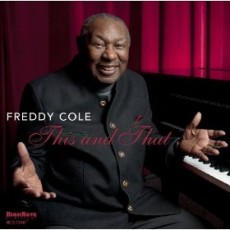
Freddy Cole was born Lionel Frederick Cole on October 15, 1931, to Edward and Paulina Nancy Cole and is the youngest sibling of musicians Eddie, Ike and Nat. Growing up in Chicago he began playing piano at age six, Cole hoped for a career with the NFL. But a hand injury ended his dream and the teenager began playing and singing in Chicago clubs. Although he was ready to hit the road at 18, his mother intervened and he continued his musical education at Chicago’s Roosevelt Institute before moving to New York City in 1951. While in New York, Cole studied at the Juilliard School of Music and went on to get a master’s degree at the New England Conservatory of Music.
The small Chicago-based label, Topper Records, released Freddy’s first single, “The Joke’s On Me” in 1952. A sophomore single, “Whispering Grass” on the OKeh label, was a moderate hit in 1953. He later spent several months on the road with Johnny Coles and Benny Golson in the Earl Bostic band before returning to hone his skills in the bistros of New York. He went on to work with Grover Washington, Jr. and to record jingles for various companies, including Turner Classic Movies.
During the 1970s, Cole recorded several albums for European and English based labels. He was the subject of the 2006 documentary “The Cole Nobody Knows” by filmmaker Clay Walker and is a member of the Steinway Artist roster. He has been inducted into the Georgia Music Hall of Fame in 2007.
Freddy cites his influences as John Lewis, Oscar Peterson, Teddy Wilson and Billy Eckstine, the latter being the subject of his release, “Freddy Cole Sings Mr. B”, that was nominated for a Grammy Award. When speaking of Eckstine, Cole recalled, “He was a fantastic entertainer. I learned so much from just watching and being around him.”
With over two-dozen albums as a leader and numerous collaborations, jazz pianist and vocalist Freddy Cole leads his quartet that holds down a rigorous schedule that continually tours the United States, Europe, South America and the Far East.
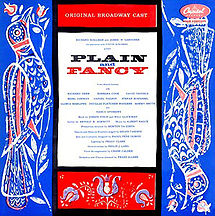
From Broadway To 52nd Street
Plain And Fancy opened at the Mark Hellinger Theatre on January 27, 1955 and ran for 461 performances. Albert Hague & Arnold B. Horwitt composed the music and the show starred Richard Derr, Shirl Conway, Will Able, Gloria Marlowe, Fletcher Rodgers and Barbara Cook. Bea Arthur was an understudy and Carol Lawrence was in the chorus. A favorite jazz tunes came from this musical was Young And Foolish.
The Story: New York City sophisticates Dan King and Ruth Winters travel to Bird-In-Hand in the Amish country of Lancaster County, PA to sell a piece of property to Jacob Yoder, who in turn intends to present it to his daughter Katie and her intended Ezra as a wedding gift. While there, they become involved with local villagers, including Hilda Miller, who mistakes Dan’s kindness for romantic overtures. Ezra’s banished brother Peter returns to claim the hand of his childhood sweetheart, Katie.
Broadway History: Previously, regardless of the size of the venue, a theatre was not considered Off-Broadway if it was within the “Broadway Box” (extending from 40th to 54th Street, and from west of Sixth Avenue to east of 8th Avenue, and including Times Square and 42nd Street. The contractual definition changed this to encompass theatres meeting the standard, which is beneficial to these theatres because of the lower minimum required salary for Actors’ Equity performers at Off-Broadway theatres as compared with the salary requirements of the union for Broadway theatres. Examples of Off-Broadway theatres within the Broadway Box are the Laura Pels Theatre and the Snapple Theater Center..
A number of Off-Broadway musicals have had subsequent runs on Broadway. These have included musicals such as Hair, Godspell, A Chorus Line, Little Shop of Horrors, Rent and The 25th Annual Putnam County Spelling Bee to name a few. Other productions such as Stomp, Blue Man Group and Altar Boyz have run for several years Off Broadway. The Fantasticks, the longest running musical in theatre history, spent its original 42-year run Off Broadway.
Sponsored By
www.whatissuitetabu.com
Daily Dose Of Jazz…
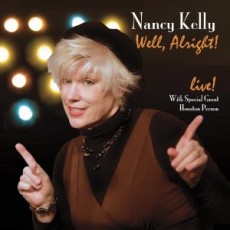
Nancy Kelly was born on October 12, 1950 in Rochester, New York and at the age of four began studying piano, clarinet, drama and dance with private instructors, and voice at the Eastman School of Music. By sixteen she formed a combo and performed in clubs around Rochester.
The early Seventies saw her joining a rock band as lead singer and touring the East coast and Midwest. She enjoyed the freedom of improvising and soon gravitated to jazz, once again forming her own group. Gaining a reputation she began performing on the West coast, the Far East and Europe and regularly performs in New York City at the Blue Note, Birdland and Dizzy’s Club Coca-Cola at Lincoln Center.
Nancy has appeared on the stages of numerous jazz festivals, sung with symphony orchestras, and has been named “Best Female Jazz Vocalist” twice in the Down Beat Readers’ Poll. He debut cd “Live Jazz” reached #11 on the Billboard charts, followed by three ore with “Born To Swing” and “Well Alright” featuring tenor saxophonist Houston Person.
A four-year stint at Jewels Jazz club in Philadelphia between 1982 – 86 helped to revitalize jazz in Philadelphia, Pennsylvania. Subsequently jazz musicians Al Cohn, Jack McDuff, Etta Jones, Shirley Scott and Joey DeFrancesco became favorites of audiences bringing together students and professional people.
Nancy Kelly continues to perform and swing with her signature smoky, take-no-prisoner, back to the roots style delivering authentic expression of real emotion.
More Posts: vocal