

From Broadway To 52nd Street
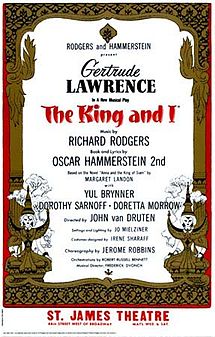
The King and I opened at the St. James Theatre on March 29, 1953 and entered into the pantheon of blockbuster musical hits with one thousand two hundred and forty-six performances. What made this a great musical were the actors – Yul Brynner, Gertrude Lawrence, Dorothy Sarnoff Doretta Morrow and Larry Douglas. Richard Rodgers and Oscar Hammerstein composed the music and lyrics from which evolved the jazz standards Hello Young Lovers, I Have Dreamed and We Kiss In A Shadow. It ran nearly three years, then the fourth longest-running Broadway musical in history, and has had many tours and revivals.
The Story: Anna, a widowed teacher who goes to Siam to tutor the King’s children, hiding her fears of the new land. She finds the King a despot and is especially sympathetic to the furtive youngsters who would marry without permission. The lovers are caught and sentenced to death. Anna and the King fight but finally come to understand each other. She perseveres and on his deathbed, the King confesses he has begun to see the wisdom of her more civilized ways
Broadway History: Broadway theatre had entered a golden age with the blockbuster “Oklahoma!”. According to John Kenrick writing of Broadway musicals, “Every season saw new stage musicals send songs to the top of the charts. Public demand, a booming economy and abundant creative talent kept Broadway hopping. To this day, the shows of the 1950s form the core of the musical theatre repertory.”
In 1950, theatrical attorney Fanny Holtzman was looking for a part for her client, veteran leading lady Gertrude Lawrence. Holtzmann realized that Landon’s book would be an ideal vehicle and contacted Rodgers and Hammerstein, who were initially reluctant but agreed to write the musical. The pair initially sought Rex Harrison to play the supporting part of the King, a role that he had played in the 1946 movie made from landon’s book, but he was unavailable. They settled on actor and television director Yul Brynner.The musical was an immediate hit, winning Tony Awards for Best Musical, Best Actress (for Lawrence) and Best Featured Actor (for Brynner). Lawrence died unexpectedly of cancer a year and a half after the opening, and several actresses played the role of Anna during the remainder of the Broadway run of 1,246 performances.
Sponsored By

www.whatissuitetabu.com
Daily Dose Of Jazz…
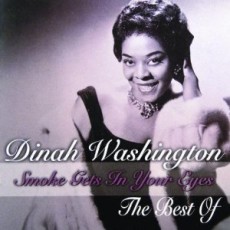
Dinah Washington was born Ruth Lee Jones on August 29, 1924 in Tuscaloosa, Alabama. A blues, R&B and jazz singer, Dinah gained an early reputation for singing torch songs. In 1962 she hired a trio of musicians and vocalists that called themselves the Allegros, consisting of Jimmy Thomas on drums, Earl Edwards on sax, and Jimmy Sigler on organ and their vocals created “effective choruses”.
Garnering the title “Queen of the Blues”, over the course of her career Dinah recorded for Keynote, Mercury, EmArcy and Roulette Records, winning a Grammy for “What A Difference A Day Makes”. She was inducted into the Alabama Jazz Hall of Fame, with her recordings inducted into the Grammy, Big Band, Jazz and the Rock and Roll Halls of Fame. She had a U.S. Postal commemorative stamp; had a street in Tuscaloosa and a park in Chicago named in her honor.
Known for her amorous personality, Washington was married eight times and divorced seven times, while having several lovers in between marriages. However, it was very early on the morning of December 14, 1963, that Dinah Washington passed away from a lethal combination of secobarbital and amobarbital. Her eighth and final husband NFL player Dick “Night Train” Lane discovered her body. She was 39.
More Posts: vocal
From Broadway To 52nd Street
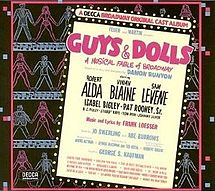
The music composed for Guys & Dolls by Frank Loesser was first heard on the stage at the 46th Street Theatre on January 24, 1950. It became a part of the blockbuster club with a total of 1200 performances. The show starred Robert Alda, Sam Levene and Vivian Blaine, the latter who would go on to star in the 1955 movie version with Frank Sinatra, Marlon Brando, Jean Simmons and Stubby Kaye. Coming out of the play into jazz prominence were the songs If I Were A Bell, I’ll Know, I’ve Never Been In Love Before and Luck Be A Lady Tonight.
The Story: New York gambler, Nathan Detroit, tries to set up a floating crap game since the highest of the high rollers, Sky Masterson, is in town. All the while the police are putting on the heat to prevent the game from happening. Nathan bets Sky that he cannot woo any girl he chooses. He picks Salvation Army’s Sister Sarah and off to Cuba she and Sky go. Ultimately the game takes place in the empty Salvation Army headquarters. Nathan has promised his girl Adelaide that he has quit gambling and will marry her. Romance ensues for all and both Nathan and Sky marry in the end.
Although Guys and Dolls was selected as the winner of the 1951 Pulitzer Prize for Drama, the prize was not awarded because writer Abe Burrows was being investigated by the House Un-American Activities Committee. Do to these troubles with HUAC, the Trustees of Columbia University vetoed the selection, and no Pulitzer for Drama was awarded that year.
Jazz History: In 1950, Charlie Parker, despite a severe drug problem, was at the height of his career. It was during that same year that he became the first jazz musician to record with a string ensemble, which produced the album Charlie Parker With Strings. The year also saw the beginning point were a series of singles on Capitol Records of a nonet led by trumpeter Miles Davis, collected and released first on a ten-inch and later a twelve-inch as the Birth of the Cool. Cool jazz recordings by Chet Baker, Dave Brubeck, Bill Evans, Gil Evans, Stan Getz and the Modern Jazz Quartet usually have a “lighter” sound that avoided the aggressive tempos and harmonic abstraction of bebop. Cool jazz later became strongly identified with the West Coast jazz scene, but also had a particular resonance in Europe, especially Scandinavia, with emergence of such major figures as baritone saxophonist Lars Gullin and pianist Bengt Hallberg. However, blind Chicago pianist Lennie Tristano set out the theoretical underpinnings of cool jazz. Its influence stretches into such later developments as bossa nova, modal jazz, and even free jazz.
Sponsored By
www.whatissuitetabu.com
Daily Dose Of Jazz…
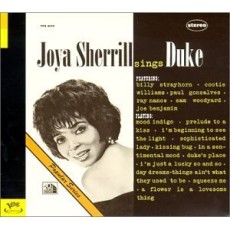
Joya Sherrill was born on August 20, 1924 in Bayonne, New Jersey and originally aspired to be a writer. While still in high school her father arranged for an introduction with Duke Ellington in 1942, aged 17. Six months later she joined the orchestra fronting the band as his vocalist. Leaving briefly to attend Wilberforce University, she returned to the group from 1944 to 1946. She had a hit with Ellington’s tune “I’m Beginning to See the Light”.
Subsequently, she worked as a soloist, performing with Rex Stewart, Ray Nance and others into the 1960s. She returned to Ellington for 1959’s A Drum Is A Woman. She toured the U.S. in 1959 and then took a role in the Broadway show “The Long Dream”. She toured with Benny Goodman in the USSR in 1962 and then returned to sing with Ellington in 1963.
One of the first Blacks to host a television program, from 1970 to 1982 she had a children’s television show, “Time for Joya”, later called “Joya’s Fun School. Although she only taped a few years worth of original episodes, the show would be seen in reruns for twelve years. Late in the 1980s she hosted a children’s show in the Middle East.
Joya Sherrill, jazz vocalist, died of complications from leukemia on June 28, 2010 in Great Neck, New York at the age of 85.
More Posts: vocal
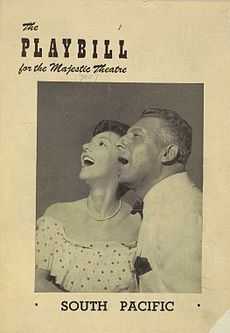
From Broadway To 52nd Street
South Pacific hit the stage of the Majestic Theatre on April 7, 1949 in the first of a 1,925 performance run. Richard Rodgers and Oscar Hammerstein composed the music from the compositions “Happy Talk”, “Some Enchanted Evening” and “A Wonderful Guy” became jazz standards. The musical starred Enzio Pinza, Mary Martin, Juanita Hall, William Tabbert, Betta St. John and Myron Mccormick.
The Story: An American nurse stationed on a South Pacific island during World War II falls in love with a middle-aged French expatriate plantation owner but struggles to accept his mixed-race children. A secondary romance, between a U.S. lieutenant and a young Tonkinese woman, explores his fears of the social consequences should he marry his Asian sweetheart. The issue of racial prejudice is candidly explored throughout the musical, most controversially in the lieutenant’s song, “You’ve Got To Be Carefully Taught”. Supporting characters, including a comic petty officer and the Tonkinese girl’s mother, help to tie the stories together. However, Hammerstein’s lack of military knowledge hampered his writing that part of the script, so the director of the original production, Logan, assisted him, receiving credit as co-writer of the book.
Broadway History: The production won an unprecedented 10 Tony Awards including Best Musical, Best Score and Best Libretto. It is the only musical production to win Tony Awards in all four acting categories. Its original cast album was the bestselling record of the 1940s. Due to it’s 1,925 it was ushered into the blockbuster hall of fame surpassing it’s predecessors by more than 800 performance.
Sponsored By
www.whatissuitetabu.com