

Daily Dose Of Jazz…
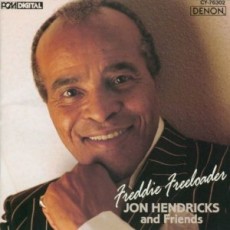
Jon Hendricks was born John Carl Hendricks on September 16, 1921 in Newark, Ohio and along with his 14 siblings moved around a lot until his A.M.E. pastor father settled in Toledo. As a teenager, Jon’s first interest was in the drums, but before long he was singing on the radio regularly with another Toledo native, pianist Art Tatum. Out of high school Jon served in the Army during WWII and after his discharge entered pre-law at the University of Toledo but stop at the graduate level because his G.I. benefits ran out. Charting a new course on the advice and encouragement given him by Charlie Parker, he moved to New York and began his singing career.
In 1957, he teamed with Dave Lambert and Annie Ross to form the legendary vocal trio Lambert, Hendricks & Ross. With Jon as lyricist, the trio perfected the art of vocalese and took it around the world, earning them the designation of the “Number One Vocal Group in the World” for five years in a row from Melody Maker magazine. After six years the trio disbanded for solo careers but not before leaving behind a catalog of legendary recordings, most of which have never gone out of print.
Pursuing a solo career, Hendricks moved his young family to London, England in 1968, toured Europe and Africa, performed frequently on British television, and appeared in British and French films and his sold-out club dates drew fans such as the Rolling Stones and the Beatles. Five years later the Hendricks settled in California, worked as the jazz critic for the San Francisco Chronicle, and taught classes at California State University, Sonoma and the University of California, Berkeley.
Over the course of his career Hendricks wrote a stage piece about the history of jazz, “Evolution of the Blues” that ran an unprecedented five years at the Off-Broadway Theatre in San Francisco and another year in Los Angeles; and his television documentary, “Somewhere to Lay My Weary Head” received an Emmy, Iris and Peabody awards; has recorded several critically-acclaimed albums on his own, collaborated with his wife and daughters, with the Manhattan Transfer on 7 Grammy winning “Vocalese”, has served on the Kennedy Center Honors committee under Presidents Carter, Reagan, and Clinton; has been appointed distinguished Professor of Jazz Studies at the University of Toledo; selected as the first American jazz artist to lecture at the Sorbonne in Paris.
Jon has toured worldwide with the “Four Brothers” comprised of Kurt Elling, Mark Murphy and Kevin Mahogany as well as working with his 15 member vocal group Vocalstra. Countless of singers and critics cite him as the one of the originators of vocalese and he has influenced just as many from Van Morrison and Al Jarreau to Bobby McFerrin and Georgie Fame. Time Magazine dubbed him the “James Joyce of Jive” while Leonard Feather called him the “Poet Laureate of Jazz”.
Vocalist Jon Hendricks endlessly performed, toured and recorded until he transitioned on November 22, 2017 in Manhattan, New York City, at age 96.
More Posts: vocal

From Broadway To 52nd Street
Our journey from Broadway to 52nd Street continues with Kismet that opened as a play on December 25, 1911 at the Knickerbocker Theatre and ran for 184 performances. However, it wasn’t until almost 42 years later to the day that it opened on Broadway as a musical on December 3, 1953. Two songs, Stranger In Paradise and Baubles, Bangles & Beads came from the musical composed by Robert Wright and George Forrest to become jazz standards. The musical ran for 583 performances with Ronald Coleman, Marlene Dietrich and Edward Arnold playing the musicals starring roles.
The Story: Haji, a wily beggar and poet is arrested on a minor infraction by the Wazir, who agrees to release him if he kills the Caliph. Hajj’s attempts fail and he is thrown in jail with his old enemy the sheik. He kills the sheik and escapes in his clothing. Learning his daughter is a concubine in the Wazir’s harem, Hajj drowns the Wazir and frees his daughter. The Caliph marries the daughter but by law must banish Hajj. When Hajj returns, the Caliph looks the other way and allows him to beg and recite poetry.
Broadway History: In the 1950s, Broadway musicals were a major part of American popular culture. Every season saw new stage musicals send songs to the top of the charts. Public demand, a booming economy and abundant creative talent kept Broadway hopping. To this day, the shows of the 1950s form the core of the musical theatre repertory. The best of these musicals integrated every element, offering recognizable characters singing in stories told with wit and genuine heart – in short, they applied the Rodgers & Hammerstein formula. The two songwriters were international celebrities, so the media treated each new Rodgers & Hammerstein stage show as a major event.
Oscar Hammerstein II died due to stomach cancer a few months after The Sound of Music opened, ending a career that spanned the golden age of musical theatre and film. After working with the innovative Jerome Kern Jerome and operetta master Sigmund Romberg, he did his finest work with Rodgers, and later coached young Stephen Sondheim. More than any other individual, Hammerstein had turned the once-innocuous Broadway musical into a potent dramatic form, and had turned lyrics into essential dramatic tools. He did it by being a superb storyteller and a dedicated craftsman. Even when dealing with serious issues, he always kept his focus on intriguing characters caught in remarkable situations.
Sponsored By

www.whatissuitetabu.com
Daily Dose Of Jazz…
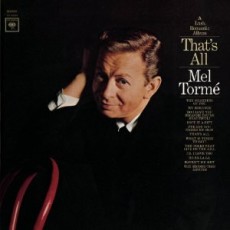
Melvin Howard Tormé was born on September 13, 1925 in Chicago, Illinois to Russian-Jewish parents whose surname was Torma but was changed to Torme as they came through Ellis Island. A child prodigy, his first professional engagement was singing “You’re Driving Me Crazy” with the Coon-Sanders Orchestra at the Blackhawk at age 4. Between 1933 and 1941, he acted in the network radio serials “The Romance of Helen Trent” and “Jack Armstrong, the All-American Boy”.
Mel wrote his first song at 13, and three years later, his first published song, “Lament to Love,” became a hit recording for Harry James. He played drums in Chicago’s Shakespeare Elementary School drum and bugle corps in his early teens. While a teenager, he sang, arranged, and played drums in a band led by Chico Marx of the Marx Brothers. His formal education ended in 1944 with his graduation from Chicago’s Hyde Park High School.
In 1943, Tormé made his movie debut in Sinatra’s first film, the musical “Higher and Higher” and an appearance in the 1947 film musical “Good News” made him a teen idol for a few years. He went on to sing and act in many films and television episodes throughout his career, even hosting his own television show in 1951–52.
In 1944 he formed one of the first jazz-influenced vocal groups, a quintet called “Mel Tormé and His Mel-Tones.” They had several hits on his own and fronting Artie Shaw’s band and blazed a path that was later followed by the Hi-Lo’s, The Four Freshman and The Manhattan Transfer. A solo act by 1947, Mel hit New York’s Copacabana and a local disc jockey in the audience, Fred Robbins, gave him the nickname “The Velvet Fog” for his smooth vocals and high tenor, a name detested by Tormé.
Mel went on to have a long and prosperous career recording for Decca, Musicraft, Capitol and Bethlehem; worked with Marty Paich in the fifties; “Blue Moon” became his signature tune; helped pioneer cool jazz; in the 60s wrote songs and musical arrangements for Judy Garland; co-wrote “The Christmas Song” with Bob Wells; and weathered the drought of vocal jazz until fertile ground reappeared in the 70s, a period that for him, lasted nearly to the end of his life.
Mel Tormé, vocalist, drummer, actor, author, composer and arranger passed away after suffering a stroke on June 5, 1999.
Daily Dose Of Jazz…
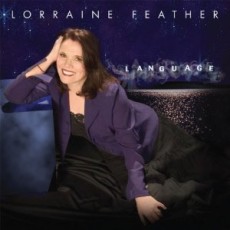
Lorraine Feather was born Billie Lorraine Feather in Manhattan on September 10, 1948 to jazz writer Leonard and Jane, a big band singer. Named after her godmother Billie Holiday, she began using her middle name in grade school.
Lorraine began working in television as a lyricist in 1992 and has received seven Emmy nominations. Her lyrics for children include work for ABC, PBS, Disney and MGM films; with composer Mark Watters wrote for Jessye Norman’s 1996 Olympic performance, and with Larry Grossman composed for Julie Andrews.
Feather’s work has been heard on numerous records covered extensively by artists such as Phyllis Hyman, Kenny Rankin, Patti Austin, Diane Schuur and Cleo Laine. Many of her own solo projects have featured contemporary lyrics to formerly instrumental pieces written by Duke Ellington, Fats Waller and other pre-bop composers. Feather’s recordings have received glowing reviews in every major jazz magazine including Down Beat and Jazz Times.
Loraine has gone on to lyric theatrical work, musical and the American Opera Projects presented excerpts of her work. Her latest release, titled “Attachments” has her penning twelve new sets of lyrics with musicians such as Dave Grusin, Joey Calderazzo, Russell Ferrante, Shelly Berg and Eddie Arkin composing the music. She continues to write, record and perform.
From Broadway To 52nd Street
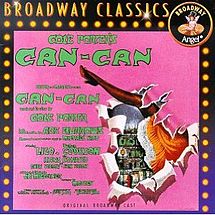
Can-Can was first seen on the stage of the Shubert Theatre on May 7, 1953 and the audience heard music composed by Cole Porter. The show ran for 892 performances. The original Broadway production ran for over two years starring Gwen Verdon in only her second Broadway role. Both she and and choreographer Michael Kidd won Tony Awards and were praised, the score and book received tepid reviews. However, three songs that rose to become jazz standards were I Love Paris, Just One Of Those Things and It’s All Right With Me.
The Story: In 1893 Paris, the dance hall Bal du Paradis in Montmartre owned by La Môme Pistache, is being threatened with closing by a self-righteous judge, Aristide Forestier. Offended by the scandalous but popular dance that the attractive dancers perform, the “Can-Can”, the judge sends the police to harass the owner and dancers, but the police like the dancers so much that they are reluctant to testify against them in court. Deciding to gather evidence, the judge takes a trip to the club. Once there, he and the owner, La Môme, fall in love but he gets the evidence to send the owner and girls to jail.
One of the dancers, Claudine, a laundry girl by day, has been pursued by art critic Hilaire, however, Claudine is in love with sculptor Boris but still arranges to have dinner with Hilaire to get a favorable review for her love. Conflicted between love and right and wrong, the judge conceded, “obscenity is in the eye of the beholder”. And gets caught in a scandalous kiss with the proprietress. Eventually, Hilaire writes a gushing review of Boris’s work. Judge Aristide loses his judgeship and is disbarred, but La Môme and the girls all go to court with him and all win their cases.
Jazz History: Live jazz was recorded, as early as 1935, but for some reason it was not considered feasible to reproduce it on 78 rpms for public consumption. This precedent was first broken in 1945 by Norman Granz, who, as one of jazz’s liveliest aficionados, originated in the early forties the notion of taking on tour for concert appearances a select group of musicians. It was an arrangement he called “Jazz at the Philharmonic”. In 1944, unbeknownst to the participating musicians, he recorded sections of a concert he was producing in Los Angeles. He then released them soon afterwards in a 12-inch 78 rpm album of three records, and there were just two tunes, “Lady Be Good” and “How High the Moon”, each of which covered three sides, or approximately fifteen minutes of playing time. His experiment proved a huge success and he released fifteen albums since then, the last an entire concert on three 12-inch LPs, amounting to about two hours of music. Other record companies followed suit, using the advantageous expanded playing time of the LP, and the record stores were stocked with live performances of all varieties and qualities, ranging from nightclub stints to private jam sessions.
Sponsored By
www.whatissuitetabu.com