

Daily Dose Of Jazz…
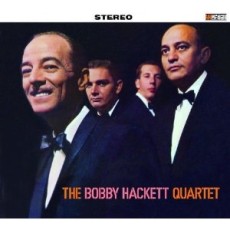
Bobby Hackett was born January 31, 1915 and raised in Providence, Rhode Island. At an early age he played the ukulele and by the time he was twelve, he was playing guitar, violin and had bought his first cornet. Leaving high school after his freshman year he took a steady job with a band that performed seven days a week at the Port Arthur and playing guitar regularly at the Rhodes and Arcadia ballrooms that often broadcasted on Providence radio and when Cab Calloway arrived short-handed and invited him to fill in.
In the fall of 1932 Bobby was recruited by The Herbie Marsh Orchestra, spent the summer of 1933 playing with Payson Re’s band, met Pee Wee Russell, by 1934, and playing college gigs with his band The Harvard Gold Coast Orchestra on weekends between Providence and Boston throughout 1935 and 36.
He worked with a new band at Nick’s in Greenwich Village, with Benny Goodman, Eddie Condon, Jack Teagarden and Teddy Wilson, played the new York World’s Fair in 1939, did the club circuit in New York, toured, recorded with his own band on MCA, took a seat with the Horace Heidt Musical Knights and recorded on the soundtrack of Fred Astaire vehicle “Second Chorus”.
After a dental surgery Bobby’s lip was in bad shape making it difficult for him to play, however, Glenn Miller offered him a job as a guitarist with the Miller Band and playing short trumpet solos. During the 1950s, he made a series of albums of ballads with a full string orchestra, produced by Jackie Gleason, in the Sixties toured with singer Tony Bennett, and by the early 1970s, Hackett performed separately with Dizzy Gillespie and Teresa Brewer. In his later years, he continued to perform in a Dixieland style even as trends in jazz changed.
Trumpeter Bobby Hackett passed away on June 7, 1976 from a heart attack. In 2012, he was selected to be inducted into the Rhode Island Music Hall of Fame.
More Posts: bandleader,cornet,guitar,trumpet
Daily Dose Of Jazz…
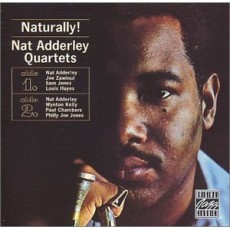
Nathaniel Adderley was born on November 25, 1931 in Tampa, Florida but grew up in Tallahassee when both his parents were hired to teach at Florida A&M University. While living in Tallahassee in the early 40s, he and his brother Julian played with Ray Charles, in the ‘50s he worked with his brother’s original group, and with Lionel Hampton and J. J. Johnson.
In 1959 joined his brother’s new quintet and stayed with it until Cannonball’s death in 1975. It was during this tenure that Nat composed “Work Song,” “Jive Samba,” and “The Old Country” for this group that have since become jazz standards.
After his brother’s death he led his own groups and recorded extensively working with Ron Carter, Sonny fortune, Johnny Griffin, Antonio Hart and Vincent Herring, among others. Adderley moved to Harlem in the 1960s, Teaneck, New Jersey in the 1970s, before moving to Lakeland, Florida where he was instrumental in the founding and development of the annual Child of the Sun Jazz Festival, held annually at Florida Southern College.
Nat Adderley, cornetists and trumpeter in the hard bop and soul jazz genres, lived with diabetes throughout his career, an illness that resulted in his death from complications on January 2, 2000. He left the jazz world a body of work that has been memorialized by a host of jazz musicians.

Daily Dose Of Jazz…
Charles “Buddy” Bolden was born on September 6, 1877 in New Orleans, Louisiana and is regarded as a key figure in the development of a New Orleans style of ragtime music that would later come to be known as jazz.
He was known as “King Bolden” and his band was a top draw in New Orleans from about 1900 until 1907, when he was incapacitated by schizophrenia. He left no known surviving recordings, but he was known for his very loud sound and constant improvisation. Instead of imitating other cornetists, Bolden played music he heard “by ear” and adapted it to his horn. In doing so, he created an exciting and novel fusion of ragtime, black sacred music, marching-band music and rural blues.
He rearranged the typical New Orleans dance band of the time to better accommodate the blues; string instruments became the rhythm section, and the front-line instruments were clarinets, trombones, and Bolden’s cornet. Bolden was known for his powerful, loud, “wide open” playing style.
While there is substantial first hand oral history about Buddy Bolden, facts about his life continue to be lost amongst colorful myth. Stories about him being a barber by trade or that he published a scandal sheet called The Cricket have been repeated in print despite being debunked decades earlier.
Bolden suffered an episode of acute alcoholic psychosis in 1907 at the age of 30. With the full diagnosis of dementia praecox, he was admitted to the Louisiana State Insane Asylum at Jackson, where he spent the rest of his life until November 4, 1931 at age 54.
More Posts: cornet
Daily Dose Of Jazz…
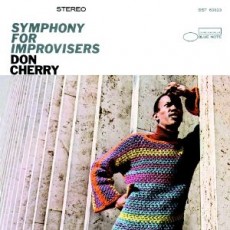
Don Cherry was born Donald Eugene Cherry on November 18, 1936 in Oklahoma City, Oklahoma. His father, trumpeter and club owner moved the family to Watts in Los Angeles, California when he was four. He would skip high school at Fremont to play with the swing band at Jefferson High, resulting in his transfer to reform school at Jacob Riis, where he first met drummer Billy Higgins.
By the early 50s Cherry was playing with jazz musicians in Los Angeles, sometimes acting as pianist in Art Farmer’s group. While trumpeter Clifford Brown was in L. A. he would informally mentor him. He became well known in 1958 when he performed and recorded with Ornette Coleman quintet. He co-led The Avant-Garde session with John Coltrane replacing Coleman, toured with Sonny Rollins, joined the New York Contemporary Five and recorded with Albert Ayler and George Russell.
Don’s first recording as a leader was Complete Communion for Blue Note in 1965 with Ed Blackwell and Gato Barbieri. He would begin leaning toward funk/fusion and play sparse jazz during his Scandinavia years. He would go on to play with Dewey Redman, Charlie Haden, Carla Bley, Lou Reed, and Sun Ra, and then ventured into developing world fusion music incorporating Middle Eastern, African and Indian into his playing.
Cherry appeared on the Red Hot Organization’s compilation CD, Stolen Moments: Red Hot + Cool, was inducted into the Oklahoma Jazz Hall of Fame, played piano, pocket trumpet, cornet, flugelhorn and bugle. He recorded some two-dozen albums as a leader and some 48 as a sideman. Don Cherry died on October 19, 1995 at age 58 from liver cancer in Málaga, Spain.
