

Daily Dose Of Jazz…
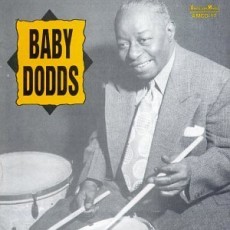
Warren “Baby” Dodds (pronounced “dots”) was born on December 24, 1898 in New Orleans, Louisiana. He was the younger brother of clarinetist Johnny Dodds and is regarded as one of the very best jazz drummers of the pre-big band era, and one of the most important early jazz drummers. Some of his early influences include Louis Cottrell, Harry Zeno, Henry Martin, and Tubby Hall.
Dodds gained reputation as a top young drummer in New Orleans, and worked on Mississippi River steamship bands with young Louis Armstrong. In 1921 moved to California to work with Joe “King” Oliver, and followed Oliver to Chicago, which would be his base of operations.
Dodds recorded with Louis Armstrong, Jelly Roll Morton, Art Hodes, his brother Johnny Dodds and by the late 1940s he worked at Jimmy Ryan’s in New York City. He also worked with Bunk Johnson when he would return to New Orleans. After suffering three strokes in 1949 and 1950, Dodds tutored and played in public irregularly, though he was unable to complete entire performances. In 1954 he played for a Natty Dominique recording session that featured bassist Israel Crosby and pianist Lil Hardin Armstrong.
Dodds was among the first drummers who improvised while performing to be recorded. He varied his drum patterns with accents and flourishes, and he generally kept the beat with the bass drum while playing buzz rolls on the snare. This play would be a long roll that lasted till the following beat, which created a smoother time feel that he later developed into the jazz ride pattern most commonly used ever since. He continues to be admired for the creativity of his playing and he believed in playing something different for every chorus of every tune. Additionally Dodds is perhaps the first jazz drummer to record unaccompanied: in 1945 he recorded two solos for Circle Records, and the next year recorded a series of solos and reminiscences for Folkways Records. Baby Dodds, jazz and Dixieland drummer passed away on February 14, 1959.
More Posts: drums
Daily Dose Of Jazz…
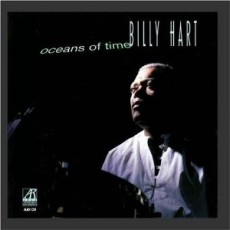
William “Billy” Hart was born November 29, 1940 in Washington, D.C. is a drummer who worked first with soul groups Sam & Dave and Otis Redding then later with locals Buck Hill and Shirley Horn. This led to work as a sideman with the Montgomery Brothers, Jimmy Smith, and Wes Montgomery prior to his death in 1968.
Hart moved to New York and started playing with Eddie Harris, Pharoah Sanders, Marian McPartland and recording with McCoy Tyner, Wayne Shorter and Zawinul. In 1969 he became a member of Herbie Hancock’s sextet followed by another stint with McCoy Tyner, then Stan Getz, Quest and Miles Davis along with extensive freelancing. In the nineties he worked with Charles Lloyd, Joe Lovano, Tom Harrell and performed with the Three Tenors – Dave Liebman, Joe Lovano and Michael Brecker.
Billy Hart is one of the most in-demand jazz drummers and educators alive and has recorded more than 500 albums as a sideman. Since the early 1990s has spent considerable time at the Oberlin Conservatory of Music, is an adjunct professor at the New England Conservatory of Music and at Western Michigan University. He conducts private lessons through The New School and New York University. He also often contributes to the Stokes Forest Music Camp and the Dworp Summer Jazz Clinic in Belgium, while leading a quartet Mark Turner, Ethan Iverson and Ben Street.
More Posts: drums
Daily Dose Of Jazz…
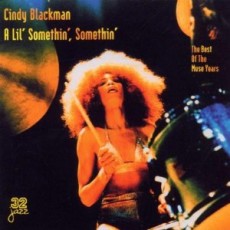
Cindy Blackman was born November 18, 1959 in Yellow Springs, Ohio into a musical family. Her mother and grandmother were classical musicians, an uncle was a vibraphonist and her dad was into jazz. Her first introduction to the drums happened when she was seven years old at a friend’s house she sat down at a drum set starting hitting and knew it was for her. Following this was joining the school band and convincing her parents to get a set of her own. By age 11 she was in Bristol, Connecticut, studying at the Hartt School of Music in Hartford and gaining an interest in jazz two years later after listening to Max Roach. It was at this time she got her first professional drum kit at fourteen.
One of her early influences was drummer Tony Williams who was the first drummer she ever saw perform live, later having the opportunity to participate in a William’s drum clinic. She soon moved to Boston, studying at the Berklee College of Music. She left after three semesters and moved to New York in 1982, became a street performer and got a chance to watch and learn from drummers like Billy Higgins, Elvin Jones, Roy Haynes, Philly Joe Jones and Art Blakey who became her mentor and major influence.
Blackman initially encountered resistance to a woman playing drums in the jazz world, both racial and gender prejudice along with her musical opinion and hairstyle. But persistence paid off in 1984 when she was showcased on Ted Curson’s “Jazz Stares of the Future”, then in 1987 her first compositions appeared on Wallace Roney’s Verses album, then Muse offered her a contract and in ’88 lead her debut session “Arcane” with Joe Henderson, Wallace Roney, Tony Williams, Clarence Seay, Kenny Garrett and Larry Willis.
Cindy has immersed herself in both jazz and rock leaving the former for a period recording and touring with Lenny Kravitz but returned to her love of jazz. She has recorded several straight-ahead jazz sessions since her 1994 release of “Telepathy” and continues to evolve the music playing with a who’s who list of luminary jazz musicians. In her own words, “To me, jazz is the highest form of music that you can play because of the creative requirements”.
More Posts: drums
Daily Dose Of Jazz…
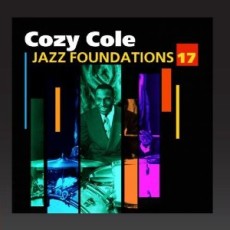
Cozy Cole was born William Randolph Cole on October 17, 1909 in East Orange, New Jersey. His first music job was with Wilbur Sweatman in 1928 and two years later he was playing with Jelly Roll Morton’s Red Hot Peppers. He had his first drum solo on the recording of “Load of Cole”. In 1931 Cozy went on to spend two years with Blanche Calloway, followed by a year with Benny Carter, then a year with Willie Bryant, two with Stuff Smith’s small combo.
For four years from1938-42 he played with Cab Calloway. In 1942, CBS Radio music director Raymond Scott hired Cozy as part of the network radio’s first mixed-race orchestra. After his stint with CBS, he played with Louis Armstrong’s All Stars.
Cole scored a #1 Cashbox magazine hit with the “Topsy Part 2” that also peaked at number three on Billboard’s Hot 100 in 1958and at number one on the R&B chart. It sold over one million copies garnering it a gold disc. The recording contained a lengthy drum solo and was one of the few drum solo recordings that ever made the Billboard Hot 100 chart.
Throughout the 1960s and 1970s Cole continued to perform in a variety of settings. Cole and Gene Krupa often played duets at the Metropole in New York City during the 1950s and 1960s. Cole appeared in music-related films, including a brief cameo in “Don’t Knock The Rock” and has been cited as an influence by many contemporary jazz and rock drummers including Cozy Powell, who took his nickname from Cole.
Cozy Cole passed away from cancer on January 31, 1981 in Columbus, Ohio.
More Posts: drums
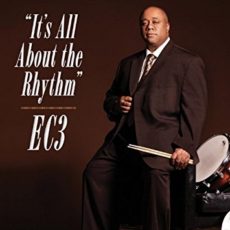
Review: EC3 | It’s All About The Rhythm
Appropriately titled, It’s All About The Rhythm, the drummer you know as EC3 takes us on a whirlwind ride across the global rhythmic landscape. He does this because it is his obsession with jazz and his attire is reminiscent of yester-year when musicians were sharp dressed men.
Choosing to hang with pop, jazz, Latin, Broadway and Motown luminaries like Pedro Flores, Kurt Weill, Stevie Wonder, Frank Foster, Burt Bacharach and Mario Bauza as well as pianists Kenny Barron, Herbie Hancock and Cedar Walton who more than adequately provide the landscape to accentuate his talents.
But it is his arrangements that move us beyond the borders of the music constructed by their greatness and prompts multiple listens. His selection of musicians and the configurations he employs exhibit his playfulness within the madness. From trio to sextet, one begins to truly appreciate not only the individual contributions each musician has brought to the birth of this project but the genius behind the trap.
Surprises in this offering are weaved in the tapestry of the music taking you on an unexpected journey into the abyss. So to say he plays well with others is an understatement and I implore you to take a moment and put some enjoyment in your travels.
carl anthony | notorious jazz | october 13, 2013
Give A Gift Of Jazz ~ Share 
#preserving genius
More Posts: bandleader,drums,history,instrumental,jazz,music,review