

From Broadway To 52nd Street
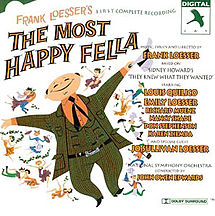
The Most Happy Fella opened at the Imperial Theatre on May 3, 1956 with Jo Sullivan, Robert Wede and Art Lund in the starring roles performing music composed by Frank Loesser. The musical ran for 676 performances and rendered unto jazz the classic tune Joey, Joey, Joey.
The Story: Rosabella comes to Napa Valley to marry the handsome young man who sent her his picture and proposed by mail. Certain that she has found someone to really love her, she soon discovers that Joe is just a hired hand and the man who proposed is Tony, an aging Italian vintner. He sent Joe’s picture fearing that one of himself would have disheartened her. The shock sends Rosabella into Joe’s arms. Eventually she realizes that Tony is an honorable, loving man. When he offers to accept not only her but the baby she is now pregnant with, she comes to love him.
Broadway History: Off-Broadway shows, performers, and creative staff are eligible for awards from the New York Drama Critics’ Circle Award, the Outer Circle Critics Award, the Drama Desk Award, the Obie Award (presented since 1956 by The Village Voice), the Lucille Lortel Award (created in 1985 by the League of Off-Broadway Theatres & Producers), and the Drama League Award. Although Off-Broadway shows are not eligible for TonyAwards, an exception was made in 1956 (before the rules were changed), when Lotte Lenya won for “Best Performance by a Featured Actress in a Musical”, for the Off-Broadway production of The Threepenny Opera.
Sponsored By

www.whatissuitetabu.com
From Broadway To 52nd Street
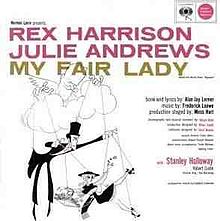
My Fair Lady opened the Mark Hellinger Theatre on March 15, 1956, running for a record 2,717 performances and making it the 7th musical to enter the roster of blockbuster musicals and to date the longest running on Broadway. The musical starred Rex Harrison, Julie Andrews and Robert Coote performing the compositions of Alan Jay Lerner & Frederick Leowe who gave the world I’ve Grown Accustomed To Her Face, Show Me, On The Street Where You Live, I Could Have Danced All Night and Wouldn’t It Be Loverly.
The Story: When Professor Henry Higgins, from perfect British class snobbishness hears the low born waif bray of flower girl Eliza Doolittle, he places a wager with his colleague Colonel Pickering that by giving her lessons in speech and class, he can pass her off to society. Unwittingly, through all their ups and downs in the learning process, the caterpillar evolves into a beautiful butterfly and Henry falls in love. Fighting his heart every step of the way and frustrating a now society lady Eliza, who has also fallen for him. Finally Henry succumbs to his heart and they find peace in their world.
Jazz History: Outside of the United States the beginnings of a distinct European style of jazz emerged in France with the Quintette du Hot Club de France, which began in 1934. Belgian guitar virtuoso Django Reinhardt popularized gypsy jazz, a mix of 1930s American swing, French dance hall “musette” and Eastern European folk with a languid, seductive feel. The main instruments are steel stringed guitar, violin and double bass. Solos pass from one player to another as the guitar and bass play the role of the rhythm section. Some music researchers hold that it was Philadelphia’s Eddie Lang and Joe Venuti who pioneered the guitar-violin partnership typical of the genre,which was brought to France after they had been heard live or on Okeh Records in the late 1920s.
Sponsored By
www.whatissuitetabu.com
Review: EC3 | It’s All About The Rhythm
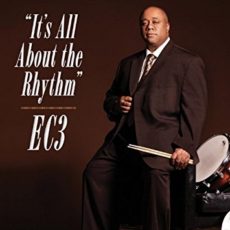
Appropriately titled, It’s All About The Rhythm, the drummer you know as EC3 takes us on a whirlwind ride across the global rhythmic landscape. He does this because it is his obsession with jazz and his attire is reminiscent of yester-year when musicians were sharp dressed men.
Choosing to hang with pop, jazz, Latin, Broadway and Motown luminaries like Pedro Flores, Kurt Weill, Stevie Wonder, Frank Foster, Burt Bacharach and Mario Bauza as well as pianists Kenny Barron, Herbie Hancock and Cedar Walton who more than adequately provide the landscape to accentuate his talents.
But it is his arrangements that move us beyond the borders of the music constructed by their greatness and prompts multiple listens. His selection of musicians and the configurations he employs exhibit his playfulness within the madness. From trio to sextet, one begins to truly appreciate not only the individual contributions each musician has brought to the birth of this project but the genius behind the trap.
Surprises in this offering are weaved in the tapestry of the music taking you on an unexpected journey into the abyss. So to say he plays well with others is an understatement and I implore you to take a moment and put some enjoyment in your travels.
carl anthony | notorious jazz | october 13, 2013
Give A Gift Of Jazz ~ Share 
#preserving genius
More Posts: bandleader,drums,history,instrumental,jazz,music,review
From Broadway To 52nd Street
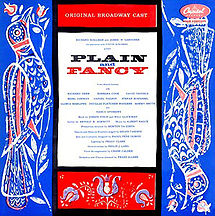
Plain And Fancy opened at the Mark Hellinger Theatre on January 27, 1955 and ran for 461 performances. Albert Hague & Arnold B. Horwitt composed the music and the show starred Richard Derr, Shirl Conway, Will Able, Gloria Marlowe, Fletcher Rodgers and Barbara Cook. Bea Arthur was an understudy and Carol Lawrence was in the chorus. A favorite jazz tunes came from this musical was Young And Foolish.
The Story: New York City sophisticates Dan King and Ruth Winters travel to Bird-In-Hand in the Amish country of Lancaster County, PA to sell a piece of property to Jacob Yoder, who in turn intends to present it to his daughter Katie and her intended Ezra as a wedding gift. While there, they become involved with local villagers, including Hilda Miller, who mistakes Dan’s kindness for romantic overtures. Ezra’s banished brother Peter returns to claim the hand of his childhood sweetheart, Katie.
Broadway History: Previously, regardless of the size of the venue, a theatre was not considered Off-Broadway if it was within the “Broadway Box” (extending from 40th to 54th Street, and from west of Sixth Avenue to east of 8th Avenue, and including Times Square and 42nd Street. The contractual definition changed this to encompass theatres meeting the standard, which is beneficial to these theatres because of the lower minimum required salary for Actors’ Equity performers at Off-Broadway theatres as compared with the salary requirements of the union for Broadway theatres. Examples of Off-Broadway theatres within the Broadway Box are the Laura Pels Theatre and the Snapple Theater Center..
A number of Off-Broadway musicals have had subsequent runs on Broadway. These have included musicals such as Hair, Godspell, A Chorus Line, Little Shop of Horrors, Rent and The 25th Annual Putnam County Spelling Bee to name a few. Other productions such as Stomp, Blue Man Group and Altar Boyz have run for several years Off Broadway. The Fantasticks, the longest running musical in theatre history, spent its original 42-year run Off Broadway.
Sponsored By
www.whatissuitetabu.com
From Broadway To 52nd Street
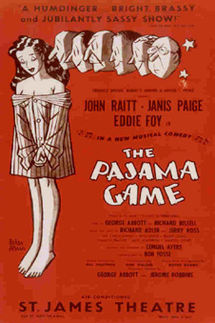
The Pajama Game drew back the first curtain at the St. James Theatre on May 13, 1954 and ran a record 1063 performances catapulting the show into the register of blockbuster musicals. Eddie Foy Jr., John Raitt, Janis Paige and Shirley MacLaine starred in the musical with music written and composed by Richard Adler & Jerry Ross. Jazz has had the privilege to give the song Hey There perpetual encores.
The Story: Adapted from the Broadway play, it’s a story of Sid, a workshop superintendent who must deal with a union demand for a 7.5-cent raise at the Sleep-Tite Pajama Factory. A strike is imminent and Babe the leader of the grievance committee leads the fight. However Sid is attracted to Babe and ensues a course of romance but is deflected. With slowdowns and machinery breakdowns promoting her cause, Sid reluctantly fires her. However he is convinced there is merit to Babe’s championship of the union and plots to get a peek at the books kept by Gladys.
Taking Gladys out to a nightclub Sid wheedles the keys from her but before he can leave the two are discovered by Babe. Sid gets a look at the books, sees that the boss has already tack on the 71/2 cents to production but has keeping the profits for himself. Sid confronts the boss, gets him to agree to the raise, goes to the union rally to bring the news and peace to his love life. Finally accepting her feelings for Sid, she falls for him. Everyone goes out to celebrate at Hernando’s Hideaway.
Jazz History: The free jazz movement, coming to prominence in the late ’50s, spawned very few standards. Free jazz’s unorthodox structures and performance techniques are not as amenable to transcription as other jazz styles. However, “Lonely Woman”, a blues by saxophonist Ornette Coleman, is perhaps the closest thing to a standard in free jazz, having been recorded by dozens of notable performers.
Free jazz is an approach to the music that was first developed in the 1950s and 1960s. Though the music produced by free jazz composers varied widely, the common feature was a dis-satisfaction with the limitations of bebop, hard bop and modal jazz, which had developed in the 1940s and 1950s. Each in their own way, free jazz musicians attempted to alter, extend, or break down the conventions of jazz, often by discarding hitherto invariable features chord changes or tempos. While usually considered experimental and avant-garde, free jazz has also oppositely been conceived as an attempt to return jazz to its “primitive”, often religious roots, and emphasis on collective improvisation.
Sponsored By
www.whatissuitetabu.com