

Hollywood On 52nd Street
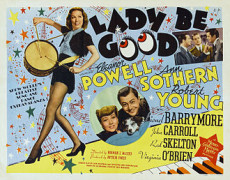
Lady Be Good was performed in the 1941 film Lady Be Good, taking its title and theme song “Oh Lady Be Good” from the 1924 George and Ira Gershwin Broadway musical, but otherwise is unrelated to the musical play. The film starred dancer Eleanor Powell, Ann Sothern, Robert Young, Lionel Barrymore and Red Skelton.
The Story: Eddie Crane, a young composer, is struggling with a tune he has just written. When his girlfriend, Dixie Donegan, provides words almost by accident, the song is published and is a great success.
A few years later, now married and successful songwriters with a hit Broadway show behind them, Dixie realizes that Eddie is spending more time in rich New York society than composing. They divorce, but quickly realize they are still in love and cannot do without each other. They remarry and write more successful songs, but then Eddie goes off to South America, ostensibly to get inspiration to write a symphony. Dixie again seeks a divorce, but the astute judge denies it. Eddie returns and they realize that despite all, they are still in love.
Sponsored By

www.whatissuitetabu.com
Hollywood On 52nd Street
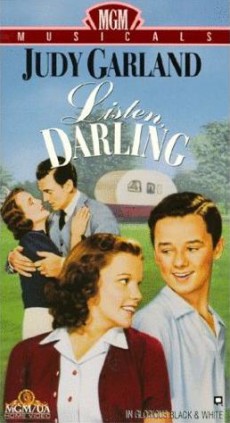
Zing Went The Strings Of My Heart is a 1934 popular song with words and music by James F. Hanley. Though Hal Le Roy and Eunice Healey introduced the song in the Broadway revue Thumbs Up! probably the most notable recordings were made by Judy Garland, who sang it in the 1938 film “Listen, Darling”.
The Story: Pinkie Wingate and her friend Herbert “Buzz” Mitchell go to great lengths to prevent her widowed mother Dottie from marrying the wrong person.
Sponsored By
www.whatissuitetabu.com
Hollywood On 52nd Street
My Blue Heaven is a popular song written by Walter Donaldson one afternoon at the Friars Club in New York City while waiting for his turn at the billiard table. At the time the song was written Donaldson was under contract to Irving Berlin, working for Irving Berlin Inc. publishing company. George A. Whiting wrote lyrics adapted for Donaldson’s music, and for a while, performed it in his vaudeville act.
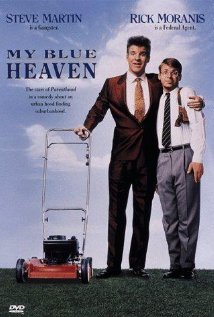
The song was first used in the 1950 film of the same title starring Betty Grable and Dan Dailey. The song was eventually used once again in the 1990 crime comedy of the same name that starred Steve Martin and Rick Moranis. By the time it appeared in the soundtrack it had been a jazz standard for many years having been recorded by Jimmie Lunceford, Don Byas, Mary Lou Williams, Benny Carter, Maxine Sullivan, Erroll Garner, Red Norvo, Oscar Peterson, Lena Horne, Teddy Wilson and numerous others.
The Story: 1950 – Kitty (Grable) and Jack (Dailey), portray married radio stars who are expecting a baby. When she miscarries, they move from radio to television and and become determined to adopt a baby. 1990 -Vincent “Vinnie” Antonelli (Martin) is a good-hearted larger than life mobster in the witness protection program. Barney Coopersmith (Moranis) is an uptight FBI agent assigned to protect Vinnie and his wife Linda and puts them in a small California suburb. Both wives leave, Vinnie and Barney get closer but has a hard time keeping him at low profile. Come to find out this town is full of mobster in witness protection. Enter two hit men, new love interests for both and eventually Vinnie becomes a prominent figure in the town.
Sponsored By
www.whatissuitetabu.com
Hollywood On 52nd Street
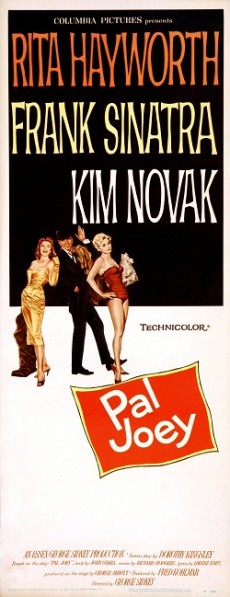
Pal Joey makes its second appearance as a 1957 drama musical film starring Rita Hayworth, Frank Sinatra and Kim Novak. The Lady Is A Tramp and My Funny Valentine (Babes In Arms/1937), There’s A Small Hotel (On Your Toes/1936), I Didn’t Know What Time It Was (Too Many Girls/1939) were introduced in their respective Broadway plays and all make their debut in the film, while I Could Write A Book and Bewitched Bothered and Bewildered make sophomore appearances. All of the above compositions composed by Richard Rodgers and Lorenz Hart became jazz standards.
The Story: The setting is San Francisco; Joey Evans (Sinatra) is a second-rate singer, a heel known for his womanizing ways, calling women “mice”, but still charming and funny. When Joey meets Linda English (Novak), a naive chorus girl, he has stirrings of real feelings. However, that does not stop him from romancing a former flame and ex-stripper, now society matron Vera Prentice-Simpson (Hayworth), a wealthy, willful, and lonely widow, in order to convince her to finance his dream, “Chez Joey”, a night club of his own.
Soon Joey is involved with Vera, each using the other for his/her own somewhat selfish purposes. But Joey’s feelings for Linda are growing. Ultimately, Vera jealously demands that Joey fire Linda. When Joey refuses, Vera closes down “Chez Joey”. Linda visits Vera and agrees to quit in an attempt to keep the club open. Vera then agrees to open the club, and even offers to marry Joey, but Joey rejects Vera. As Joey is leaving for Sacramento, Linda runs after him, offering to go wherever he is headed. After half-hearted refusals, Joey gives in and they walk away together, united.
Sponsored By
www.whatissuitetabu.com
Hollywood On 52nd Street
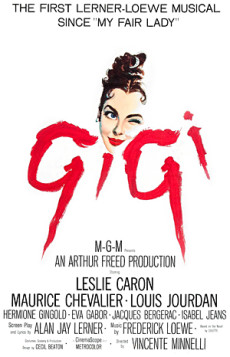
“Thank Heavens For Little Girls” is from the 1958 Academy Award-winning film Gigi. Frederick Loewe and Alan Jay Lerner composed the song and lyrics and it went on to win the Academy Award for Best original Song in 1958. A cover version by Billy Eckstine peaked at #8 in the UK Singles Chart in 1959. The film starred Leslie Caron, Maurice Chevalier and Louis Jordan.
The Story: Set in turn-of-the-20th century Paris, the film opens with Honoré Lachaille, a charming old roué among high society. Dodging marriage Honoré is concerned with his bored nephew who enjoys hanging out with his mamita, Madame Alvarez and her precocious and carefree granddaughter Gigi. However she is sent away to be groomed as a courtesan and learn etiquette and charm. The two young people spend a lot of time together with the thought of taking Gigi as a mistress. Finally Gaston finds the thought unbearable with the help of high society. Taking Gigi home, he wanders the streets until finally ending back at Madame Alvarez’s door asking for Gigi’s hand in marriage. They couple are elegant, beautiful, and happily married. Honoré has been a framing device for the film, which can be seen as a romantic victory of love over cynicism.
Sponsored By
www.whatissuitetabu.com