Daily Dose Of Jazz…

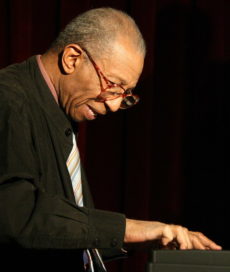
Duke Burrell was born on born July 9, 1920 in New Orleans, Louisiana and worked throughout his career in the Crescent City. He performed and recorded with Louis Jordan, Johnny Otis and on the final recordings of clarinetist Barney Bigard and the Pelican Trio along with Barry Martyn. He would reunite with Bigard for an Ellington segment recording with bassist Bobby Stone, drummer Louis Bellson and trumpeter Ray Nance.

By 1973 Duke became a bandleader and the following year formed the Louisiana Shakers that included Sammy Rimington, Sam Lee, McNeil Breaux and Teddy Edwards in the quintet lineup. He went on to lead four recording sessions between 1973 and 1976.

Pianist, composer, arranger and bandleader Duke Burrell passed away on August 5, 1993 in Los Angeles, California.

Sponsored By

SUITE TABU 200

www.whatissuitetabu.com
NJ-TWITTER

  #preserving genius

More Posts:

Daily Dose Of Jazz…

Louis Thomas Jordan was born on July 8, 1908 in Brinkley, Arkansas where his father was a music teacher and bandleader for the Brinkley Brass Band and the Rabbit Foot Minstrels. Losing his mother young, he studied music under his father, starting out on the clarinet, then piano and ultimately landed on the saxophone as his primary instrument. In his youth he played in his father’s bands instead of doing farm work when school closed. During his early career period he played the piano professionally, but alto saxophone became his main instrument. However, he would become even better known as a songwriter, entertainer and vocalist.

He briefly attended and majored in music at Arkansas Baptist College in Little Rock, but after a period with the Rabbit Foot Minstrels and with other local bands like Bob Alexander’s Harmony Kings, he went to Philadelphia and then New York. By 1932, Jordan was performing with the Clarence Williams band, and when he was in Philadelphia he played clarinet in the Charlie Gaines band.

1936 saw him joining the Savoy Ballroom orchestra, led by the drummer Chick Webb. A vital stepping-stone in his career, Louis introduced songs as he began singing lead, and often singing duets with up and comer Ella Fitzgerald. They would later reprise their partnership on several records, by which time both were major stars. In 1938, Webb fired Jordan for trying to persuade Fitzgerald and others to join his new band.

He became famous as one of the leading practitioners, innovators and popularizers of jump blues, a swinging, up-tempo, dance-oriented hybrid of jazz, blues and boogie-woogie. Jordan’s band also pioneered the use of the electronic organ.

Jordan was a talented singer with great comedic flair, and he fronted his own band for more than twenty years. He duetted with some of the biggest solo singing stars of his time, including Bing Crosby, Ella Fitzgerald and Louis Armstrong. An actor and a major black film personality, he appeared in dozens of “soundies” or promotional film clips, made numerous cameos in mainstream features and short films, and starred in two musical feature films made especially for him.

With his dynamic Tympany Five bands, Jordan mapped out the main parameters of the classic R&B, urban blues and early rock-and-roll genres with a series of highly influential 78-rpm discs released by Decca Records. These recordings presaged many of the styles of black popular music of the late 1940s, 1950s and 1960s and exerted a strong influence on many leading performers in these genres.

Known as The King of the Jukebox for his crossover popularity with both black and white audiences of the swing era, Louis was a prolific songwriter who wrote or co-wrote many songs that stayed in the top of the Billboard charts and that were influential classics of 20th-century popular music.

Pioneering alto saxophonist, pianist, clarinetist, singer, actor, songwriter and bandleader Louis Jordan, one of the most successful black recording artists of the 20th century, passed away on February 4, 1975 at age 66 in Los Angeles, California.

Sponsored By
NJ APP

NJ-TWITTER

  #preserving genius

More Posts: ,,,

Daily Dose Of Jazz…

Ronnell Bright was born July 3, 1930 in Chicago, Illinois. Wanting to be a classical pianist, at age nine he won a prize and played with the Chicago Youth Piano Symphony Orchestra. He went on to study at the Juilliard School, completing his studies in the early 1950s. His first encounter with jazz was in a United States Navy band. After his discharge he went back home and worked and recorded with bassist Johnny Pate and it was in the mid 1950s that he became the pianist for singer Carmen McRae.

1955 saw Bright moving to New York City where he performed and recorded with Rolf Kühn, and with Buddy Tate on the Swingville Sessions. Two years later he joined the Dizzy Gillespie big band and formed his own trio with Richard Davis and drummer Art Morgan. From 1958 he was pianist and music director of the orchestra for Sarah Vaughan, Lena Horne and Gloria Lynne. In 1964, he became Nancy Wilson’s arranger, pianist and musical director and moved to Los Angeles, California.

Working mainly in the Hollywood studios, in 1972 Ronnell became a member of the Supersax formation for two years, taught at high school for a year and worked as a composer with lyricist Johnny Mercer. He also composed songs performed by Sarah Vaughan, Cal Tjader, Horace Silver and Blue Mitchell and was involved in recordings by Coleman Hawkins, Anita O’Day, Shirley Scott and Frank Wess.

By the beginning of the 1990s he settled in Denver, Colorado and gave himself the title of “Doctor of Divinity”  and with his wife Reverend Dianne Bright, he produced jazz programs for their own church community, the Harmony Church, where local musicians often performed as guests of the Harmony Orchestra.

Pianist, arranger and composer Ronnell Bright who recorded four albums as a leader grooved to modern jazz and swing, continued to play and produce occasionally until he passed away at 91 years old on August 12, 2021.

Sponsored By
VOICES FROM THE COMMUNITY

Voices From The Community
NJ-TWITTER

  #preserving genius

More Posts:

Daily Dose Of Jazz…

Dave Grusin was born Robert David Grusin on June 26, 1934 in Littleton, Colorado to pianist mother and violinist father who emigrated from Riga, Latvia. He went on to study music at the University of Colorado at Boulder and received his degree in 1956.

He produced his first single Subways Are for Sleeping in 1962 and his first film score for Divorce American Style five years later. He would go on to score Winning, The Friends of Eddie Coyle, The Midnight Man and Three Days of the Condor, The Graduate, The Champ, The Fabulous Baker Boys, On Golden Pond, Tootsie, Mulholland Falls and The Goonies. He has been nominated six times for Academy Awards for his scoring and in 1988, he won an Oscar for Best Original Score for The Milagro Beanfield War.

In 1978 he had started GRP Records with his business partner, Larry Rosen, and began to create some of the first commercial digital recordings. He also composed the original opening fanfare for TriStar Pictures film studio. Through the end of the century he continued to score films, television theme songs and episode music.

From 2000 through 2011, Dave concentrated on composing classical and jazz compositions, touring and recording with collaborators, including guitarist Lee Ritenour, with whom he was nominated three times and won a Grammy for the album Harlequin. won a Grammy Award in 1985.

Throughout his career he has conducted the Andy Williams Show orchestra, was musical director and arranger for the Catarina Valente TV show, lived in Amsterdam, received honorary doctorates from Berklee College of Music and the University of Colorado, College of Music. Pianist, composer, arranger and producer Dave Grusin has and continues to collaborate with James Taylor, Renée Fleming, Paul Simon, Sérgio Mendes, Quincy Jones, Al Jarreau, Patti Austin, Billy Joel, Dave Valentin and Sadao Watanabe, among others.

Sponsored By
VOICES FROM THE COMMUNITY

Voices From The Community
NJ-TWITTER

  #preserving genius

More Posts:

Daily Dose Of Jazz…

Sing Miller was born James Miller in New Orleans, Louisiana on June 17, 1914. He started out his career singing with the Harmonizing Browns Quartet and playing banjo, but in the late 1920s he switched to piano. He did solo freelance work and as an accompanist in New Orleans in the 1930s, playing with Percy Humphrey for a time.

Serving in the military during World War II, after his discharge he played with Earl Foster’s band from 1945 to 1961. During the 1960s he was a regular at Preservation Hall, working with Kid Thomas Valentine, Kid Sheik Colar, The Humphrey Brothers, Jim Robinson, and Polo Barnes. He did asolo tours of Europe in 1979 and 1981, and recorded two full-length albums under his own name, a 1972 effort for Dixie Records and one in 1978 for Smoky Mary.

Pianist Sing Miller, who was a longtime performer on the New Orleans jazz scene, passed away on May 18, 1990.

Sponsored By
NJ APP

NJ-TWITTER

  #preserving genius

More Posts:

« Older Posts       Newer Posts »