

Daily Dose Of Jazz…
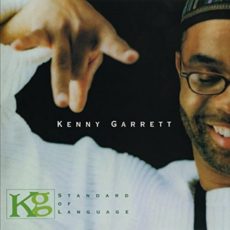
Kenny Garrett, born October 9, 1960 in Detroit, Michigan and his father played saxophone as a hobby. After graduating from Mackenzie High School in 1978 he joined the Duke Ellington Orchestra, led by Mercer Ellington. He moved on to join the Mel Lew Orchestra playing the music of Thad Jones followed by a stint with the Dannie Richmond Quartet that focused on the music of Charles Mingus.
1984 saw him recording his first album as a bandleader, Introducing Kenny Garrett, on the Criss Cross label. Moving to Atlantic Records he recorded Prisoner of Love and African Exchange Student. Since 1990 the majority of Garrett albums are co-produced by pianist/composer Donald Brown beginning with signing with Warner Bros. Records label, releasing Black Hope in 1992. Songbook, his first album made up entirely of his own compositions, recorded in 1997, was nominated for a Grammy Award.
Over the course of his ongoing career Kenny has performed and recorded with among others, Art Blakey, Joe Henderson, Brad Mehldau, Freddie Hubbard, Woody Shaw, McCoy Tyner, Pharoah Sanders, Brian Blade, Marcus Miller, Chick Corea, John McLaughlin, Herbie Hancock, Bobby Hutcherson, Ron Carter, Elvin Jones, Geri Allen, Jack Walrath, Cedar Walton, Rodney Kendrick, Charnett Moffett and Mulgrew Miller. Best known in many circles for the five years he spent playing with Miles Davis during the trumpeter’s electric period.
Garrett has won a Grammy Award, has been nominated for a Soul Train Award, a Grammy and a NAACP Image Award nominations for Seeds from the Underground, was awarded an Echo Award in the Saxophonist of the Year in 2013 and has received an Honorary Doctorate in Music from Berklee College of Music. Post-bop saxophonist and flautist Kenny Garrett who has released nineteen albums as a leader and over thirty as a sideman, continues to pursue his solo career.
More Posts: saxophone
Daily Dose Of Jazz…
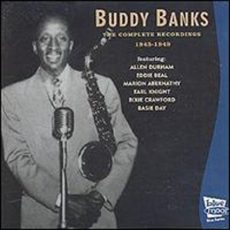
Ulysses Banks, nicknamed Buddy, was born on October 3, 1909 in Dallas, Texas and began playing saxophone in his youth. Moving to Los Angeles, California in the early Thirties he played with the Charlie Echols band from 1933 to 1937. He remained in the group after it was taken over by Claude Kennedy and subsequently by Emerson Scott due to Kennedy’s death. The group then scored a gig at the Paradise Cafe, and Cee Pee Johnson became its leader and played in Johnson’s ensemble until 1945.
Following his departure from the group Buddy led his own group that featured tenor saxophone and trombone as its most prominent instruments. Holding down the trombone chair was Allen Durham and then by Wesley Huff. Guitarist Wesley Pile and drummer Monk McFayalso recorded as members of this group. The ensemble played throughout southern California and recorded until 1949.
Banks led a new group in 1950, but disbanded it quickly and started playing piano, and though he accompanied Fluffy Hunter on tenor saxophone in 1953, he spent most of the rest of his life on piano. From 1953 to 1976 he enjoyed a piano-bass duo with Al Morgan. By 1980 he was playing solo piano.
Tenor saxophonist, pianist and bandleader Buddy Banks passed away on September 7, 1991 in Desert Hot Springs, California.
Daily Dose Of Jazz…
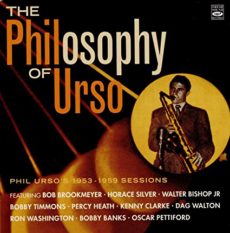
Phil Urso was born on October 2, 1925 in Jersey City, New Jersey and learned clarinet as a child, but switched to tenor sax while in high school. He served in the Navy during World War II and then moved to New York City in 1947.
Once he landed in the mecca for jazz from 1948 to 1954 he played with Elliot Lawrence, Woody Herman, Terry Gibbs, Miles Davis, Oscar Pettiford , Jimmy Dorsey, and Bob Brookmeyer.
In 1955, he first began working with Chet Baker, and was a prominent contributor to Baker’s Pacific Jazz releases in 1956. Urso and Baker would collaborate sporadically for some 30 years. He also recorded with Walter Bishop Jr., Horace Silver, Percy Heath, Kenny Clarke and Bobby Timmons among others.
He went on to work with Claude Thornhill late in the 1950s, but receded from national attention in later decades. Moving to Denver, Colorado he continued performing locally into the 1990s. Tenor saxophonist Phil Urso passed away on April 7, 2008 in Denver.
More Posts: saxophone
Daily Dose Of Jazz…
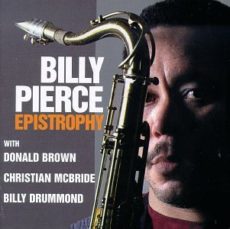
Billy Pierce was born September 25, 1948 in Hampton, Virginia and was raised in Florida by parents who were both educators. The household valued music and Pierce and his siblings each learned an instrument. He took up the saxophone as a child and started out listening to records by Dave Brubeck. Later he was drawn to the music of John Coltrane and Cannonball Adderley. Since he was only 16 when he graduated from high school, his parents steered him toward a college in the South so he wouldn’t be too far from home. After he turned 18, and studied with Joe Viola, Andy McGhee and Joe Allard at Berklee College of Music,
Also known as Billy, he went on to play with Art Blakey and the Jazz Messengers in the early 1980s and in the Tony Williams quintet in the mid-1980s to early 1990s. He has led numerous sessions and released an equal number of CDs. He is the school’s woodwind department chair.
He has recorded with Blakey and Williams as well as with Makoto Ozone and Superblue. Saxophonist Billy Pierce continues to perform, compose and record.
More Posts: saxophone
Daily Dose Of Jazz…
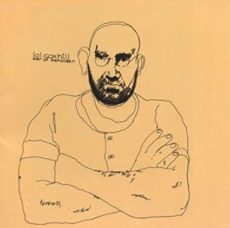
Lol Coxhill was born George Lowen Coxhill on September 19, 1932 in Portsmouth, Hampshire, UK. Growing up in Aylesbury, Buckinghamshire he bought his first saxophone in 1947 at 15. After national service he became a busy semi-professional musician, touring US airbases with Denzil Bailey’s Afro-Cubists and the Graham Fleming Combo.
The 1960s saw Lol playing with Rufus Thomas, Mose Allison, Otis Spann, and Champion Jack Dupree. He also developed his practice of playing unaccompanied solo saxophone, often busking in informal performance situations. He performed mostly as a sideman or as an equal collaborator, rather than a conventional leader with a trio or quartet. Instead he had many intermittent but long-lasting collaborations with like-minded musicians.
In the late 1960s and early 1970s, he was a member of the Canterbury scene bands Carol Grimes and Delivery and then Kevin Ayers and the Whole World. He became known for his solo playing and for duets with pianist Steve Miller and guitarist G. F. Fitzgerald. Coxhill collaborated with Mike Oldfield, Morgan Fisher, Chris McGregor’s Brotherhood of Breath and its musical descendant The Dedication Orchestra, Django Bates, the Damned, Hugh Metcalfe, Derek Bailey and performance art group Welfare State among numerous others.
He often worked in small collaborative groups with semi-humorous names Typically these bands performed a mix of free improvisation interspersed with ballroom dance tunes and popular songs. There was a humor in his music though the free playing was not intended as a joke. He performed at the Bracknell Jazz Festival, and following a performance at Bracknell he recorded the melodramatic monologue Murder in the Air.
Soprano saxophonist Lol Coxhill, who also played the sopranino saxophone and was a free improviser and raconteur, passed away on July 10, 2012.

More Posts: saxophone