

Daily Dose Of Jazz…
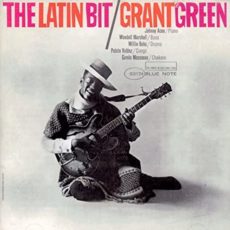
John Adriano Acea was born September 11, 1917 in Philadelphia, Pennsylvania to Adriano Acea of Cuba and Leona Acea of Virginia. One of six children, he was stricken with rheumatic fever and wasn’t expected to live during his first decade of life.
During the 1930s, Acea started out as a trumpeter and saxophonist and after his military service in the Army in 1946, he switched to playing the piano. He later became a session musician with jazz veterans Eddie Lockjaw Davis, Cootie Williams, Dizzy Gillespie, Illinois Jacquet, Dinah Washington, James Moody, Zoot Sims, and Roy Haynes. Between 1951 to 1962 he would record with Grant Green, Dodo Greene, Joe Newman, Leo Parker, Don Wilkerson, and Jesse Powell.
Acea is listed as co-composer of Nice ‘N’ Greasy that was the closing track to Lou Donaldson’s 1962 album, The Natural Soul. He is also credited as a composer on recordings by Gillespie, Jacquet, and Moody.
Pianist Adriano Acea, known as Johnny Acea, passed away on July 25, 1963.

More Posts: history,instrumental,jazz,music,piano,saxophone,trumpet
Daily Dose Of Jazz…
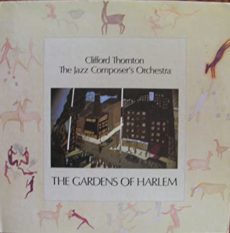
Clifford Edward Thornton III was born on September 6, 1936 in Philadelphia, Pennsylvania into a musical family, his uncle pianist Jimmy Golden and his cousin, drummer J. C. Moses. He began piano lessons when he was seven-years-old, and studied with trumpeter Donald Byrd during 1957 after Byrd had left Art Blakey’s Jazz Messengers, and also that he worked with 17-year-old tuba player Ray Draper and Webster Young. Following a late 1950s stint in the U.S. Army bands, he moved to New York City.
In the early 1960s, Clifford lived in the Williamsburg area of Brooklyn, New York in an apartment building with other young musicians, including Rashied Ali, Marion Brown, and Don Cherry. He performed with numerous avant-garde jazz bands, recording as a sideman with Sun Ra, Archie Shepp, Pharoah Sanders, and Sam Rivers.
During the Seventies, Thornton and others were affected by the compositional ideas of Cecil Taylor, was active in the Black Arts Movement, and associated with Amiri Baraka and Jayne Cortez. This musical and artistic network provided him with a variety of perspectives on ideas such as black self-determination, performance forms, outside playing, and textural rhythm; and giving him access to performers who would provide the abilities some of his later compositions required.
He was included in the dialogue around the developing thought of political artists, including Shepp, Askia M. Touré, and Nathan Hare, as well as the journals Freedomways and Umbra. As an educator, he taught world music at Wesleyan University and created an Artists-in-Residence on campus, giving the academic world-music community exposure to Sam Rivers, Jimmy Garrison, Ed Blackwell, and Marion Brown. He arranged performances by Rashied Ali, Horace Silver, McCoy Tyner, and numerous others
Trumpeter, trombonist, activist, and educator Clifford Thornton, who played free and avant~garde jazz in the 1960 and ‘70s, passed away on November 25, 1989.
More Posts: bandleader,educator,history,instrumental,jazz,music,trombone,trumpet
Conversations About Jazz & Other Distractions
Conversations About Jazz Features
The Composers on September 3
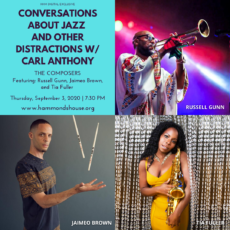
Hammonds House Digital invites you to join us for Conversations about Jazz & Other Distractions hosted by former jazz radio host and founder of Notorious Jazz, Carl Anthony. Every other Thursday, Carl takes audiences on a unique journey through the world of jazz music with artist talks, workshops, and listening sessions.
On September 3 Conversations about Jazz delves into the subject of influential jazz composers. Carl’s guests for this program will be saxophonist, composer and educator Tia Fuller; trumpeter, composer and leader of the Royal Krunk Jazz Orkestra Russell Gunn; and drummer, educator and activist Jaimeo Brown. They will discuss their own music, composers that have influenced them, leadership, making albums and more. This program is for the jazz novice and jazz head alike. The event is FREE, but you must register. To register click HERE.
Saxophonist Tia Fuller is an accomplished solo artist who has recorded five full-length projects with her quartet. Her most recent album, Diamond Cut, received a Grammy nomination in the Best Instrumental Jazz category. She is recognized as well-respected collaborator who has recorded and toured with numerous high-profile artists. She performed as part of the I AM… Sasha Fierce and Beyoncé Experience World Tour on stages across the globe; served as assistant musical director for Esperanza Spaulding’s Radio Music Society tour; and recorded and toured with Dianne Reeves for her Grammy-winning Beautiful Life album. Currently, Fuller is a faculty member at Berklee College of Music.
Trumpeter, composer and band leader Russell Gunn grew up listening to rap and hip hop. At the age of sixteen his dedication to the art of jazz took shape, although hip-hop has remained an influence on his work. Gunn has performed with numerous musicians including Wynton Marsalis, Jimmy Heath, Roy Hargrove, James Moody, and R&B hitmaker Maxwell. In 1999 Gunn released his first solo project, Ethnomusicology Vol. 1, which earned him a Grammy nomination. SmokinGunn followed a year later and, in 2001, Ethnomusicology Vol. 2. Since that time, Gunn has released two more volumes in his Ethnomusicology series. In 2007 the trumpeter paid homage to fellow St. Louis, IL, native and trumpet icon Miles Davis with Russell Gunn Plays Miles. More recently Gunn released Pyramids (2019) and Get It How You Live (2020) with his Afro-Futurist Jazz Big Band, The Royal Krunk Jazz Orkestra.
Jaimeo Brown (pronounced jah-mayo) began his drum career at age 16 with his father bassist Dartanyan Brown, mother pianist and woodwind specialist, Marcia Miget, and drum teacher, Sly Randolph. In the last 20 years, Brown has worked with musicians including Stevie Wonder, Carlos Santana, Q-Tip, Carl Craig, Bobby Hutcherson, Joe Locke, David Murray, and others. He gained experience performing and educating audiences around the world as an ambassador for the US State Department. In addition to performing, Jaimeo contributed material for the Oscar and Grammy award winning documentary ’20 Feet from Stardom’ and PBS production of Ralph Ellison’s ‘King of the Bingo Game.’ As the Director of Transcending Arts Jaimeo is a passionate educator, working in community service in NJ and NY by giving lessons to kids through programs such as NJPAC and New City Kids.
Hammonds House Museum is generously supported by the Fulton County Board of Commissioners, Fulton County Arts and Culture, the City of Atlanta Mayor’s Office of Cultural Affairs, AT&T and WarnerMedia.
Hammonds House Museum’s mission is to celebrate and share the cultural diversity and important legacy of artists of African descent. The museum is the former residence of the late Dr. Otis Thrash Hammonds, a prominent Atlanta physician and a passionate arts patron. A 501(c)3 organization which opened in 1988, Hammonds House Museum boasts a permanent collection of more than 450 works including art by Romare Bearden, Robert S. Duncanson, Benny Andrews, Elizabeth Catlett, Jacob Lawrence, Hale Woodruff, Amalia Amaki, Radcliffe Bailey and Kojo Griffin. In addition to featuring art from their collection, the museum offers new exhibitions, artist talks, workshops, concerts, poetry readings, arts education programs, and other cultural events throughout the year.
Located in a beautiful Victorian home in Atlanta’s historic West End, Hammonds House Museum is a cultural treasure and a unique venue. During the COVID-19 pandemic, they continue to observe CDC guidelines, but look forward to welcoming in-person visitors soon! For more information about upcoming virtual events, and to see how you can support their mission, visit their website: hammondshouse.org.MEDIA: For more information, contact Karen Hatchett at Hatchett PR, karen@hatchettpr.com.
More Posts: conversations,drums,history,instrumental,jazz,musicians,saxophone,trumpet
Daily Dose Of Jazz…
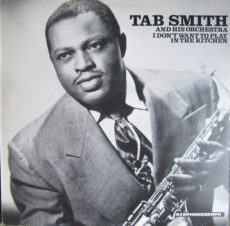
Frank Galbreath was born on September 2, 1913 in Robeson County, North Carolina. He got his start with local groups such as the Domino Five of Washington and Kelly’s Jazz Hounds of Fayetteville. He then found work with groups in other regions such as the Florida Blossoms minstrel show and the Kingston Nighthawks, a territory band. He was with Smiling Billy Steward’s Floridians when they played the 1933 World’s Fair in Chicago, Illinois.
The mid~1930s saw Galbreath moving to Chicago, and playing with Fletcher Henderson, Jelly Roll Morton, Edgar Hayes, and Willie Bryant. Around 1937 he joined Lonnie Slappey’s Swingers in Philadelphia, Pennsylvania but was called back to New York by Lucky Millinder, with whom he played for some time. Following this he joined the Louis Armstrong Orchestra until its dissolution in 1943, then he went on to play with Charlie Barnet for a few weeks before serving in the Army. After his discharge, he worked in the second half of the decade with Luis Russell, Tab Smith, Billy Eckstine, and Sy Oliver, then returned to play with Millinder from 1948 to 1952.
From 1952 he played in USO tours, first with Snub Mosley and then with various other ensembles over the course of the next decade. Frank led his own band during the decade, then played in the bands of Arthur Prysock and Benny Goodman. During the Sixties, he played with Ray Charles, Fats Domino, and Sammy Davis, Jr.
In 1963 he moved to Atlantic City, New Jersey and played locally until his failing health forced his retirement in 1969. Trumpeter Frank Galbreath passed away in November 1971.
More Posts: history,instrumental,jazz,music,trumpet
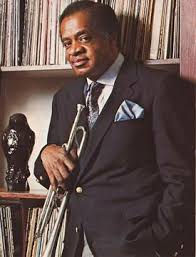
Three Wishes
The Baroness asked Donald Byrd what his three wishes would be and he replied:
-
-
“Health.”
-
“Education.”
- “Long life.”
-
*Excerpt from Three Wishes: An Intimate Look at Jazz Greats ~ Compiled and Photographed by Pannonica de Koenigswarter

More Posts: baroness,history,instrumental,jazz,music,pannonica,three,trumpet,wishes