

Requisites
Big Blues ~ Art Farmer & Jim Hall | By Eddie Carter
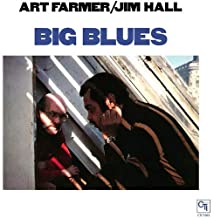
This next choice from the library I acquired after hearing a selection on SiriusXM’s Real Jazz channel. The album is titled Big Blues (CTI Records CTI 7083), released in 1979 and the two men co-leading this enjoyable date are Art Farmer on flugelhorn and Jim Hall on guitar. Rounding out the ensemble are Mike Mainieri on vibes, Mike Moore on bass, and Steve Gadd on drums. My copy used in this report is the 2017 ORG Music Stereo Audiophile reissue (ORGM-2019).
The song that initially sparked my interest leads off the first side, Benny Golson’s 1956 contemporary jazz classic, Whisper Not! It’s one of his most recorded compositions and also became a beloved vocal after Leonard Feather added lyrics in 1962. The quintet jointly creates a mellow melody with a blues beat to begin the song. Jim makes his guitar sing first with a relaxed casualness and steady rhythm. Art gets into an infectious laid-back groove next moving upward with bright chops and impeccable prowess. Mike takes over for the finale with an astonishing drive and intensity preceding the reprise and gentle coda.
The 1969 jazz standard, A Child Is Born by Thad Jones closes the first side starting gently with a brief introduction and tender theme by the rhythm section. Farmer starts the soloing with a ravishingly beautiful, muted performance, followed by Hall who delivers passionately elegant lines on the next interpretation. Mainieri gives a delicately gentle and evocative presentation recalling the spirit and imagination of the song’s composer into the serenely beautiful climax. Big Blues by Jim Hall starts the second side with a spirited midtempo opening chorus by the ensemble and the solo order is the same as on Whisper Not. Jim takes the lead here, showing us his versatility with charming articulation. Art follows, using the mute to deliver skillful assertion on the next reading. Mike’s closing statement is captivating from the moment it starts, expressing joy into the reprise and fadeout. Pavane For A Dead Princess by Maurice Ravel ends the album and was written as a solo piano piece in 1899. The song’s original title is Pavane pour une infante défunte (Pavane for a Dead Infanta) and the ensemble begins the introduction and melody at a slow tempo fitting the original composition. Farmer steps up first, back on the open horn, beginning as he did on the theme, then raises the temperature to midtempo before returning to a softer mood for the close. Mainieri pulls out all the stops on the next reading with a sparkling presentation. Hall takes the final bow with a gorgeous performance preceding the reprise and graceful fadeout.
Big Blues was originally produced by Creed Taylor and engineered by David Palmer who worked at Electric Lady Studios, and Joel Cohn who’s worked on many CTI albums. This reissue was mastered from the original analog tapes by Bernie Grundman and pressed on 180-gram Audiophile vinyl at Pallas Group in Germany. As was the case of many of the classic CTI Records, the sound quality is first-rate with an excellent soundstage across the highs, midrange, and low end that won’t disappoint the listener in their favorite spot to listen to music. Art Farmer and Jim Hall recorded together four other times, Interaction (1963), Live at The Half Note, To Sweden With Love (1964), and Panorama-Live at The Village Vanguard (1997). Each is highly recommended, and I feel the same can be said for Big Blues. I invite you to make time for this one on your next vinyl hunt, it’s an enjoyable album of Contemporary Jazz with extraordinary chemistry, and exceptional performances you won’t soon forget!
~ Interaction (Atlantic 1412/SD 1412); Live at The Half Note (Atlantic 1421/SD1421); Panorama-Live at The Village Vanguard (Telarc Jazz CD-83408); To Sweden With Love (Atlantic 1430/SD 1430) – Source: Discogs.com
~ Whisper Not, A Child Is Born ~ Source: JazzStandards.com
~ Pavane For A Dead Princess ~ Source: Wikipedia.org
© 2020 by Edward Thomas Carter

More Posts: choice,classic,collectible,collector,guitar,history,instrumental,jazz,music,trumpet

Daily Dose Of Jazz…Trumpet
Jon Eardley was born on September 30, 1928 in Altoona, Pennsylvania and first started on trumpet at the age of 11. His father played in the Paul Whiteman Orchestra. From the age of eighteen, he played1946 to 1949 he played in the Air Force Band in Washington, D.C., then led with his own quartet in D.C. from 1950 to 1953.
A move to New York City in 1953 got him introduced to the jazz scene. The following year he played with Phil Woods, then left for Gerry Mulligan for three years, and during that time played with Hal McIntyre. Returning to his hometown, Jon played there until 1963, when he moved to Europe and settled for a time in Belgium.
1969 saw his next residency in Cologne, Germany where he played with Harald Banter and Chet Baker and working through the 1980s. The last years before death he played in the WDR Big Band Cologne, Germany. Trumpeter Jon Eardley passed away on April 1, 1991 in Lambermont, near Verviers, Belgium.

More Posts: bandleader,history,instrumental,jazz,music,trumpet
Daily Dose Of Jazz…
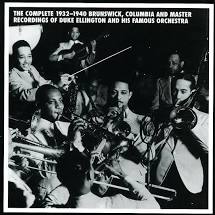
Charlie Allen was born on September 25, 1908 in Jackson, Mississippi and grew up in Chicago, Illinois and in the early 1920s just out of high school began playing. In 1925 he was a member of the band led by Hugh Swift, then went on to play with Dave Peyton and Doc Cook in 1927, and Clifford King in 1928 and Johnny Long by the end of the decade.
Allen joined Earl Hines from 1931 to 1934, then did a short stint in Duke Ellington’s orchestra in 1935, though he never recorded any solos with the orchestra. He would play with Fletcher Butler in 1936 and then returned to play with Hines again in 1937.
Charlie played in various groups in Chicago in the 1940s and 1950s and later in his life became a music educator, working in the Chicago Musicians’ Union. He also designed custom trumpet mouthpieces, used by Cat Anderson, among others. Trumpeter Charlie Allen passed away on November 19, 1972 in Chicago, Illinois.
More Posts: history,instrumental,jazz,music,trumpet
Daily Dose Of Jazz…
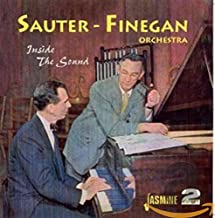
Bobby Nichols was born on September 15, 1924 in Boston, Massachusetts. He began playing trumpet when he was nine and later attended the New England Conservatory. His biggest job before joining the military was as a trumpeter with Vaughn Monroe’s Orchestra from 1940 to 1943, impressive for a 15-year old. Joining the Army in 1943 he became a member of the Glenn Miller Army Air Force Band and during its two years of existence, his advanced swing solos gave the huge group much of its jazz credibility.
After his discharge, staying busy for the next 15 years, Bobby never became known to the general public. He worked with Tex Beneke between 1946-47, led his own group, and worked with Ray McKinley in 1948. After playing with Tommy Dorsey in 1951, he became a longtime member of the Sauter-Finegan Orchestra from 1952-61 and a studio musician. When the Sauter-Finegan big band eventually broke up, having never led his own record date, he slipped completely into obscurity.
Trumpeter Bobby Nichols, who at nineteen exhibited fire in his playing but never made it big despite his many solos, at 95 years old is sought by collectors of the Glenn Miller Army Air Force Band recordings, died in 1975 in Aruba.
More Posts: history,instrumental,jazz,music,trumpet
Daily Dose Of Jazz…
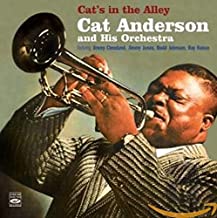
Cat Anderson was born William Alonzo Anderson on September 12, 1916 in Greenville, South Carolina. Losing both parents when he was four years old, he was sent to live at the Jenkins Orphanage in Charleston, South Carolina where he learned to play the trumpet. It was his classmates that gave him the nickname “Cat” based on his fighting style.
He toured and made his first recording with the Carolina Cotton Pickers, a small group based at the orphanage. After leaving the Cotton Pickers, Anderson played with guitarist Hartley Toots, the Claude Hopkins Big Band, Lucky Millinder, the Erskine Hawkins Orchestra, the Sabby Lewis Orchestra, the Lionel Hampton Orchestra, with whom he recorded the classic Flying Home No. 2, and the Doc Wheeler Sunset Orchestra with whom he also recorded from 1938–1942.
His career took off in 1944 when he joined Duke Ellington’s orchestra at the Earle Theater in Philadelphia, Pennsylvania. He quickly became a central part of Ellington’s sound. Although Anderson was a very versatile musician, capable of playing in a number of jazz styles, he is most renowned for his abilities in the extreme high or “altissimo” range. He had a big sound in all registers but could play up to a “triple C” with great power, able to perform his high-note solos without a microphone.
A master of half valve and plunger mute playing, Cat was capable of filling in for anyone else who was not there. He led and fronted his own big band and in addition, he was a very skilled arranger and composer. He performed his own compositions El Gato and Bluejean Beguine with Ellington, and others of his compositions and arrangements with his own band, for example on his 1959 Mercury recording, Cat on a Hot Tin Horn.
After 1971, he settled in the Los Angeles, California area, where he continued to play studio sessions, perform with local small and big bands, and to tour Europe. He recorded seven albums as a leader, and as a sideman recorded sixty-four with Johnny Hodges, Quincy Jones, Rosemary Clooney, Frances Faye, Mel Torme, Earl Hines, Bell Berry, Benny Carter, Claude Bolling, Gene Ammons, Louis Bellson, Duke Ellington, Ella Fitzgerald, and Lionel Hampton. Trumpeter Cat Anderson passed away from cancer on April 29, 1981.
More Posts: arranger,bandleader,composer,history,instrumental,jazz,music,trumpet