

Daily Dose Of Jazz…
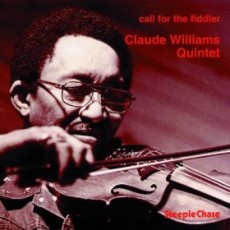
Claude “Fiddler” Williams, born on February 22, 1908 in Muskogee, Oklahoma, by the age of 10 had learned to play guitar, mandolin, banjo and cello and was inspired to learn the violin after hearing Joe Venuti play. He played around Oklahoma with bassist Oscar Pettiford and by 1927 had his first professional gig with Terence Holder’s territory band that soon became known as the Clouds of Joy led by Andy Kirk after Holder’s ouster.
Claude enjoyed a great deal of success due to the performing and composing talents of Mary Lou Williams. Their short-lived relationship ended due to health issues but during the thirties he worked with Alphonse Trent, George E. Lee, Chick Stevens, Nat King Cole and his brother Eddie.
In 1936 Claude became the first guitarist to record with Count Basie and throughout the 30’s and 40’s worked Chicago, Cleveland and Flint with the Four Shades of Rhythm. Throughout the 50’s he worked with Jay McShann, Eddie “Cleanhead” Vinson and Hank Jones.
Settling in Kansas City in 1953 he spent most of the next 20 years leading his own groups. By the 70’s a gig with McShann led to his first recordings in three decades and his second career was born. Over the next two decades he toured with McShann, worked as a feature soloist at jazz festivals, Parisian musical Black & Blue, a New York date with Roland Hanna and Grady Tate, played Carnegie Hall and Lincoln Center, and President Bill Clinton’s first inauguration. In 1997 Williams was the first inductee of the Oklahoma Jazz Hall Of Fame.
Claude “Fiddler” Williams, the venerable elder statesman of jazz, who outlasted virtually all his contemporaries and achieved his greatest successes at an advanced age and was the last surviving jazz musician to be recorded before 1930, passed away at the age of 96 of pneumonia in Kansas City on April 26, 2004.
More Posts: violin
Daily Dose Of Jazz…
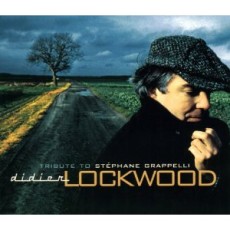
Didier Lockwood was born on February 11, 1956 in Calais, France and began studying classical violin and composition at the Calais Conservatory at six years old. But thanks to his brother Francis, Didier’s world was opened to other forms of music and he quit his studies in 1972. Entranced by the improvisation of Jean-Luc Ponty’s playing he took up the amplified violin. He credits being influenced by Polish violinist Zbigniew Siefert and fellow Frenchman Stephane Grappelli with whom he toured. By 1975 he joined progressive rock group Magma followed by fusion group Uzeb.
During the 70’s he played in Paris with Aldo Romano and Daniel Humair among others, led a fusion group called Surya and recorded with Tony Williams. The 80’s saw Didier performing at the Montreux Jazz Festival teamed with guitarist Allan Holdsworth, bassist/vocalist Jack Bruce, drummer Billy Cobham and keyboardist David Sancious, playing in the U.S. and recording with violin colleagues John Blake and Michal Urbaniak.
Lockwood’s career has been diverse ranging from fusion to swing to advanced hard bop but he first gained fame for exploring new musical landscapes and performing various sound imitations such as seagulls and trains. Although slated as the heir apparent to the line of great French violinists behind Grappelli and Ponty, by the nineties he maintained a very low profile. He established a string instrument improvisation school in 2001 called Centre des Musiques Didier Lockwood, has been touring with jazz guitarist Martin Taylor since 2006 and written several film scores.

More Posts: violin
Daily Dose Of Jazz…
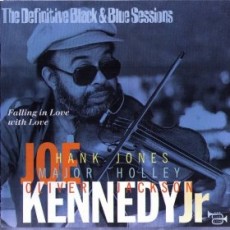
Joe Kennedy, Jr. on November 17, 1923 in Pittsburgh, Pennsylvania and was introduced to the violin by his grandfather. During his induction in the Army he performed with the Camp Lee Symphony Orchestra in Petersburg, Virginia. Returning home he cut his jazz teeth as a member of the Four Strings along with Ahmad Jamal, with Mary Lou Williams supervising their debut recording session.
Kennedy would go on to study and earn degrees at Carnegie Mellon, Virginia State College, Duquesne University. As an educator with the Richmond Public Schools he was the Instrumental Music Supervisor, Supervisor of Music and Supervisor of Secondary Arts and Humanities, Director of Jazz Studies at Virginia Tech and Virginia Commonwealth University developing “An Introduction to African American Music” at the latter.
Joe would be one of the first Blacks to become the Resident Violinist with the Richmond Symphony from 1963 – 1981, traveled abroad with the Benny Carter All-Stars and performed at numerous concerts and festivals throughout the United States, and Europe.
Kennedy performed and recorded several albums as a leader as well as with pianist Ahmad Jamal. He performed with Benny Carter, Toots Thielemans, Billy Taylor and the Modern Jazz Quartet among others. Violinist, composer, arranger and educator Joe Kennedy, Jr., recipient of the 2001 Legacy Award, passed away on April 17, 2004.

More Posts: violin