

Daily Dose Of Jazz…
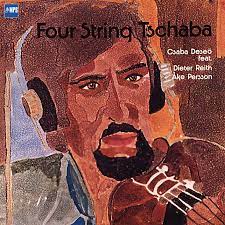
Csaba Deseo was born February 15, 1939 in Budapest, Hungary. His mother was a violin teacher and he began playing the instrument at the age of 10. He continued his musical education at Béla Bartók Conservatory in Budapest, and got his diploma in 1961. He taught in music schools until 1967 when he became a member of the Hungarian National Philharmonic Orchestra, where he played until 1999. During the time he played innumerable concerts in Hungary and in many countries of the world from Japan to the United States. He performed with artists like Sir Georg Solti, Leonard Bernstein, Ádám Fischer, and Yehudi Menuhin, to name a few.
His career took off in 1963 when he appeared with his first group at the legendary Dalia Club in his hometown. From 1964 they gave regular concerts and were frequently featured on Hungarian Radio and TV. He would play at festivals and jamborees in the Sixties, then recorded his debut album under his own name Four String Tschaba in 1975 for MPS Records in West Germany. In that session Deseo played both violin and viola, and he would go on to record 4 LPs and 6 CDs with Hungarian and foreign musicians.
1975 saw Csaba meeting Zagreb vibraphonist Bosko Petrovic, with whom he played regularly until 2011. He also appears as a guest star in Germany, where he usually solos with the group of Walter Kurowski.
Since 1980 Deseo has fronted bands with different line-ups. His more important partners were pianist Laszlo Gardony, vibraphonist Richard Kruza, guitarist Andor Kovacs, bassist Bela Lattmann and drummer Imre Koszegi. Since 1990 he’s been working mainly in a trio and is a regular guest artist at the concerts of the Benko Dixieland Band and the Budapest Ragtime Band.
During the past few decades he has also played with international stars and is a regular contributor to the specialist Hungarian music magazine, Gramofon ~ Classical and Jazz. Violinist Csaba Deseo continues to perform and record.

More Posts: bandleader,history,instrumental,jazz,music,viola,violin

CHELSEY GREEN & THE GREEN PROJECT
Described as “passionate, electrifying, and innovative,” international, Billboard-charting recording artists, Chelsey Green and The Green Project, break down stereotypes of traditional string playing. By fusing traditional classical technique with popular songs and original pieces in various genres – including R&B, Pop, Soul, Funk, Jazz and more – The Green Project brings vibrant violin, viola and rich vocals to audiences in a whole new way.
The Green Project has toured around the world and performed many prestigious venues and events including the Strathmore Music Center, the opening of the Smithsonian National Museum of African American History and Culture, BET Honors Awards Dinner, Capital Jazz SuperCruise, The John F. Kennedy Center, Port-Au-Prince International Jazz Festival, The Citadel in Cairo, Kuwait National Opera House, Bahrain Spring of Culture Festival, Boise State University and more!
Additionally, Chelsey Green and The Green Project have been honored to have feature debut performances of their original music and arrangements with several internationally acclaimed and award winning professional ensembles including the US Air Force Band, the National Symphony Orchestra, the Prince Georges Philharmonicand more!
The Green Project released their debut EP, Still Green: The EP in April 2012 to rave reviews. Their second release and first full length album, The Green Room, debuted on the Billboard Contemporary Jazz Album Chart at #22 and #7 on the iTunes Jazz Albums chart! The group has also released a holiday single, “Sleigh Ride” (2015) and a hot summer single, “Summertime” (2018) which features talented multi-instrumentalist, Warren Wolf.
Most recently, The Green Project has released “ReEnvisioned” (2020). This 4-track, genre-bending EP acts as both palate cleanser and preview to their new musical direction. Released in July 2020, this special project features new instrumental and vocal originals and a fresh interpretation of a classic jazz standard that features jazz trumpet great, Sean Jones. ReEnvisioned reached #4 on the iTunes Jazz Chart on the day of its release and continued to chart worldwide for several months. ReEnvisioned has also received acclaim in many notable written publications including The Hollywood Digest, SoulTracks.com and more!
Saturday 4/22 ~ 7:00 pm & 9:30 pm | $35~$45 + fee
Sunday 4/23 5:00 pm & 7:30 pm | $35~$45 + fee
Streaming Pass: 5:00pm & 7:00pm only | $10.00 + fee
More Posts: adventure,album,club,festival,genius,jazz,museum,music,preserving,restaurant,travel,violin
Daily Dose Of Jazz…
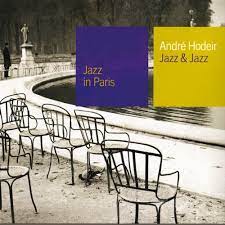
André Hodeir was born January 22, 1921 in Paris, France and trained as a classical violinist and composer. He studied at the Conservatoire de Paris, where he was taught by Olivier Messiaen and won first prizes in fugue, harmony, and music history. While pursuing these studies he discovered jazz and various music forms besides jazz and classical. He recorded on violin under the pseudonym Claude Laurence.
In 1954 he was a founder and director of Jazz Groupe de Paris, which included Bobby Jaspar, Pierre Michelot and Nat Peck. In 1957, at the invitation of Ozzie Cadena of Savoy Records, he recorded an album of his compositions with Donald Byrd, Idrees Sulieman, Frank Rehak, Hal McKusick, Eddie Costa, George Duvivier, and Annie Ross.
In addition to two books of Essais (1954 and 1956), he wrote film scores, including Le Palais Idéal by Ado Kyrou for the film Chutes de pierres, danger de mort by Michel Fano, and Brigitte Bardot’s Une Parisienne.
He founded an orchestra during the Sixties and composed a work based on the Anna Livia Plurabelle story from the novel Finnegans Wake by James Joyce. Violinist, composer, arranger and musicologist André Hodeir transitioned on November 1, 2011.

More Posts: arranger,bandleader,composer,history,instrumental,jazz,music,musicologist,violin
Daily Dose Of Jazz…
The Orphan Who Became Malta’s Jazz Star
Some jazz stories follow a straight line from struggle to success. Juice Wilson’s story? It’s a globe-spanning odyssey that most musicians couldn’t dream up if they tried.
A Child Finding His Voice Through Music
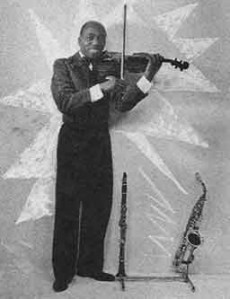
Born January 21, 1904, Wilson was orphaned young and raised by his uncle in Chicago from age three. In a city that could be brutally indifferent to a child without parents, music became his lifeline, his identity, his way forward.
He started on drums with the Chicago Militia Boys Band, then switched to violin at eight—an instrument that would eventually carry him around the world. By twelve, he was already gigging professionally with bandleader Jimmy Wade. At fourteen, he was playing alongside the legendary cornetist Freddie Keppard, one of New Orleans’ pioneering jazz voices.
This wasn’t just prodigious talent—this was a kid who had to grow up fast, and music was both his emotional escape and his economic future.
Building His Reputation, City by City
The 1920s found Wilson working Great Lakes steamboats (those floating conservatories where so many musicians learned their craft), doing residencies with trombonist Jimmy Harrison in Ohio, playing in Erie with pianist Hersal Brassfield, then moving to Buffalo to work with bandleader Eugene Primus and even the Buffalo Junior Symphony Orchestra.
He was building his chops, city by city, gig by gig, learning to navigate both the world of jazz and the world of classical music—a versatility that would serve him well in the years ahead.
New York, Then the World
In 1928, Wilson made the inevitable move to New York City, where he played the legendary Savoy Ballroom with Lloyd Scott’s orchestra—the big time, the room where reputations were made and broken nightly.
But then something remarkable happened: at decade’s end, Wilson toured Europe with Noble Sissle’s celebrated orchestra and made a decision that would define the rest of his life—he decided to stay abroad.
A European Adventure
What followed reads like an adventure novel. Wilson worked in Holland with bandleaders Ed Swayzee and Leon Abbey, performed with the Utica Jubilee Singers, joined the Louis Douglass Revue, played with Little Mike McKendrick’s International Band, and worked with Tom Chase’s ensemble. He traveled to Spain and North Africa, soaking up sounds, languages, and cultures that most American jazz musicians would never experience firsthand.
He was bringing American jazz to audiences who’d only heard it on scratchy recordings, if at all. And he was absorbing Mediterranean and North African musical traditions in return, creating his own unique fusion.
Finding Home in Malta
perhaps Malta discovered him. Wilson became a beloved figure on the sun-drenched Mediterranean island, working throughout the 1940s and 1950s as a multi-instrumentalist and entertainer. He made the island his home base while continuing to tour the region, becoming a bridge between American jazz and European audiences.
Full Circle
Wilson finally returned to the United States in the 1960s, bringing with him decades of stories, experiences, and musical adventures that few of his American contemporaries could match.
A Life Well Traveled
Think about that journey: from an orphaned child in Chicago to a beloved musician on a Mediterranean island halfway around the world, carrying American jazz to corners of the globe that rarely heard it performed live. When Juice Wilson died peacefully on May 22, 1993, he left behind a life that proves jazz was always meant to be a universal language—you just had to be brave enough to speak it anywhere, to anyone who would listen.
Some musicians stay in one city their whole lives, perfecting their craft in familiar surroundings. Juice Wilson chose the harder path—and became living proof that home isn’t where you’re born, but where your music is welcomed and celebrated.
More Posts: violin

Daily Dose Of Jazz…
Matty Malneck born Matthew Michael Malneck on December 9, 1903 in Newark, New Jersey and his career as a violinist began when he was age 16. He was a member of the Paul Whiteman orchestra from 1926 to 1937. During the same period he recorded with Mildred Bailey, Annette Hanshaw, Frank Signorelli, and Frankie Trumbauer.
He led a big band that recorded for Brunswick, Columbia, and Decca. His orchestra provided music for The Charlotte Greenwood Show on radio in the mid-1940s and Campana Serenade in 1942–1943. His group played in the film St. Louis Blues in 1939 and You’re in the Army Now in 1941. At this point in his career he changed the group’s name to Matty Malneck and His St. Louis Blues Orchestra.
Malneck’s credits as a songwriter and composed hit songs such as Eeny Meeny Miney Mo and Goody Goody, both with lyrics by Johnny Mercer, I’ll Never Be The Same, with music by Malneck & Frank Signorelli, lyrics by Gus Kahn, and I’m Thru With Love, music by Malneck & Fud Livingston, lyrics by Kahn.
Violinist, songwriter, and arranger Matty Malneck transitioned on February 25, 1981.

More Posts: arranger,bandleader,composer,history,instrumental,jazz,music,violin