

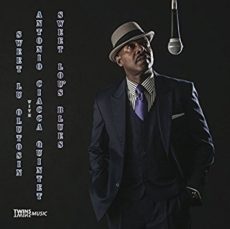
Review: Sweet Lu Olutosin | Sweet Lu’s Blues
When pursuing dreams that extend far beyond the horizon of sight, the journey demands unwavering faith. This not only applies to the visionary but to the listener as well. So on a beautiful sunny afternoon I put my ear buds in and settled down with Sweet Lu’s Blues for what I anticipated would be a wonderful adventure in sound and color. From the very first note of Malcolm’s Song I was transported to a “Gay Paris!” street scene with dancers in colorful attire moving provocatively to Sweet Lu’s words.
Then ever so gently he slips into the romance of falling in love every day with the same woman, deftly followed by the promise of the bittersweet side of love in the blues when a man falls hard. Scatting through Call Him Blackjack he easily moves us to drift into the simple pleasures life has to offer to the adventurous. Turning his attention to the Sinatra classic he slows down to interpret Nancy With The Laughing Face and closing the project with the up-tempo of The Baron, a Latin beat under Be My Mamacita and the title track that had me bopping my head and tapping my foot.
I would do grave dishonor if I failed to give praise for the fine aggregation of musicians that comprise the Antonio Ciacca Quintet. Never the understatement, these voices will become familiar compliments to your ear as they place their signature on this project. The arrangements are fun, exciting and surprising with each track and as the title tune came to a close I unabashedly shouted “Applause, Applause!” to Lutalo Olutosin for a vision that unquestionably hit the sweet spot on the mark.
carl anthony | notorious jazz | november 15, 2014
Give A Gift Of Jazz ~ Share 
#preserving genius
More Posts: bandleader,history,instrumental,jazz,music,review,vocal
Daily Dose Of Jazz…
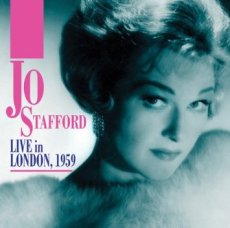
Jo Elizabeth Stafford was born on November 12, 1917 in Coalinga, California. Her mother was an accomplished banjo player who folk songs became of great influence. Her first public singing appearance came in Long Beach when she was 12. She attended Long Beach Polytechnical High School with dreams of a career in opera but with the onset of the Great Depression she joined her sisters and became The Stafford Sisters. Popularity grew and they got their start at KNX Radio when Jo was just 18 and went on to perform at KHJ Radio in Los Angeles
The sisters found work in the film industry as backup vocalists, made their first recording with Louis in 1936 and a year later she created arrangements for Fred Astaire on the soundtrack of “A Damsel In Distress”. Jo went on to join the Pied Pipers, work with Tommy Dorsey in New York, record four sides for RCA Victor and then returned to Los Angeles. After the Dorsey years the group was signed to Johnny Mercer’s new label Capitol Records and started singing on the radio shows of Frank Sinatra, Bob Crosby and Mercer.
In 1944, Stafford left the Pied Pipers going solo, picked up the nickname G.I. Jo for her continuous performance for the US troops, hosted “The Chesterfield Supper Club” and before the decade ended had a couple of million-seller tunes. By the 50s she was doing work for Voice of America, recording at Columbia Records becoming the first artist to sell 25 million records and hosted The Jo Stafford Show on TV. In the Sixties she recorded for Reprise, Warner and Dot record labels in the Sixties, won a Grammy for Best Comedy Album for her performance a part of the comedy duo Jonathan and Darlene Edwards.
Stafford went into semi-retirement in the mid-60s citing the music business as no longer fun and retiring completely in 1975. She devoted her time to charity for those with developmental disabilities. She donated her library to the University of Arizona and was inducted into the Big Band Academy of America’s Golden Bandstand in 2007.
Jo Stafford, singer of jazz standards and tradition pop music whose career spanned thirty years passed away of congestive heart failure on July 16, 2008. Her work in radio, television and music is recognized by three stars on the Hollywood Walk of Fame.

Put A Dose In Your Pocket
More Posts: vocal
Hollywood On 52nd Street
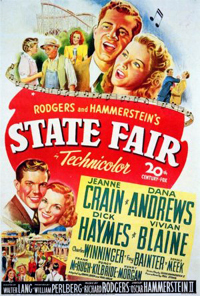
It Might As Well Be Spring has been a classic jazz favorite for many years but it didn’t start out that way. It was a song taken from the 1945 film State Fair with music by Richard Rodgers and lyrics by Oscar Hammerstein II. It won the Academy Award for Best Original Song and was part of the only original film score.
Jeanne Crain, who played Margy Frake, sang the song in the film, but was dubbed by Louanne Hogan. Dick Haymes, who portrayed the original Wayne Frake, made the first hit recording of the song, followed by Frank Sinatra, Sammy Kaye, Paul Weston, Margaret Whiting, Shirley Bassey, Ella Fitzgerald, Sarah Vaughan, Blossom Dearie, Nina Simone, Brad Mehldau and Jane Monheit.
The Story: Love, romance and competition take center stage as the Frake family sets off for the state fair. Margy is melancholy and looks forward to the break in routine. Father Abel is excited about entering his prize pig Blue By for the ribbon and bets his neighbor. Mother is entering the cooking competition with her pickles and mincemeat recipes. Brothe Wayne is left forlorn by his girlfriend’s inability to go with him.
At the fair all the romances take a different turn of occurrences and lucky beaus end up with new ladies, Blue Boy wins in all his categories thanks to his lady love Esmeralda, and it’s a happily ever after story ending.
Sponsored By

www.whatissuitetabu.com
Daily Dose Of Jazz…
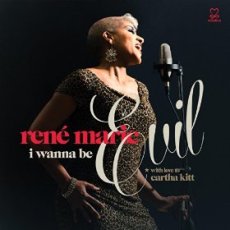
René Marie was born René Marie Stevens on November 7, 1955 in Warrenton, Virginia. With the encouragement of her children, the jazz vocalist and songwriter started her professional musical career in 1997 at the age of 42.
Performing at Washington D.C.’s Blues Alley in 1999, René signed with the MaxJazz label out of St. Louis and released four albums to critical acclaim and her sophomore project “Vertigo” received a coronet ranking by the “Penguin Guide to Jazz”, a distinction given to less than 85 other recordings in jazz history.
Her work often combines contrasting songs such as “Dixie” and the anti-lynching “Strange Fruit” on Vertigo or Ravel’s Bolero with Leonard Cohen’s Suzanne” on Live at Jazz Standard.
Attracting controversy and national attention in 2008, René substituted the lyrics of “The Star-Spangled Banner” with “Lift Every Voice and Sing” when invited to sing the national anthem at a civic event in Denver. This arrangement of the national anthem forms part of the titular suite of Marie’s 2011 CD, “The Voice of My Beautiful Country” on the Motema Music label.
René Marie specializes in writing her own music, and she comments on the fact that this is not the norm in jazz in one of her songs, “This for Joe,” after a club manager who got mad at her for singing originals. Her 8th release, Black Lace Freudian Slip, maintains the tradition.
She followed that project by steering away from tradition with a rare tribute album to Eartha Kitt, her latest titled “I Want To Be Evil”. Vocalist Rene Marie continues to record, perform and tour worldwide.
Give A Gift Of Jazz – Share
More Posts: vocal
Daily Dose Of Jazz…
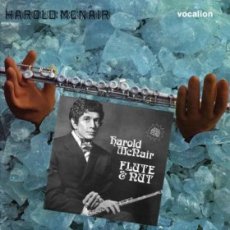
Harold McNair was born on November 5, 1931 in Kingston, Jamaica and started his instrumental training at the Alpha Boys School. Recording and playing mostly Caribbean music styles in the Bahamas, the first decade of his career he was known as “Little G”. During this time he sang and played both alto and tenor saxophones.
McNair played a calypso singer in the 1958 film Island Women and by 1960 he was in Miami recording his first album as a leader “Bahama Bash”, with a mixture of jazz and calypso numbers. It was around this time that he began playing the flute, which would eventually become his signature instrument. Though he took a few lessons in New York, he was largely self-taught.
Departing for Europe later in 1960 Harold toured with Quincy Jones, worked on film and TV scores in Paris, then settled in London gaining a formidable reputation and leading a regular gig at Ronnie Scott’s nightclub
Drawing the admiration of bassist Charles Mingus, in London to shoot the 1961 motion picture All Night Long, McNair became a member of the rehearsal quartet and appeared on the soundtrack on the now famous Mingus composition “Peggy’s Blue Skylight”.
A brief return to The Bahamas produced his first all jazz album “Up in the Air with Harold McNair”, then back to permanent London residence to release his first UK album of hard swinging standards as a leader, “Affectionate Fink” on Island Records with Ornette Coleman.
He signed with RCA and released his most famous composition “The Hipster” in 1968 that has become a playlist fixture. He continued to perform and record into 1971 working and recording with the likes of Philly Joe Jones, Eddie “Lockjaw” Davis, Blossom Dearie, Ginger Baker’s Air Force big band and John Cameron as both leader and sideman.
Harold McNair, flautist, alto and tenor saxophonist whose unique phrasing on the flute in particular also led to great demand for his services among non-jazz musicians, passed away of lung cancer in Maida Vale, North London on March 7, 1971 at age 39.
Put A Dose In Your Pocket