


Daily Dose Of Jazz…
Nina Simone was born Eunice Kathleen Waymon on February 21, 1933 in Tryon, North Carolina, the sixth of eight children. She began playing piano at age three and demonstrating a talent with the instrument, she performed at her local church but her concert debut, a classical recital, was given when she was twelve. With the financial assistance of her mother’s employer, Nina was able to take piano lessons, graduated from high school and studied at Julliard School of Music.
Her ambition to become the first black concert pianist was thwarted by the realities of poverty, racial prejudice and denial for full scholarship at the prestigious Curtis Institute of Philadelphia. So changing direction she began playing in a small club in Philadelphia to fund her continuing musical education to become a classical pianist, and was required to sing. Approached by Bethlehem Records, she recorded her debut album “Little Girl Blue” in which “I Loves You, Porgy” became a smash hit in 1958.
Her original style arose from a fusion of gospel and pop songs with classical music accompanied with her expressive jazz-like singing in characteristic low tenor injecting as much of her classical background to give it more depth and quality.
A vocal civil rights activist, Simone’s music became highly influential in the fight black people faced for equal rights at this time in America and was a source of inspiration and enjoyment for her generation, continuing to be for those that follow.
Nina Simone, singer, songwriter, pianist and arranger widely associated with jazz passed away quietly in her sleep after a long battle with breast cancer on April 21, 2003 in Carry-le-Rouet, Bouches-du-Rhone, France. She recorded over forty albums, mostly between 1958 and 1974 but left a legacy of music that has influenced generations of artists from Cat Stevens and Van Morrison to Talib Kweli and Mos Def to Christina Aguilera, Mary J. Blige and John Legend.

Daily Dose Of Jazz…
Wallace Bishop was born February 17, 1906 in Chicago, Illinois and started on drums as a teenager, studying under Jimmy Bertrand. His first professional gig was with Art Sims and his Creole Roof Orchestra in Milwaukee in 1926. Around this time he also played with Jelly Roll Morton, Bernie Young, Hughie Swift, Richard M. Jones and Tommy Dorsey.
Often addressed as “Bish”, from 1928 to 1930 he played with Erskine Tate followed with the Earl Hines Orchestra from 1931-1937. By the 1940s he was playing with Jimmie Noone, Coleman Hawkins, Don Redman, Phil Moore, Foots Thomas, John Kirby and Sy Oliver among others.
While touring Europe with Buck Clayton in 1949, Wallace elected to remain there, and found work both with noted European jazz musicians and with touring or expatriate Americans, including Bill Coleman, Don Byas, Ben Webster, Kid Ory, Milt Buckner, Buddy Tate and T-Bone Walker. Bishop recorded only two pieces as a bandleader in 1950, with a trio, but he continued to record regularly into the 1970s.
Wallace Bishop, a subtle and supportive jazz drummer who was one of the finest drummers of the swing era, passed away on May 2, 1986 in Hilversum, Holland.

Daily Dose Of Jazz…
Herbert Lee “Peanuts” Holland was born on February 9, 1910 in Norfolk, Virginia. Holland learned to play trumpet at the Jenkins Orphanage. A veteran of the Alphonse Trent territory band with whom he recorded and played with from 1928 to 1933, he also played with Al Sears, the Jeters-Pillars Orchestra, Willie Bryant Jimmie Lunceford and Lil Armstrong’s band.
In 1938 Peanuts led his own very successful band prior to moving to New York City the following year. There he joined the big bands of Coleman Hawkins and Fletcher Henderson. Through the first half of the Forties he was part of Charlie Barnet’s band and in 1946 with Don Redman toured Europe.
Holland elected to stay in Europe living in Paris and Stockholm and performing with his own small combo. He amassed a catalog of 46 recordings for European labels between 1946 and 1960 regularly working with such jazz names as Mezz Mezzrow, Don Byas, Billy Taylor and Claude Bolling.
Jazz trumpeter Peanuts Holland best known for his contributions to swing jazz, passed away on February 7, 1979 in Stockholm, Sweden, just two days shy of his 69th birthday.

Daily Dose Of Jazz…
Natalie Maria Cole was born February 6, 1950 in Los Angeles, California the daughter of Nat King Cole and former Ellington Orchestra singer Maria Cole. Exposed to a host of great singers as a child, she first sang on her father’s Christmas album at six and began performing at 11. At 15 she attended Northfield Mount Hermon School followed by University of Massachusetts – Amherst, transferred to University of Southern California, returned to U Mass and graduated with a degree in Child Psychology and a minor in German.
While in college Natalie was singing on weekends and was welcomed on the club circuit in hope of singing her father’s music. However she stayed as far from his music as managers would allow and it was her own style of soul that attracted R&B producers Chuck Jackson and Marvin Yancy. The subsequent partnership produced 1975’s “Inseparable” that garnered her a Grammy for Best R&B Vocal Performance for “This Will Be” and Best New Artist for the album. She returned to pick up Grammy awards in 1976 and 1977 along with two platinum albums and gold singles.
By 1978, she would star in her first television special on CBS to rave reviews and garnered another gold album in the classic Natalie Live set. A string of hits followed with more gold albums but by the early 80s Cole’s career paused as she entered rehab multiple times for heroin and cocaine addiction.
1985 saw her back in good health and on the comeback trail hitting the charts with songs like “Dangerous” and “Pink Cadillac” through the decade culminating with a 1990 performance of “Wild Women Do” on the soundtrack of Pretty Woman. In 1991 she returned to her vocal jazz roots producing her best selling album “Unforgettable…with Love” covering 22 of her father’s greatest hits, again winning several Grammy awards. Her release of several more jazz CDs brought her more recognition with the album “Take A Look” winning a Grammy for Best Jazz Vocal Performance and “When I Fall In Love” from her Stardust album won a 1996 Grammy.
Natalie Cole has received numerous other awards and accolades, has carved out a secondary career in acting both on television and the silver screen, appeared live in concerts or other music-related programs and continued to record and perform until her passing away of congestive heart failure on December 31, 2015.

More Posts: vocal
Daily Dose Of Jazz…
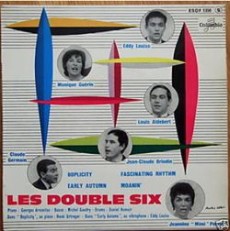
Jeannine “Mimi” Perrin was born February 2, 1926 in France and began private music instruction including piano as a child and pursued English studies at the Sorbonne. Recovering from tuberculosis, in 1949 she hit the French jazz scene in the cabarets of Saint-Germain-des-Pres and came to prominence with her trio. Towards the end of the 50s she worked as a studio background vocalist but was also a member of Blossom Dearie’s vocal group Blue Stars of France.
In 1959, she formed the vocal sextet Les Double Six, alluding to the fact that the group used overdubbing in the studio to sing twelve-part songs. The group became successful in the Sixties patterning itself to the vocalise of King Pleasure and Lambert, Hendricks & Ross. Mimi toured her group throughout Europe and North America recording with Quincy Jones, Dizzy Gillespie and Ray Charles.
Perrin was the leader and principal soloist in the group and established herself as a soloist and one of the great jazz singers with John Coltrane’s “Naima”. A later group, founded in 1966 by Perrin, did not achieve her previous success, and she abandoned music after another bout of tuberculosis.
From 1972 onwards, she worked as a translator of science fiction and fantasy and in the 1980s and 1990, she translated such novels Dean Koontz and John LeCarre as well as Alice Walker’s The Color Purple, along with the biographies of Nina Simone, Dizzy Gillespie, Quincy Jones and Steven Spielberg. Vocalist and pianist Mimi Perrin passed away on November 16, 2010 in Paris, France.