

Daily Dose Of Jazz…
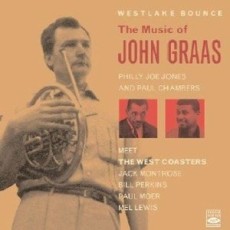
French Horn jazz musician and arranger John Graas was born March 14, 1917 in Dubuque, Iowa. Classically trained, partially at Tanglewood Music Center, he soon became interested in jazz and studied ways to bring it together with classical. His earliest effort would be called Third Stream music.
Following the path of dual music loves, between 1941 and 1953 John was a member of the Indianapolis Symphony Orchestra, The Claude Thornhill Orchestra, the Army Air Corps band during WWII, the Cleveland Orchestra, the Tex Beneke Orchestra and the Stan Kenton Orchestra.
Eventually settling in Los Angeles, Graas found work as a studio musician and played with kindred spirits on the innovative side of West Coast jazz including Shorty Rogers, Jimmy Giuffre, Gerry Mulligan, Art Pepper, Buddy Collette and Shelly Manne. All of these musicians were involved in efforts to blend jazz with elements of classical music.
John recorded a few albums under his own name, including French Horn Jazz, Coup de Graas, and Jazzmantics. His “Jazz Chaconne No. 1” was an example of his ambitious attempts to fuse jazz with classical music. It appeared on the 1958 International Premiere in Jazz with his “Jazz Symphony No. 1”, which, despite its title, was far more classical than jazz.
The 1950s held intense activity for Graas, as performer, composer, and arranger. Leading groups under his own name, he appeared in the musical aggregations of Stan Kenton, Maynard Ferguson, Billy May, Pete Rugolo, Mel Lewis, Henry Mancini and Bobby Darin among others.
John Graas was known primarily as one of the first and best French horn players in jazz. He had a short but busy career on the West Coast, until his career was cut short by his death of a heart attack, at age 45, on April 13, 1962 in Los Angeles, California.
More Posts: french horn

The Jazz Voyager
Rex Hotel: 194 Queen St. W., Toronto, Ontario, Canada / Telephone: (416) 598-2475 “Where jazz musicians come to hear jazz.”
From humble beginnings in the late ’80s, The Rex Hotel Jazz & Blues Bar has grown into a musical mecca presenting 19 shows per week. The bar has been at the forefront of Toronto’s thriving local jazz scene. The casual atmosphere, eclectic mix of retro-chic decor, and an exciting variety of draught beer combine to make The Rex feel like a second home.
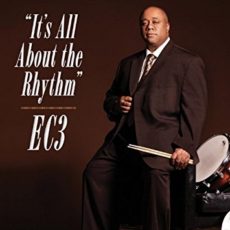
Review: EC3 | It’s All About The Rhythm
Appropriately titled, It’s All About The Rhythm, the drummer you know as EC3 takes us on a whirlwind ride across the global rhythmic landscape. He does this because it is his obsession with jazz and his attire is reminiscent of yester-year when musicians were sharp dressed men.
Choosing to hang with pop, jazz, Latin, Broadway and Motown luminaries like Pedro Flores, Kurt Weill, Stevie Wonder, Frank Foster, Burt Bacharach and Mario Bauza as well as pianists Kenny Barron, Herbie Hancock and Cedar Walton who more than adequately provide the landscape to accentuate his talents.
But it is his arrangements that move us beyond the borders of the music constructed by their greatness and prompts multiple listens. His selection of musicians and the configurations he employs exhibit his playfulness within the madness. From trio to sextet, one begins to truly appreciate not only the individual contributions each musician has brought to the birth of this project but the genius behind the trap.
Surprises in this offering are weaved in the tapestry of the music taking you on an unexpected journey into the abyss. So to say he plays well with others is an understatement and I implore you to take a moment and put some enjoyment in your travels.
carl anthony | notorious jazz | october 13, 2013
Give A Gift Of Jazz ~ Share 
#preserving genius
More Posts: bandleader,drums,history,instrumental,jazz,music,review
Daily Dose Of Jazz…
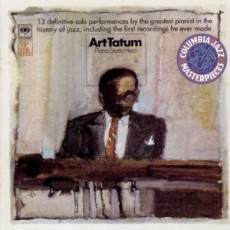
Arthur Tatum, Jr. was born in Toledo, Ohio on October 13, 1909. His father was a guitarist and his mother played piano. A prodigy with perfect pitch, Tatum learned to play by ear, picking out church hymns by the age of three, learning tunes from the radio and copying piano-roll recordings his mother owned. As a child he was also very sensitive to the piano’s intonation and insisted it be tuned often. He developed an incredibly fast playing style, without losing accuracy.
Suffering from infancy with cataracts that left him blind in one eye and only very limited vision in the other, Art had a number of surgical procedures to improve his eye condition but lost some of the benefits when he was assaulted in 1930. He enrolled in the Columbus School for the Blind and studied music, piano and learned Braille. Drawing inspiration from pianists James P. Weldon and Fats Waller, who exemplified the stride piano style, he also identified with the more modern style of Earl Hines.
By the age of 19, he was playing with singer Jon Hendricks at the Waiter’s and Bellmen’s Club. As word of Tatum spread, national performers including Duke Ellington, Louis Armstrong, Joe Turner and Fletcher Henderson when passing through Toledo would make it a point to drop in to hear the piano phenomenon. However, the major event that propelled his meteoric rise to success was his appearance at a 1933 cutting contest at Morgan’s Bar in New York City that included Waller, Johnson and Willie “The Lion” Smith. Standard contest pieces included Johnson’s “Harlem Strut” and “Carolina Shout” and Fats Waller’s “Handful of Keys.” Tatum triumphed with his arrangements of “Tea For Two” and “Tiger Rag”, in a performance that was considered to be the last word in stride piano. Tatum’s debut was historic because he outplayed the elite competition and heralded the demise of the stride era.
Tatum went on to have a prolific performing and recording career being widely acknowledged as one of the greatest jazz pianists of all time. The virtuoso, while piano was his most obvious skill, he also had an encyclopedic memory for Major League Baseball statistics. Art Tatum passed away at age 47 from kidney failure on November 5, 1956 in Los Angeles, California.
More Posts: piano
From Broadway To 52nd Street
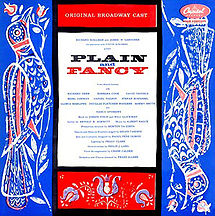
Plain And Fancy opened at the Mark Hellinger Theatre on January 27, 1955 and ran for 461 performances. Albert Hague & Arnold B. Horwitt composed the music and the show starred Richard Derr, Shirl Conway, Will Able, Gloria Marlowe, Fletcher Rodgers and Barbara Cook. Bea Arthur was an understudy and Carol Lawrence was in the chorus. A favorite jazz tunes came from this musical was Young And Foolish.
The Story: New York City sophisticates Dan King and Ruth Winters travel to Bird-In-Hand in the Amish country of Lancaster County, PA to sell a piece of property to Jacob Yoder, who in turn intends to present it to his daughter Katie and her intended Ezra as a wedding gift. While there, they become involved with local villagers, including Hilda Miller, who mistakes Dan’s kindness for romantic overtures. Ezra’s banished brother Peter returns to claim the hand of his childhood sweetheart, Katie.
Broadway History: Previously, regardless of the size of the venue, a theatre was not considered Off-Broadway if it was within the “Broadway Box” (extending from 40th to 54th Street, and from west of Sixth Avenue to east of 8th Avenue, and including Times Square and 42nd Street. The contractual definition changed this to encompass theatres meeting the standard, which is beneficial to these theatres because of the lower minimum required salary for Actors’ Equity performers at Off-Broadway theatres as compared with the salary requirements of the union for Broadway theatres. Examples of Off-Broadway theatres within the Broadway Box are the Laura Pels Theatre and the Snapple Theater Center..
A number of Off-Broadway musicals have had subsequent runs on Broadway. These have included musicals such as Hair, Godspell, A Chorus Line, Little Shop of Horrors, Rent and The 25th Annual Putnam County Spelling Bee to name a few. Other productions such as Stomp, Blue Man Group and Altar Boyz have run for several years Off Broadway. The Fantasticks, the longest running musical in theatre history, spent its original 42-year run Off Broadway.
Sponsored By

www.whatissuitetabu.com