

Daily Dose Of Jazz…
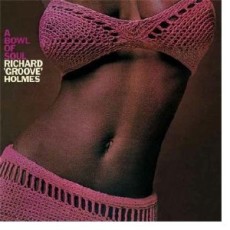
Richard Arnold “Groove” Holmes was born in Camden, New Jersey on May 2, 1931. A self-taught organist, he began his early career working along the East coast. It wasn’t until a recording session with Les McCann and Ben Webster in 1961 that widespread interest was piqued in his work.
Touring and recording throughout the 60s he achieved important recognition and acceptance amongst mainstream and post-bop jazz audiences. His landmark recording of “Misty” brought him critical acclaim and is considered by some a precursor of acid jazz.
He developed a solid relationship with Gene Ammons and their playing exemplified the soul-heavy organ-tenor playing that proliferated the decade. He played with big bands including one led by Gerald Wilson and recorded with Dakota Staton, Houston Person and Jimmy Witherspoon among others.
His sound was immediately recognizable in the upper register, but even more so because of his virtuosity in creating, undoubtedly, the most rapid, punctuating, and pulsating bass lines of all the jazz organists. He stands alongside the elite of jazz organists Jimmy Smith, Brother Jack McDuff and Jimmy McGriff for his contributions to the instrument and music.
Performing to the end of life, his last concerts in a wheelchair, organist Richard “Groove” Holmes, revered in soul-jazz circles died of a heart attack on June 29, 1991 in St. Louis, Missouri after a long struggle with prostate cancer.
More Posts: organ
Daily Dose Of Jazz…
Hayes Alvis was born on May 1, 1907 in Chicago, Illinois. He started his career playing drums but switched to tuba and bass after playing with Jelly Roll Morton in 1927-28. He played tuba and arranged for Earl Hines from 1928 to 1930.
Moving to New York City in 1931 Hayes played with Jimmie Noone in the Mills Blue Rhythm Band from 1931-34 and 1936. A very early double-bass solo can be heard on his 1932 recording “Rhythm Spasm”. He also occasionally played baritone saxophone in this ensemble as well, and was the group’s tour manager. From 1935 to 1938 Alvis played with Duke Ellington, working with fellow bassist/tubist Billy Taylor.
After his stint with Ellington, Alvis played with Benny Carter, Joe Sullivan and Louis Armstrong, replacing Pops Foster. From 1942 to 1945 he played in the Army band led by Sy Oliver. After the war, he played with Dave Martin until 1947, and then took a longstanding run as a house musician at the Cafe Society in New York City.
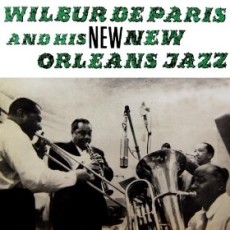
In the 1950s, he played in various swing and Dixieland revival groups, including Wilbur De Paris’s New Orleans Jazz. In the early seventies he played in a trio with Jay McShann and Tiny Grimes.
Never recording as a leader, bassist, tubist and sideman Alvis Hayes died in New York City on December 30, 1972 at the age of 65.

Daily Dose Of Jazz…
Percy Heath was born on April 30, 1923 in Wilmington, N.C. but was raised in Philadelphia. The second of four children, he was the brother of saxophonist Jimmy Heath and drummer Albert “Tootie” Heath. With music in the house, as a child Percy started playing violin at eight but it wasn’t until after serving as a Tuskegee Airman during WWII that he took up the bass. After a stint in music school he was playing in Philly clubs, ventured to Chicago in 1948 to record a Milt Jackson session with his brother. Moving to New York he worked with Joe Morris, Johnny Griffin and Dizzy Gillespie.
Working with Dizzy were pianist John Lewis, drummer Kenny Clarke, vibist Milt Jackson and bassist Ray Brown who would become the Modern Jazz Quartet. When Ray decided to leave to become a part of his wife Ella Fitzgerald’s band, Percy stepped into the position and the MJQ was officially launched in 1952, with Connie Kay replacing Clarke shortly after.
In 1975 along with brothers Jimmy and Albert and Stanley Cowell, he formed the Heath Brothers, sometimes playing cello when recording a series of albums. Over the course of his lifetime he played and recorded with such notables as Miles Davis, Charlie Parker, Wes Montgomery, Thelonious Monk and Dizzy Gillespie.
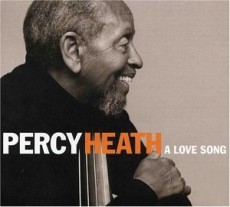
After a second bout with bone cancer Percy Heath passed away on April 28, 2005 in Southampton, New York. His final recording A Love Song garnered critical acclaim and was a fitting tribute to his long and illustrious career.

Daily Dose Of Jazz…
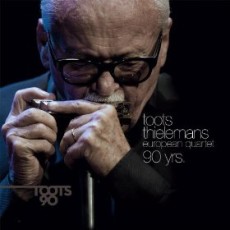
Jean-Baptiste Frédéric Isidor Baron Thielemans was born on April 29, 1922 in Brussels, Belgium. Known to the world as Toots, he began his musical training on accordion at age three. Not playing harmonica until he was seventeen, Toots original reputation was made as a guitarist greatly influenced by Django Reinhardt. By 1949 he was sharing the Paris Jazz Festival bandstand with Charlie Parker, Miles Davis, Max Roach and Sidney Bechet for a jam session. That same year he began touring Europe with Benny Goodman and making his recording debut with Zoot Sims.
Moving to the US in 1952 he joined Charlie Parker’s All-Stars and worked with Miles Davis and Dinah Washington. He played and recorded with names like Ella Fitzgerald, Peggy Lee, George Shearing, Quincy Jones, Oscar Peterson, Bill Evans, Paul Simon, Billy Joel, The Happenings, Astrud Gilberto, Shirley Horn, Elis Regina and others.
His composition “Bluesette”, recorded in 1962, where he introduced whistling and guitar in unison, has become a jazz standard. Norman Gimbel later penned the lyrics and the tune became a worldwide hit for several singers and is still highly requested.
His trademark harmonica playing and whistling has been heard in movie scores, television series and commercials. He has been a proponent of world music releasing a French flavored album Chez Toots and the two-volume Brasil Project. He has received honorary doctorates, made a baron by King Albert II of Belgium, and in 2008 became a NEA Jazz Master.
Apart from his popularity as an accomplished musician, he is well liked for his modesty and kind demeanor. The composer and musician continued to play and record until he passed away on August 22, 2016 in Braine-l’Alleud, Belgium. He is credited with single-handedly introducing the chromatic harmonica as a jazz instrument in the Fifties, playing with the dexterity of a saxophone.
More Posts: harmonica
Daily Dose Of Jazz…
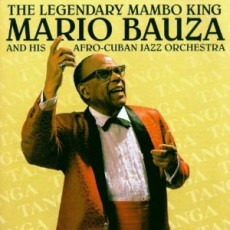
Mario Bauzá was born on April 28, 1911 in Havana, Cuba and was classically trained. By age nine he was playing clarinet in the Havana Philharmonic Orchestra and would stay there for the next three years. In 1925 he ventured to New York to record with Maestro Antonio Maria Romeu’s band “Charanga Francesca”. He was fourteen. Five years later he returned to New York and reputedly learned to play trumpet in two weeks to become a part of the Don Azpiazu Orchestra.
Bauzá became lead trumpeter and musical director for Chick Webb’s Orchestra by 1933, and it was during his time with Webb that Bauzá both met fellow trumpeter Dizzy Gillespie and discovered and brought into the band singer Ella Fitzgerald. 1938 saw Bauzá joining Cab Calloway’s band, later convincing Calloway to hire Dizzy as well, with whom Bauzá would continue to collaborate even several years after he left Calloway’s band in 1940. The fusion of Bauzá’s Cuban musical heritage and Gillespie’s advancements in bebop eventually culminated in the development of cubop, one of the first forms of what is commonly referred to as Latin jazz.
Bauzá became musical director of Machito and his Afro-Cubans in 1941, a band led by his brother-in-law, Frank Grillo, also known as Machito, and in 1942 he brought a young timbales player named Tito Puente into the fold. For the next 30 years Bauzá remained director of the band up until 1976 where he began working sparingly leading his own Afro-Cuban orchestra through the eighties and into the early 90s, where his last band made a guest appearance on The Cosby Show.
Mario Bauzá, who died in New York City on July 11, 1993, was one of the first musicians to introduce Latin music to the United States by bringing Cuban musical styles into the New York jazz scene. He was one of the most influential figures in the development of Afro-Cuban music, and his innovative work and musical contributions have many jazz historians to call him the “Founding Father of Latin Jazz”.

More Posts: bandleader,clarinet,trumpet