


Daily Dose Of Jazz…
Justin Robinson was born August 14, 1968 in Manhattan, New York City and first began playing saxophone at the age of 13, while attending the High School of Music and Arts, formerly LaGuardia High School. His influences were Charlie Parker and Jackie McLean.
From 1984 to 1986 he was a part of the McDonald’s High School Jazz Band and at the age of 18 he joined with Philip Harper and Winard Harper actively helping in their formation of the Harper Brothers. By 1988 Betty Carter brought him into her band and from the early 1990s, he has played with Cecil Brooks III, Abbey Lincoln, Diana Ross, Little Jimmy Scott, Carnegie Hall Jazz Band, the Dizzy Gillespie All Star Band, Kate Higgins, Sam Newsome and especially Roy Hargrove, both in the Big Band as well as in the quintet.
After his 1991 recording debut with Justin Time on the Verve label, to the Bobby Watson, Eddie Henderson, Kenny Barron and Gary Bartz participated release of Challenge in 1998, on which he was accompanied by his childhood friend Stephen Scott. Always a thoughtful leader who takes his time to compose and record, his third project In The Spur Of The Moment was released in 2012.
Alto saxophonist Justin Robinson is currently touring with the quintet and big band of trumpeter Roy Hargrove.

More Posts: saxophone
Daily Dose Of Jazz…
Anna Mae Winburn was born Anna Mae Darden on August 13, 1913 to a musical family in Port Royal, Tennessee and along with her three sisters migrated to Kokomo, Indiana, at a young age. Her first known publicized performance was singing with the studio band of Radio WOWO, Fort Wayne, Indiana. She worked at various clubs in Indiana, at times appearing under the pseudonym Anita Door.
From there she moved to North Omaha, Nebraska where she sang and played guitar for a variety of territory bands, or groups whose touring activities and popularity were geographically limited to several adjoining states, that were led by Red Perkins. During that time Winburn was a collaborator of Lloyd Hunter, frequently singing with Lloyd Hunter’s “Serenaders”. She also led the Cotton Club Boys out of Omaha, a group that at one point included the amazing guitarist Charlie Christian.
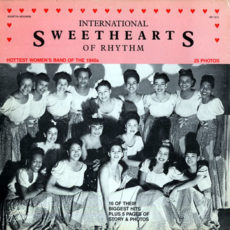
When many of the musicians were lost to the World War II draft she left for Oklahoma City and led bands for a short while. It was there that she led Eddie Durham’s “All-Girl Orchestra”, which eventually earned her an invite to join the International Sweethearts of Rhythm. Durham had been the composer for the International Sweethearts of Rhythm for two years before leaving to join Count Basie’s band.] After being recommended by Jimmie Jewel, who owned North Omaha’s Dreamland Ballroom, Anna Mae became the leader of the band in 1941. She was reportedly hired for her attractive figure, with the intention of doing little actual composing or singing but was the leader of the band until it folded in late 1949.
Vocalist and bandleader Anna Mae Winburn, who flourished beginning in the mid-1930s and led the all-female big band International Sweethearts of Rhythm, that was perhaps one of the few and one of the most racially integrated dance-bands of the swing era, passed away in Hempstead, New York on September 30, 1999.

Uplift Someone’s World

More Posts: vocal
Daily Dose Of Jazz…
Karen Briggs was born August 12, 1963 in Harlem, Manhattan, New York City to a family of musicians, father played trumpet, grandfather played saxophone and piano, and other family members were vocalists. It was when the family moved to Portsmouth, Virginia that she took up the violin at age 12, with a talent for playing by ear.
Briggs was the head of her class orchestra as a teenager and performed at a competition at Woodrow Wilson High School. Playing alongside her father and his colleagues, at their encouragement at age fifteen she committed to become a professional jazz violinist. After graduating high school in 1981, she became the first member of her family to attend college, going to Norfolk State College, and majoring in music education and mass media studies.
In 1983, while still in college Karen began performing at the Virginia Symphony Orchestra but finding classical music restricting she left after four years. Returning to New York in 1987 she sought out jazz, won several amateur night competitions at the Apollo Theater, then the following year married and moved to Los Angeles, California, where she became a frequent performer at the jazz club Marla’s Memory Lane. Briggs’ first professional tour was with the 100 piece ensemble group Soul II Soul, touring the United States and Japan in 1989. She then auditioned for Yanni, secured a place in his upcoming tour by playing over a performance of his piece Within Attraction. Linda Evans, then in a relationship with Yanni, pushed for Briggs to be a featured soloist in Yanni’s Live at the Acropolis tour. Briggs’ performances during the tour gained her broad recognition and the moniker “Lady in Red” and ultmaely toured with Yanni for thirteen years.
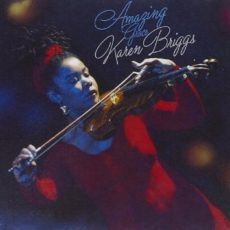
Post Yanni, Karen joined Stanley Clarke, Lenny White, Richie Kotzen, and Rachel Z forming the short-lived jazz fusion group Vertú and recording only one album. She released her debut album Karen in 1992 followed by her sophomore project Amazing Grace in ‘96 and Soulchestral Groove in 2009. She currently holds residency in the Lao Tizer Jazz Quartet and also performs with the all-women group Jazz in Pink.
Violinist Karen Briggs, also known as the Lady in Red, has recorded three albums as a leader and continues to perform, tour, record and collaborate with artists outside the jazz spectrum, such as Dave Grusin, Diana Ross, Wu Tang Clan, En Vogue and Chaka Khan.
Jazz Is Global – Share
More Posts: violin
Daily Dose Of Jazz…
Bruz Freeman was born Eldridge Freeman on August 11, 1921 in Chicago, Illinois. Also known as “Buzz” Freeman with his brothers, guitarist George Freeman and tenor saxophonist Von Freeman, he played for several years in the house band at the Pershing Hotel.
In 1950, he was a member of John Young’s trio with bassist LeRoy Jackson and recorded with Young’s orchestra backing vocalist Lurlean Hunter.
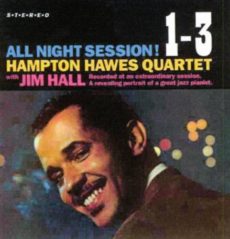
By the mid-1950s, Bruz became a member of the Hampton Hawes Quartet, with Red Mitchell and Jim Hall, and with line-ups led by Herb Geller. In 1950, with his brothers George and Von, LeRoy Jackson, and Chris Anderson, he played with Charlie Parker shortly before his death. This jam session was recorded at Bird’s apartment and was later released in 1960 by Savoy Records.
He went on to record with Clora Bryant in the late Fifties and John Carter, Bobby Bradford, Bob Thiele in the Sixties. Fro 1977-1978 he joined a short-lived band based in California led by Kenny Mann and with Britt Woodman on trombone. Drummer Bruz Freeman never recorded as a leader and passed away on November 21, 2005 at age 84 in Boulder City, Nevada.
Sponsored By

Voices From The Community
More Posts: drums
Daily Dose Of Jazz…
Nat Towles was born on August 10, 1905 in New Orleans, Louisiana the son of string bassist Phil “Charlie” Towles. Starting his musical career as a guitarist and violinist at the age of 11, he switched to the bass at the age of 13. Performing in New Orleans through his teenage years with Gus Metcalf’s Melody Jazz Band, he eventually played with a number of bands, including those of Buddie Petit, Henry “Red” Allen, Jack Carey, and the Original Tuxedo Jazz Orchestra.
In 1923 he formed The Nat Towles’ Creole Harmony Kings and this jazz band became one of the prominent territory bands in Texas, Oklahoma, Kansas, and Nebraska. By 1925 he was playing bass for Fate Marable, and the following year reformed his own band. 1934 saw him organizing a band of young musicians studying music at Wiley College in Austin, Texas.
Nat worked a club circuit in Dallas during this period, reportedly for a gangster who owned 26 nightclubs throughout the city. During this period T-Bone Walker and Buddy Tate worked for him. During the 1930s he transformed his band into The Nat Towles Dance Orchestra, signed with the National Orchestra Service, and focused on swing music through the 1930s and 1940s.
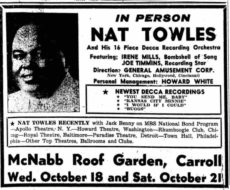
In 1934 Towles took up residence in North Omaha, Nebraska, where his band was stationed for the next 25 years. With this outfit he dueled with Lloyd Hunter for dominance over the much-contested Near North Side in North Omaha, where he was held over at the Dreamland Ballroom for several weeks. In 1936 and 1937 his band held residence at Omaha’s Krug Park.
In 1943 he also held a three-month stint at the Rhumboogie Club in Chicago, and later that year took up residency again with Billy Mitchell in tow in Omaha’s Dreamland Ballroom. He went on to play extensively throughout New York City, playing with trombonist Buster Cooper, saxophonists Red Holloway, Buster Bennett and Preston Love.
As their bandleader, Towles is credited with influencing a variety of musicians including Sir Charles Thompson and Neal Hefti, as well as superior saxophonists Jimmy Heath, Oliver Nelson and Paul Quinichette. As an educator he influenced many younger musicians such as pianist Duke Groner and trombonist Buddy McLewis, aka Joe McLewis.
Continuing to lead bands throughout the 1950s, in 1959 he retired to California and opened a bar. Bassist, guitarist and violinist Nat Towles, who feared the limelight would steal away his best players thus never sought national recognition and leaving no known recordings, passed away in January of 1963 in Berkeley, California of a heart attack.
Give A Gift Of Jazz – Share
More Posts: guitar,string bass,violin