

Daily Dose Of Jazz…
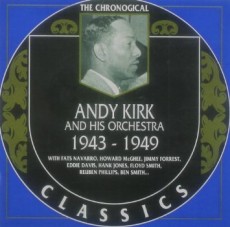
Andrew Dewey Kirk was born on May 28, 1898 in Newport, Kentucky but grew up in Denver, Colorado and was tutored by Paul Whiteman’s father, Wilberforce. He started his musical career playing with George Morrison’s band, but then went on to join Terence Holder’s Dark Clouds of Joy. In 1929 he was elected leader after Holder departed, renamed the band Clouds of Joy and also relocated the band from Dallas, Texas, to Kansas City, Kansas.
Also known as the Twelve Clouds of Joy for the number of musicians, they set up in the Pla-Mor Ballroom on the junction of 32nd and Main. They made their first recording for Brunswick Records that same year. Mary Lou Williams came in as a last moment pianist and so impressed the label’s Dave Kapp that she became a regular member and arranger of the band.
With the move they grew highly popular as they epitomized the Kansas City jazz sound and in mid-1936 Andy signed with Decca and made scores of popular records for the next decade. In 1938, he and band held the top spot of the Billboard chart for 12 weeks with “I Won’t Tell a Soul (I Love You)”, written by Hughie Charles and Ross Parker and featured Pha Terrell on vocals. In 1942 leading His Clouds of Joy, they recorded “Take It and Git”, which on October 24, 1942, became the first single to hit number one on the Harlem Hit Parade, the predecessor to the Billboard R&B chart. In 1943, with June Richmond on vocals, he had a number 4 hit with “Hey Lawdy Mama”.
Over time the band had Buddy Tate, Claude Williams, John Williams, bill coleman, Don Byas, Shorty Baker, Howard McGhee, Jimmy Forrest, Fats Navarro, Charlie Parker, Ben Thigpen,, Hank Jones, Joe Williams and Reuben Phillips among others.
In 1948, Kirk disbanded the Clouds of Joy and continued to work as a musician, but eventually switched to hotel management and real estate, but kept his hand in music serving as an official in the Musicians’ Union.[
Although the leader of the band, saxophonist and tubist Andy Kirk seldom was a soloist, utilizing the talent in his band for the spotlight. His genius lay in realizing how best to make use of his band members’ skills. On December 11, 1992 at the age of 94, he passed away in New York City.

Give A Gift Of Jazz – Share
Daily Dose Of Jazz…
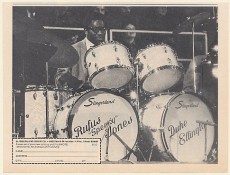
Rufus “Speedy” Jones was born May 27, 1936 in Charleston, South Carolina. Starting out on trumpet he switched to drums at the age of 13. He got an early start in 1954 with Lionel Hampton before being drafted. While stationed at Fort Jackson, Rufus played in a quintet every Saturday night at the black United Service Organization clubhouse in Columbia.
From 1959 to 1963 Rufus played with Henry “Red” Allen and Maynard Ferguson’s Orchestra. He led his own quintet during 1963-1964 producing a Cameo LP, his only album as a leader. He gained fame for his flamboyant work with Count Basie in the mid-1960s and backed that up with Duke Ellington in the latter half of the decade. He also notably appeared with James Brown. On April 25, 1990 drummer Rufus “Speedy” Jones passed away in Las Vegas, Nevada.
Inspire A Young Mind
More Posts: drums
Daily Dose Of Jazz…
Miles Dewey Davis III was born May 26, 1926 in Alton, Illinois into an affluent family, father a dentist and his mother a blues pianist. They owned a substantial ranch in the Delta region of Pine Bluffs, Arkansas. When he was one years old the family moved to East St. Louis and it was between there and Pine Bluffs that his appreciation for music came out of the Black church.
His musical studies began at 13, when his father gave him a trumpet and arranged lessons with local musician Elwood Buchanan. He learned to play with out vibrato which gave him his clear signature tone. By age 16, Davis was a member of the music society and, when not at school, playing professionally first at the local Elks Club. At 17, he spent a year playing in Eddie Randle’s band, the Blue Devils and during this time, Sonny Stitt tried to persuade him to join the Tiny Bradshaw band, then passing through town. His mother insisted that he finish his final year of high school and he graduated from East St. Louis Lincoln High School in 1944.
In 1944, the Billy Eckstine band visited East St. Louis with Dizzy Gillespie and Charlie Parker in tow. Miles was brought in on third trumpet for a couple of weeks because the regular player, Buddy Anderson, was out sick. Even after this experience, once Eckstine’s band left town, Davis’ parents were still keen for him to continue formal academic studies.
However, In the fall of 1944, following graduation from high school, Davis moved to New York City to study at the Juilliard School of Music. His arrival marked a new chapter and he spent his first weeks attempting to contact Charlie Parker, against all advice even from Coleman Hawkins. Finally locating his idol, he became one of the cadre of musicians who held nightly jam sessions at Minton’s Playhouse and Monroe’s, both Harlem nightclubs. He was among future leaders of bebop Fats Navarro, Freddie Webster, J. J. Johnson as well as the established Thelonious Monk and Kenny Clarke.
Dropping out of Juilliard after asking permission from his father, Miles began playing professionally, performing in several 52nd Street bands led by Coleman Hawkins, and Eddie Lockjaw Davis. By 1945, he entered a recording studio for the first time, under the leadership of Herbie Field. This was the beginning of his many sideman recordings until 1946 when he recorded as a leader with the Miles Davis Sextet plus Earl Coleman and Ann Hathaway. Though a member of the groundbreaking Charlie Parker Quintet, he can be heard accompanying singers. He would play with Max Roach, Al Haig, Sir Charles Thompson, Duke Jordan, Curley Russell, Tommy Potter and Leonard Gaskin. This gave him numerous recording sessions and the beginning of what would become his cool jazz style.
After Parker’s breakdown and committal to Camarillo State Mental Hospital while on tour in Los Angeles, Davis, found himself stranded. He roomed and collaborated for some time with Charles Mingus, got a job with Billy Eckstine and eventually got back to New York. He would freelance and sideman in some of the most important combos on the New York jazz scene.
By 1948 Davis grew close to Canadian composer and arranger Gil Evans and his basement apartment had become the meeting place for several young musicians and composers such as Davis, Roach, John Lewis and Gerry Mulligan who were unhappy with the bebop scene. Together they created the tuba band sound that included French horn and tuba in the nonet line-up. The objective was to achieve a sound similar to the human voice, through carefully arranged compositions and by emphasizing a relaxed, melodic approach to the improvisations.
A contract and recording sessions between 1949-1950 with Capitol Records brought about the release of Birth Of The Cool in 1956, which gave its name to the cool jazz movement. Though met with resistance, years later it was co-opted by white musicians like Mulligan and Dave Brubeck and the critics who hailed it as a success.]
By the first half of the 1950s Davis was on tour in Paris with Tadd Dameron, Kenny Clarke and James Moody, and living the life of a black musician abroad. He was involved with French actress and singer Juliette Greco for a time and then returned to the States to be underappreciated by the critics and a liaison with the mother of his two children unraveled. This is when his heroin addiction began, with subsequent arrests. But iwas during this period that he became acquainted with Ahmad Jamal’s music and his elegant approach and use of space influenced him deeply and he definitely severed all ties to bebop.
Through the decade he would record for Prestige, work with Art Blakey, Sonny Rollins and John Coltrane, began using the Harmon mute creating a signature sound and phrasing. The most important Prestige recordings of this period were Dig, Blue Haze, Bag’s Groove, Miles Davis and the Modern Jazz Giants and Walkin’. This placed him in the center of the hard bop movement. It also hailed his period of withdrawal, being distant, cold, contempt for critics, and his quick temper.
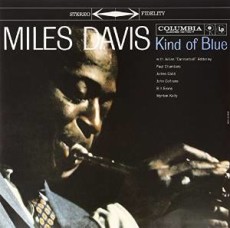
His first great quintet included John Coltrane, Red Garland, Paul Chambers and Philly Joe Jones. This group brought forth such titles as Relaxin’, Steamin’, Workin’ and Cookin’ all with The Miles Davis Quintet. From 1957 to 1963 Davis recorded a series of albums with Gil Evans playing often trumpet and flugelhorn on Miles Ahead, Porgy and Bess, Sketches of Spain, and Quiet Nights. In 1959 with Bill Evans, Wynton Kelly, John Coltrane, Cannonball Adderley, Paul Chambers and Jimmy Cobb he recorded his magnus opus Kind Of Blue.
Through the Sixties he recoded with a number of musicians, Hank Mobley, Sonny Stitt, Jimmy Heath, George Coleman, Ron Carter, Tony Williams, Herbie Hancock and Sam Rivers. But it was Hancock, Williams, Carter and Wayne Shorter that became the nucleus of his second great quintets.
He would work with Chick Corea and Dave Holland, enter into his electric period playing with Joe Zawinul, John McLaughlin, Jack DeJohnette, Airto Moriera, Bennie Maupin and recorded the landmark Bitches Brew. He would create the Cellar Door Band before retiring in 1975. By 1979, he overcame his cocaine addiction and regained his enthusiasm for music and put together new smaller combos playing up until his death.
Miles Davis is regarded as one of the most innovative, influential and respected figures in the history of music. He has received numerous Grammy Awards, and according to the RIAA, the album is the best-selling jazz album of all time, having been certified as quadruple platinum (4 million copies sold. In 2009, the US House of Representatives voted 409–0 to pass a resolution honoring the album as a national treasure. On September 28, 1991 he passed away in Santa Monica, California.
Dose A Day – Blues Away
More Posts: flugelhorn,trumpet
Daily Dose Of Jazz…
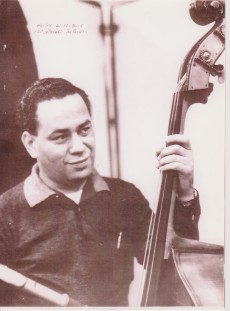
Lloyd Trotman was born on May 25, 1923 in Boston, Massachusetts. He began playing the club scene on 52nd Street in New York in 1945, playing with the likes of Duke Ellington and Billie Holiday. One of his earliest recording sessions was on Duke Ellington’s 1950 album Great Times Piano Duets with Billy Strayhorn and Oscar Pettiford.
He worked with, traveled with, and recorded with many jazz artists including Johnny Hodges, Woody Herman, Bud Powell, Red Allen, Coleman Hawkins, Jimmy Scott, Billie Holiday, Lucky Millinder, Boyd Raeburn and Blanche Calloway. He was a member of the Apollo house band during the late 40’s and early 1950s.
During the 1950s Lloyd worked as a session musician at Atlantic, RCA Victor, Mercury, Okeh, Vik, Cadence, Brunswick and many other recording studios alongside producers and arrangers such as Ahmet Ertegun, Jerry Wexler, Leiber and Stoller, Jesse Stone, Sammy Lowe, Leroy Kirkland and Archie Bleyer. He played behind Sam “The Man” Taylor, King Curtis, Panama Francis, Mickey Baker, Ernie Hayes, Al Caiola among others and was a member of Alan Freed’s Rock & Roll Orchestra at the Brooklyn Paramount and Fox Theaters during the late 1950s.
He continued to play many weekend nightclub dates into the early 1980’s and after retiring from the music business, he became a loan officer at Islip National Bank. Jazz bassist Lloyd Trotman, who backed numerous jazz, Dixieland, R&B, and rock and roll artists in the 1940’s, 1950s and 1960s, passed away at the aged 84, on October 3, 2007 on Long Island, New York.
Take A Dose On The Road
More Posts: bass
Daily Dose Of Jazz…
Archie Shepp was born on May 24, 1937 in Fort Lauderdale, Florida but was raised in Philadelphia, Pennsylvania. He studied piano, clarinet and alto saxophone before focusing on the tenor saxophone. He studied drama at Goddard College from 1955-59, eventually turning professional.
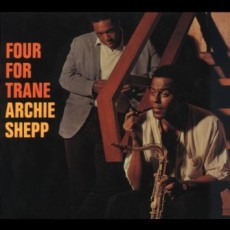
Shepp played in a Latin jazz band for a short time before joining the band of avant-garde pianist Cecil Taylor. His debut recording as a leader was under his own name, Archie Shepp-Bill Dixon Quartet on the Savoy label. The 1962 session included an Ornette Coleman composition was the initial link to the formation of the New York Contemporary Five, which included Don Cherry. Two years later with the admiration of Coltrane he recorded Four For Trane on Impulse Records with trombonist Roswell Rudd, bassist Reggie Workman and alto John Tchicai.
Archie participated in the sessions for Coltrane’s A Love Supreme in late 1964, but none of the takes were included on the final release but has since been made available on a 2002 reissue. He would cut Ascension with Coltrane in 1965, and his place alongside Coltrane at the forefront of the avant-garde jazz scene was epitomized when the pair split the record New Thing At Newport, the first side a Coltrane set, the second a Shepp set.
During the decade he would develop his political consciousness and Afrocentric orientation, recording albums that reflected. His albums Fire Music and The Magic of Ju-Ju put him at the forefront of the free-form avant-garde movement along with Pharoah Sanders. He continued to experiment into the new decade, at various times with harmonica players and even spoken word poets. Never far from political and social commentary Archie released Attica Blues for the prison riots and The Cry Of My People that spoke to civil rights. He also wrote for theater including The Communist and Lady Day: A Musical Tragedy.
In 1971, Shepp was recruited to the University of Massachusetts Amherst that began a thirty-year career as a professor teaching Revolutionary Concepts in African-American Music and Black Musician in the Theater, also teaching African-American Studies at SUNY in Buffalo, New York.
In the late 1970s and beyond Archie would record blues, ballads, spirituals, tributes to traditional jazz musicians, as well as R&B. He would perform with Sun Ra’s Arkestra, French trumpeter Eric Le Lann, with Michel Herr creating the original score for the film Just Friends. He also appeared on the Red, Hot Organization’s tribute to Fela Kuti titled Red, Hot and Riot.
He has been featured in two documentary films, 1981’s Imagine The Sound, in which he discusses and performs his music and poetry, and Mystery Mr. Ra in which he discusses and performs his music and poetry. Shepp also appears in Mystery, Mr. Ra, a 1984 French documentary about Sun Ra.
In 2004 he founded his own record label, Archieball, together with Monette Berthomier in Paris. Tenor and soprano saxophonist, pianist, vocalist Archie Shepp continues to perform, collaborate and record.
Put A Dose In Your Pocket