Daily Dose Of Jazz…
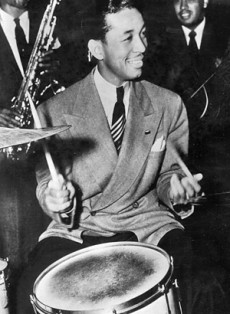
Drummer and singer Lee Young was born on March 7, 1914 as Leonidas Raymond Young in New Orleans, Louisiana to parents who were both musicians and teachers. The younger brother of tenorist Lester Young, his father drilled music into his children long before they started school, preparing them for the carnival and vaudeville road. The family finally settled in Los Angeles.
Steeped in the roots deep in New Orleans jazz, Lee played and recorded with Fats Waller in the thirties, and helped forge a burgeoning and vibrant jazz scene in Los Angeles in the ‘40s, and in 1944 he was drumming with Les Paul, J. J. Johnson, and Illinois Jacquet at Norman Granz’s first Jazz At The Philharmonic. In the Fifties he conducted and drummed for Nat King Cole.
Young was the first Black musician to be a regular studio musician in Hollywood and taught Mickey Rooney to play drums for a movie. By the 60’s he was a successful A&R man and record producer for Vee-Jay and Motown with a reputation for predicting what would sell.
Young is considered one of the most significant figures in jazz who directly connected the world to the early glories of jazz: the birth of jazz in New Orleans, the jazz age, the swing era and bebop. He led an integrated band at a time when it was not fashionable. He worked with Duke Ellington, Count Basie, Benny Goodman, Lionel Hampton and Les Hite. Lee Young passed away at the age of 94 on July 31, 2008.
Lee Young: 1914-2008 / Drums

More Posts: drums
Daily Dose Of Jazz…
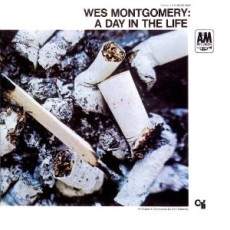
John Leslie “Wes” Montgomery was born on March 6, 1923 in Indianapolis, Indiana. Although he started learning guitar relatively late at the age of 19 and not skilled at reading music, Wes had an incredible ear, learning by listening to the recordings of his idol Charlie Christian. He began his self-taught education in 1943 using his thumb instead of a pick and by the end of the decade he was touring with Lionel Hampton.
Montgomery’s recording can be divided into three periods. His Riverside recordings from 1959-1963 were spontaneous small group sessions; the orchestral dates with arranger Don Sebesky and producer Cecil Taylor at Verve were from ’64 to ’66; and the Creed Taylor years of simple pop melodies underscored with strings and woodwinds. The later sessions produced three best-selling albums that introduced AM radio listeners to jazz and his performances were as freewheeling as his earlier Riverside records.
Considered one of the seminal figures of jazz guitar in the company of innovators like Charlie Christian and Django Reinhardt; Wes alongside Tal Farlow, Johnny Smith, Jim Raney and Barney Kessell put guitar on the map as a bebop/post-bop instrument. He is credited with influencing future guitar lions Pat Martino, George Benson, Emily Remler, Kenny Burrell, Jimi Hendrix, Stevie Ray Vaughan and Pat Metheny.
During his career he would team up with his brother Monk who played string and electric bass and Buddy, who played vibes and piano, releasing a number of albums as the Montgomery Brothers. His career garnered him two Grammy nominations, a Grammy award, Down Beat’s New Star award, and Down Beat Critic’s Poll award for best jazz guitarist from ‘60 to ‘63 and from ‘66 to ‘67. At the height of his career and his success, Wes Montgomery succumbed to a heart attack on June 15, 1968 in his hometown of Indianapolis.

More Posts: guitar
Daily Dose Of Jazz…
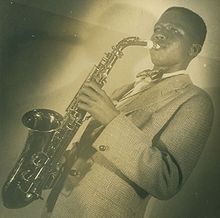
Pee Wee Moore was born Numa Smith Moore on March 5, 1928 in Raleigh, North Carolina. Attending Hampton Institute as a pre-med major, after one semester switched to music taking up the saxophone, joining the Royal Hamptonians and touring on a USO circuit. While asleep in the back seat driving back to New York, Pee Wee lost his left eye in a car accident. However this had no effect on his playing.
In the 30’s Moore played with the Jeter-Pillars Orchestra, recorded with Floyd Ray and sat alongside Dizzy Gillespie in the Les Hite big band from 1939 to 1942. His first recordings with Dizzy Gillespie’s ensemble occurred from 1946-47.
Throughout the fifties Moore played with Lucky Millinder, Louis Jordan, Illinois Jacquet, James Moody, Mary Lou Williams and Dizzy Gillespie, whom he recorded several albums with for Verve. He worked with pianist Bill Doggett in the mid-sixties.
Moore moved back to Raleigh to care for his ailing mother and recover from alcohol addiction. Earning a living as a handyman, he continued to play throughout the rest of his life at various venues in the Raleigh-Durham area. On April 13, 2009 jazz saxophonist Pee Wee Moore passed away at the age of 81.
More Posts: saxophone
Daily Dose Of Jazz…
Zenzile Miriam Makeba was born on March 4, 1932 in the Prospect Township of Johannesburg, South Africa. Known to her many fans as simply Miriam Makeba or Mama Afrika, her career spanned more than 50 years.
As a child, she sang at the Kilmerton Training Institute in Pretoria, while attending for eight years followed by touring with an amateur group. Her professional career began in the 1950s with the Manhattan Brothers prior to her forming her own group, The Skylarks, singing a blend of jazz and traditional melodies of South Africa.
By 1959 she was performing in the musical King Kong with her future husband Hugh Masekela and though she became a successful recording artist, she received a pittance for her work without residual royalties. However in the same year her big break arrived when she was given a short guest appearance in the indie anti-apartheid documentary “Come Back, Africa” and she made such an impression that the director managed a visa for her to leave the country for the Venice Film Festival.
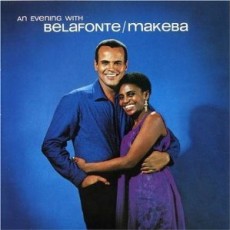
Traveling to London she met Harry Belafonte who assisted her in gaining entry to and fame in the United States. She released many of her most famous hits there including “Pata Pata”, “The Click Song” and “Malaika”. In 1966, Makeba, in collaboration with Belafonte received a Grammy for Best Folk recording “An Evening With Belafonte/Makeba” that dealt South African apartheid.
Miriam went on to perform at the 1974 Rumble In The Jungle between George Foreman and Muhammad Ali, on Paul Simon’s Graceland, authored an autobiography, starred in Sarafina, guest appeared on the Cosby Show, took part in Amandla: A Revolution in Four Part Harmony and returned to South Africa under the persuasion of Nelson Mandela.
She was awarded the Dag Hammarskjöld Peace Prize, was named Goodwill Ambassador for the UN Food and Agriculture Organization, was awarded the UN Gold Otto Hahn Peace Medal and voted 38th in the top 100 Great South Africans. While on a concert stage taking a stand against injustice against humanity singing her hit song “Pata Pata”, she succumbed to a heart attack on November 9, 2008.

More Posts: vocal
Daily Dose Of Jazz…
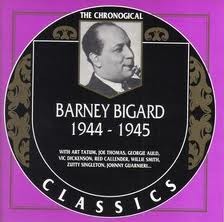
On March 3, 1906 Barney Bigard was born Albany Leon Bigard in New Orleans, Louisiana. As a child he studied music and clarinet with Lorenzo Tio. In the early twenties his move to Chicago had him working and recording with Joe “King” Oliver, Johnny Dodds, Jelly Roll Morton and numerous others.
Bigard’s initial fame came as a tenor saxophonist in the twenties and was #2 behind Coleman Hawkins before moving to the clarinet. In 1927 his swinging style joined the ranks of the Duke Ellington Orchestra, a relationship that lasted till 1942, both as a featured soloist and section tenor. Credited with composing or co-composing several tunes, Barney’s most notable is the Ellington standard “Mood Indigo”.
Tiring of the road with Ellington, Bigard moved to Los Angeles getting into sound tracking, with an on-screen performance with Louis Armstrong in the 1946 film “New Orleans”. By the late 40’s he teamed with Kid Ory followed by once again touring the world with Louis Armstrong’s All Stars band from 1947 to 1955. In the late 50’s he played with Cozy Cole and became semi-retired by 1962, occasionally playing and recording with Art Hodes, Earl Hines and sometimes as a leader.
Considered one of the most distinctive clarinetists in jazz, composer and tenor saxophonist Barney Bigard passed away on June 27, 1980 in Culver City, California.