

Daily Dose Of Jazz…
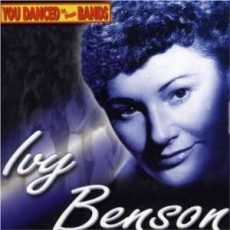
Ivy Benson was born on November 11, 1913 in Holbeck, Leeds, England. Her father Digger Benson, a musician who played with ensembles, began teaching her to play piano at the age of five. She played at working men’s clubs from the age of eight, billed as Baby Benson, and performed on BBC Radio’s Children’s Hour at nine years.
Ivy’s father had ambitions for her to become a concert pianist, but she was inspired to become a jazz musician after hearing a Benny Goodman record and learned to play clarinet and alto saxophone. Leaving school at 14, she took a job at the Montague Burton factory in Leeds, putting aside half a crown from her wages each week to save up for her first saxophone, supplementing her income by playing evenings in dance bands.
Benson joined a sextet, Edna Croudson’s Rhythm Girls in 1929, touring with them until 1935, followed by Teddy Joyce and the Girlfriends where she became a featured soloist. Moving to London in the late 1930s, she formed her own band and her first significant engagement was performing with the all-female revue Meet the Girls, starring Hylda Baker.
During World War II opportunities opened up and Ivy’s band became the BBC’s resident dance band in 1943 and was top of the bill at the London Palladium for six months in 1944. By wars end she was playing the VE Day celebration in Berlin, touring Europe and the Middle East performing for Allied troops, headlining variety theatres and performing at the 1948 Summer Olympics. Over the next thirty years the band experience much success with television appearances, a tribute on This Is Your Life, and a speaking role in the film The Dummy Talks.
The group disbanded in 1982 but she was honored as a fellow of Leeds Polytechnic, a plaque at her childhood home and a play, The Silver Lady, was based on her life. Retiring to Clacton-on-Sea, Essex, multi-instrumentalist Ivy Benson passed away on May 6, 1993 at age 79.
Daily Dose Of Jazz…
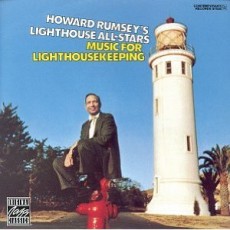
Howard Rumsey was born on November 7, 1917 in Brawley, California and first began playing the piano, followed by the drums and finally the bass. After jobs with Vido Musso and Johnnie Davis, he became part of Stan Kenton’s first band. After an argument ensued he left Kenton and played with Charlie Barnet and Barney Bigard before taking a short hiatus from music.
Upon his return Howard hit the Los Angeles jazz scene and formed the Lighthouse All-Stars. For most of the 1950s this group played each Sunday at the Lighthouse Cafe in Hermosa Beach. During its lifetime, the Lighthouse All-Stars were one of the primary modern jazz institutions on the West Coast that provided a home for many Los Angeles musicians. He opened his debut show on May 29, 1949 to immediate success.
Rumsey employed in the first Lighthouse All-Stars group the Los Angeles musicians who had been a part of the Central Avenue scene in the 1940s, including Teddy Edwards, Sonny Criss, Hampton Hawes, Frank Patchen, Bobby White and Keith Williams. His second band featured a new wave of players, Jimmy Giuffre, Shorty Rogers, and Shelly Manne. The success of this group soon had them recording for Les Koenig’s Contemporary Records. This contract expanded to include many of the members of the group leading sessions for this same label, such as Art Pepper and Stan Getz.
This third edition of the Lighthouse All-Stars included Bud Shank, Bob Cooper, Rolf Ericsson and Max Roach. This band took part in a historic recording in 1953 that featured both Chet Baker and Miles Davis, along with Russ Freeman and Lorraine Geller.
Various editions of the band hosted other players until the early Sixties when jazz interest faded in Los Angeles, but during its heyday some seventy-five musicians came through their ranks until the group eventually dissolved. From 1971 to 1985 he owned and operated the 200 seat club Concerts by the Sea in Redondo Beach, California.In 2005 the film Jazz on the West Coast: The Lighthouse was released about the group. Double-bassist Howard Rumsey passed away on July 15, 2015 from complications of pneumonia in Newport Beach, California, at the age of 96.

More Posts: bass

Daily Dose Of Jazz…
Red Richards was born Charles Coleridge Richards on October 19, 1912 in New York City and began playing classical piano at age ten. After hearing Fats Waller at age 26 he concentrated on jazz. His first major professional gig was with Tab Smith at the Savoy Ballroom in New York from 1945 to 1949. He went on to play and record with Pee Wee Russell, Bob Wilber, Sidney Bechet, Buck Clayton, Big Chief Moore, Muggsy Spanier, Fletcher Henderson through the Fifties.
Richards toured Italy and France with Mezz Mezzrow, accompanied Frank Sinatra while in Italy, became a solo performer for a year in Columbus, Ohio, and played with Wild Bill Davison in the late 50s and again in 1962.
In 1960 Red formed Saints & Sinners with Vic Dickerson, playing with this ensemble until 1970. He joined jazz drummer Chuck Slate’s band in 1971, recorded an album with him called “Bix ‘N All That Jazz”. Through the mid-Seventies he worked with Eddie Condon, put together his own trio for two years, played with Panama Francis’s Savoy Sultans touring with them from1979 through the Eighties.
Pianist Red Richards recorded nine albums as a leader, recorded with Bill Coleman in 1980 and continued to tour nearly till the time of his death on March 12, 1998 in Scarsdale, New York.
More Posts: piano
From Broadway To 52nd Street
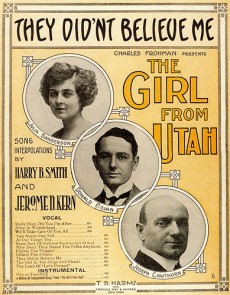
The Girl From Utah, a British import to Broadway, opened at the Knickerbocker Theater on August 24, 1914 and ran for 120 performances. J. A. E. Malone directed this musical that starred Julia Sanderson, Donald Brian, Joseph Cawthorn, Queenie Vassar and Venita Fitzhugh. Composer Jerome Kern was asked to give it an American flavor and along with lyricist Herbert Reynolds they composed “They Didn’t Believe Me”. History contends that this was Kern’s career-making opportunity to express himself and this musical would hint at the emerging American style of musical comedy.
The Story: In London, an American girl named Una is pursued across the Atlantic Ocean to London by a Mormon but is saved from a bigamous marriage when she falls in love with a handsome hoofer.
Broadway History: It was during 19th century that the development of not only the American theatre took place throughout the country but the all powerful “Syndicate” – the cartel of theatre owners who joined forces under the influence of one of Broadway’s early great producers, Abraham Lincoln Erlanger. One of the great stars of theatre in the early twentieth century was George M. Cohan. Rising through the ranks of vaudeville from a child star to adulthood, he flaunted his patriotism not for those born in America but those immigrating to this great country to become citizens and patriots. Cohan epitomized the sense of the country by self-proclaiming himself as a real live nephew of Uncle Sam.
Sponsored By

www.whatissuitetabu.com
More Posts: broadway
From Broadway To 52nd Street
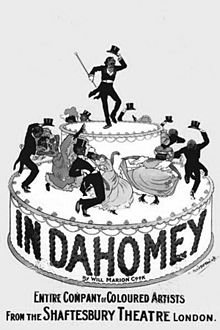
In Dahomey opened on February 18, 1903 at the New York Theater and ran for 53 performances, then considered a successful run. It was a landmark American musical comedy, in that it was “the first full-length musical written and played by blacks significantly marked the first full-length Black to be staged in an indoors venue at a major Broadway house and the first black musical to have its score published, albeit in England. As one of the most successful musical comedies of its era, it propelled composer Will Marion Cook, lyricist Paul Lawrence Dunbar and leading performers Bert Williams, James Smith and George Sisay to become household names. It was “the first African American show that synthesized successfully the various genres of American musical theatre popular at the beginning of the twentieth century—minstrelsy, vaudeville, comic opera and musical comedy.
Though a jazz standard did not emanate from this musical either, the In Dahomey poster features the famous “cake walk” with the character portrayed by Bert Williams and prompted Percy Grainger to write a highly virtuosic concert “rag” titled In Dahomey (Cakewalk Smasher), that he completed in 1909.
The Story: A tale of a group of Blacks, who, having found a pot of gold, move to Africa and become rulers of Dahomey (present-day Benin).
Broadway History: One of the most influential sources of the American musical was one of its most shameful. The minstrel show got its start in the early nineteenth century when a number of white entertainers, mostly of Irish descent, found they could connect with their more raucous audiences by applying burnt cork to their skin and caricaturing black people in various songs, dances and skits. However, the portrayals by white entertainers created a dialogue that became very fashionable, even though they perpetuated negative stereotypes. Black entertainers knew they didn’t speak like that and formed a troupe, and out of that came comic duos on Broadway like Flournoy Miller and Aubrey Lyles in the 20’s, William Gaxton and Victor Moore in the 30’s. But one man transcended minstrelsy’s denigration of his race and became not only the most popular comedian of his day, but the most famous African American since Frederick Douglass. He was Bert Williams, who denied entrance into Stanford University, worked as a banjo player in saloons and minstrels until he teamed up with George Walker. The team gained fame, which led them to head the cast of “In Dahomey” in 1903, the first full-length musical written and played by blacks performed at a major Broadway house.
Sponsored By
www.whatissuitetabu.com