

Daily Dose Of Jazz…
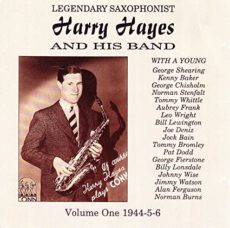
Harry Hayes was born Henry Richard Hayes in Marylebone in the West End of London, England on March 23, 1909, a bookmaker’s son. Winning a scholarship to his local grammar school, he was given a soprano saxophone by his father when he was 11 and by age 16, made his professional debut as an alto player at the Regent dance hall in Brighton. He was soon playing at London’s Kit Kat Club and the Piccadilly hotel. In 1927, he joined Elizalde at the Savoy, working alongside Americans like saxophonists Adrian Rollini, Fud Livingstone and Bobby Davis, trumpeter Chelsea Quealey, and pianist Jack Russin.
He became highly successful during the big band era of popular music that dominated by radio and bands playing London hotels and clubs. The late 1920s through the 30s, Hayes worked with musicians and bands such as Sydney Kyte at Ciro’s Club, pianist Billy Mason at the Cafe de Paris, Spike Hughes’s Orchestra at the Empress Rooms, Leslie “Hutch” Hutchinson, and Maurice Winnick at the Carlton, with Harry Roy at the Mayfair and with Sydney Lipton at the Grosvenor House. In 1932, he was featured in the band that accompanied Louis Armstrong’s first British tour.
Called up in 1940, Hayes served in the Welsh Guards band but continued to perform with others. After his discharge in 1944, he formed an eight-piece band, which went on to record sessions for HMV at Abbey Road featuring some of the best players of the day including Harry Roche, Norman Stenfalt, a young George Shearing and tenor saxophone Tommy Whittle. He played with Benny Carter, and appeared in a London Jazz At The Philharmonic concert with Oscar Peterson, Ella Fitzgerald, and Lester Young.
By 1947, Hayes was playing Charlie Parker bebop, and opening his first music shop in Shaftesbury Avenue. He was also active as a music teacher. While working with Kenny Baker in the 1950s, he led his own band at various London nightspots. Retiring from regular playing in 1965, he continued to run his shops until 1985. He was granted the freedom of the City of London in 1988 nd his last performance was at the Birmingham international jazz festival in 1992. Saxophonist and shopkeeper Harry Hayes passed away at the age of 92 on March 17, 2002.

More Posts: bandleader,history,instrumental,jazz,music,saxophone,shopkeeper

Daily Dose Of Jazz…
Sonny Burke, born Joseph Francis Burke on March 22, 1914 in Scranton, Pennsylvania and in the Thirties attended Duke University where he formed and led the jazz big band called The Duke Ambassadors. Graduating in 1937, during the 1930s and 1940s, he was a big band arranger in New York City, working with Sam Donahue’s band.
In the 1940s and 1950s, he worked as an arranger for the Charlie Spivak and Jimmy Dorsey bands, among others. 1955 saw him writing, along with Peggy Lee, the songs to Disney’s Lady and the Tramp. He also wrote songs with John Elliot for Disney’s Toot, Whistle, Plunk and Boom, which won the 1953 Oscar for Best Short Animated Feature.
Burke wrote the music for number of popular songs that continue to be regarded as jazz standards including Black Coffee, with lyric by Paul Francis Webster, and Midnight Sun, co-written with jazz vibraphonist Lionel Hampton. An active arranger, conductor and A&R man at major Hollywood record labels, especially Decca Records, he worked with Charles “Bud” Dant. He also wrote and arranged the theme for the early 1960s television show Hennesey, a jazzy update of the Sailor’s Hornpipe.
Later Sonny went on to become musical director at Warner Bros./Reprise Records. He was responsible for many of Frank Sinatra’s albums and produced Sinatra’s iconic recording of My Way and Petula Clark’s classic This Is My Song written by Charles Chaplin for his movie A Countess From Hong Kong. He was also the bandleader for recordings of leading singers such as Dinah Shore, Bing Crosby, The Andrews Sisters, The Mills Brothers, Ella Fitzgerald, and Mel Tormé.
Arranger, composer, big band leader, and producer Sonny Burke passed away from cancer on May 31, 1980 in Santa Monica, California at the age of 66.
More Posts: arranger,big band leader,composer,history,instrumental,jazz,music,producer
Daily Dose Of Jazz…
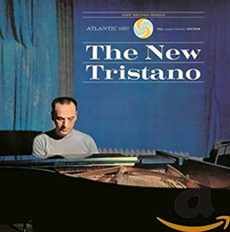
Lenny Tristano was born Leonard Joseph Tristano on March 19, 1919 in Chicago, Illinois, the second of four brothers. He started on the family’s player piano at the age of two or three. He had classical piano lessons when he was eight, Born with weak eyesight, and then with measles, by the age of nine or ten, he was totally blind. He attended the Illinois School for the Blind in Jacksonville, Florida for a decade around 1928. During his school days, he played several other instruments, including trumpet, guitar, saxophones, and drums and by eleven, he had his first gigs, playing clarinet in a brothel.
Back in Chicago, Tristano got his bachelor’s degree in music from the American Conservatory of Music but left before completing his master’s degree, moving to New York City in 1946. He played saxophone and piano with leading bebop musicians, Charlie Parker, Dizzy Gillespie, and Max Roach among others. He formed his own small bands, which soon displayed some of his early interests – contrapuntal interaction of instruments, harmonic flexibility, and rhythmic complexity. His 1949 quintet recorded the first free group improvisations, that continued in 1951, with the first overdubbed, improvised jazz recordings.
He started teaching music, with an emphasis on improvisation, in the early 1940s, and by the mid-1950s was concentrating on teaching instead of performing. He taught in a structured and disciplined manner, which was unusual in jazz education when he began. His educational role over three decades meant that he exerted an influence on jazz through his students, including saxophonists Lee Konitz and Warne Marsh.
Through the Fifties to the Sixties he would go on to record for the New Jazz label which would become Prestige Records, and Atlantic Records, he founded his own label Jazz Records, create his own recording studio, tour throughout Europe, played A Journey Through Jazz, a five-week engagement at Birdland, s well as other New York City jazz haunts. His last public performance in the United States was in 1968 but continued teaching into the Seventies.
Having a series of illnesses in the 1970s, including eye pain and emphysema from smoking for most of his life, on November 18, 1978 pianist, composer, arranger, and jazz improvisation educator Lennie Tristano passed away from a heart attack at home in Jamaica, New York.
More Posts: bandleader,clarinet,drums,history,instrumental,jazz,music,piano,saxophone
Daily Dose Of Jazz…
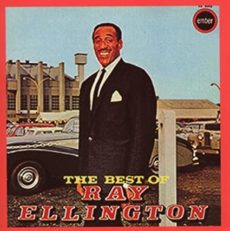
Ray Ellington was born Henry Pitts Brown on March 17, 1916 at 155 Kennington Road, Kennington, London, England, the youngest of four children. His father, a Black music-hall comedian, and entertainer, his mother a Russian Jew. When his father died when he was four years old, he was brought up as an Orthodox Jew and attended the South London Jewish School before entering show business at the age of twelve, when he appeared in an acting role on the London stage.
His first break came in 1937 when he replaced Joe Daniels in Harry Roy and His Orchestra as the band’s drummer. His vocal talents were put to good use too, from the time of his first session when he recorded Swing for Sale. Ellington was called up in 1940, joined the Royal Air Force (RAF) as a physical training instructor where he served throughout the war. He played in various service bands including RAF Blue Eagles.
After demobilisation, Ellington resumed his career, fronting his own group, playing at The Bag O’Nails club. Early in 1947, he rejoined the Harry Roy band for a few months. The Ray Ellington Quartet was formed in the same year, specializing in jazz, while experimenting with many other genres. His musical style was heavily influenced by the comedic jump blues of Louis Jordan. His band was one of the first in the UK to feature the stripped-back guitar/bass/drums/piano format that became the basis of rock and roll, as well as being one of the first groups in Britain to prominently feature the electric and amplified guitar of Lauderic Caton. The other members of his quartet were pianist Dick Katz and bassist Coleridge Goode until 1955 when the players changed.
Vocalist, drummer and bandleader Ray Ellington passed away from cancer on February 27, 1985.
More Posts: bandleader,drums,history,instrumental,jazz,music,vocal
Daily Dose Of Jazz…
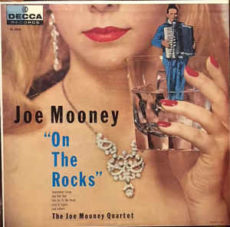
Joe Mooney was born in Paterson, New Jersey on March 14, 1911 and went blind when he was around 10 years of age. His first job, at age 12, was playing the piano for requests called in to a local radio station. He and his brother, Dan, played together on radio broadcasts in the late 1920s, and recorded between 1929 and 1931 as the Sunshine Boys and the Melotone Boys, both sang while Joe accompanied on piano. They continued performing together on WLW in Cincinnati, Ohio until 1936, after which time Dan Mooney left the music industry.
In 1937, he began working as a pianist and arranger for Frank Dailey, a role he reprised with Buddy Rogers in 1938. Through the early 1940s, Joe arranged for Paul Whiteman, Vincent Lopez, Larry Clinton, Les Brown, and The Modernaires. Putting together his own quartet in 1943, he sang and played the accordion with accompaniment on guitar, bass, and clarinet.
In the last half of the 1940s his group experienced considerable success in the United States. By 1946, a newspaper columnist wrote that Mooney’s music “has the most cynical hot jazz critics describing it in joyous terms, such as exciting, new, the best thing since Ellington, and as new to jazz as the first Dixieland jazz band was when it first arrived”. As for Mooney himself, the columnist wrote that he “played in virtuoso fashion … a fellow who knows not only his instrument, but jazz music, both to just about the ultimate degree.”
In the 1950s, Mooney sang with the Sauter-Finegan Orchestra and played with Johnny Smith in 1953. After moving to Florida in 1954 he concentrated more on the organ and recorded in 1956. 1963 saw a group of friends form a company to produce a record, Joe Mooney and His Friends. He recorded again in the middle Sixties. Accordionist, organist, and vocalist Joe Mooney passed away after a stroke at age 64, on May 12, 1975, in Fort Lauderdale, Florida.
More Posts: accordion,bandleader,history,instrumental,jazz,music,organ,vocal