

Daily Dose Of Jazz…
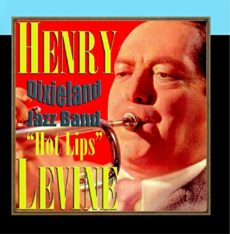
Henry Levine was born on November 26, 1907 in London, England but his family emigrated to the United States in 1908. In 1917, he heard Nick LaRocca with the Original Dixieland Jazz Band and decided to become a musician and learn trumpet.
From 1925 he worked as a professional musician with the Original Dixieland Jazz Band, and from the mid-1920s in various studio bands with Nat Shilkret and Vincent Lopez. From 1927 he performed with the British bandleader Bert Ambrose, and also made recordings with Fred Elizalde in London.
Returning to the States he played with Cass Hagan and Rudy Vallee before working again as a studio musician. He was head of the NBC Chamber Music Society of Lower Basin Street Jazz Group, recording several sessions with them. After the end of the Second World War Levine worked as a director of radio, television and hotel orchestras.
In 1961 he went moved to Las Vegas, Nevada and retired in 1982. He has been lauded by Allmusic as an excellent lead trumpeter and effective soloist. Under his own name, he recorded a single with jazz standards such as Rockin ‘Chair and I’ve Found a New Baby for RCA Victor. British-American trumpeter Henry “Hot Lips” Levine passed away in May 1989.

More Posts: trumpet
Daily Dose Of Jazz…
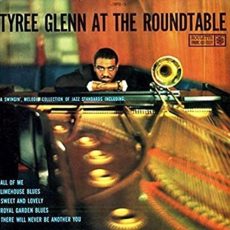
Tyree Glenn was born William Tyree Glenn on November 23, 1912 in Corsicana, Texas. He played trombone and vibraphone with local Texas bands before moving to Washington, D.C. in the early Thirties. He performed with several prominent bands of the Swing Era, playing with Bob Young and Tommy Myles before moving to the West Coast.
While he was living out West, Tyree first played with groups headed by Charlie Echols followed by Eddie Barefield, Eddie Mallory and Benny Carter. By the end of the decade from 1939 to 1946 he played with Cab Calloway. He toured around Europe with Don Redman’s big band in 1946, then joined Duke Ellington until 1951 as a wah-wah trombonist in the Tricky Sam Nanton tradition and Ellington’s only vibraphonist, being well-featured on the Liberian Suite. After his time with Ellington he played with Howard Biggs’s Orchestra.
During the 1950s, Glenn did studiowork, led his quartet at the Embers, did some television, radio and acting work, and freelanced in swing and Dixieland bands. In 1953 he joined Jack Sterling’s New York daily radio show, with which he remained until 1963. During 1965–68, he toured the world with Louis Armstrong’s All-Stars, staying with the group until Armstrong passed in 1971.
He would go on to record with Louis Bellson, Gene Krupa, Buck Clayton, Clark Terry and during his last few years he led his own group, recording seven albums. Trombonist Tyree Glenn, was also a studio musician, actor and composer who penned Sultry Serenade, which was recorded by Duke Ellington and Erroll Garner, moved to Englewood, New Jersey where he passed away from cancer on May 18, 1974.
More Posts: trombone
Daily Dose Of jazz…
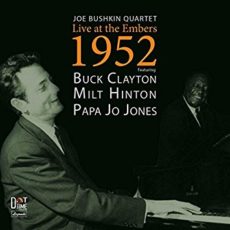
Joe Bushkin was born on November 7, 1916 in New York City and began his career playing trumpet and piano with New York City dance bands. He acquired a lot of experience performing with Frank LaMare’s Band at the Roseland Ballroom in Brooklyn, New York.
In 1935 he joined Bunny Berigan’s band, played with Eddie Condon from 1936 to 1937, and with Max Kaminsky and Joe Marsala, before rejoining Berigan in 1938. He then left to join Muggsy Spanier’s Ragtime Band in 1939. From the late Thirties through to the late 1940s he also recorded with Eddie Condon as well as performing on radio and television. After his World War II service he worked with Louis Armstrong, Bud Freeman and Benny Goodman.
Best-known for his composition Oh! Look at Me Now with John DeVries, composed when he was working in Tommy Dorsey’s band. The song would become Frank Sinatra’s first hit. In his 60s, Bushkin’s semi-retirement was ended by an offer from Bing Crosby for them to tour together in 1976 and 1977. He also appeared on Crosby’s 1975 Christmas TV special with Fred Astaire, performed in a concert series at New York’s St. Regis Hotel in 1984 that celebrated his 50 years in show business.
Pianist Joe Bushkin passed away in Santa Barbara, California on November 3, 2004, three days shy of his 88th birthday, which he had dreamed of celebrating the 88 piano keys.

More Posts: piano
Daily Dose Of Jazz…
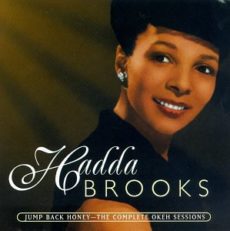
Hadda Brooks was born Hattie L. Hapgood on October 29, 1916 in Los Angeles, California. Raised in the Boyle Heights area by her parents who had migrated from the South her mother, Goldie Wright, was a doctor and her father, John Hapgood, a deputy sheriff, but it was her grandfather, who introduced her to theater and the operatic voices of Amelita Galli-Curci and Enrico Caruso. In her youth she formally studied classical music with an Italian piano instructor, Florence Bruni, with whom she trained for twenty years.
She attended the University of Chicago, later returned to Los Angeles, becoming to love the subtle comedy of black theater and vaudeville entertainer and singer Bert Williams. She began playing piano professionally in the early 1940s at a tap-dance studio owned by Hollywood choreographer and dancer Willie Covan. For ten dollars a week, she played the popular tunes of the day while Covan worked with such stars as Fred Astaire, Gene Kelly, and Shirley Temple.
Preferring ballads to boogie-woogie, Brooks worked up her style by listening to Albert Ammons, Pete Johnson, and Meade Lux Lewis records. Her first recording, the pounding Swingin’ the Boogie, for Jules Bihari’s Modern Records, was a regional hit in 1945, and her most famous song Out of the Blue, the title track to the film of the same name she appeared in on the recommendation of Benny Goodman.
She went on to begin singing with the encouragement Charlie Barnet, and recorded her first vocal recording You Won’t Let Me Go, played the small part of a lounge piano player in films, and was the second Black woman to host her own television show in 1957 with The Hadda Brooks Show after The Hazel Scott Show on DuMont in 1950. She toured Europe, Australia
In the 1970s, she commuted to Europe for performances in nightclubs and festivals, but performed rarely in the United States, living for many years in Australia and Hawaii. Retiring from music for sixteen years, she resurfaced to open Perino’s in Los Angeles and clubs in San Francisco and New York City as well as resuming her recording career. She continued appearing in films throughout the rest of her career, received the Pioneer Award from the Smithsonian and the Los Angeles Music Awards honored her with the Lifetime Achievement Award.
Pianist, vocalist and composer Hadda Brooks, who got her name from Jules Bihari, passed away Los Angeles, following open-heart surgery at age 86 on November 21, 2002.
Daily Dose Of Jazz…
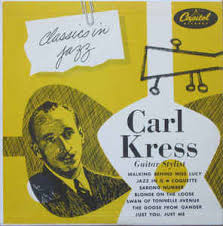
Carl Kress was born on October 20, 1907 in Newark, New Jersey and started on piano before picking up the banjo. Beginning in 1926, he played guitar during his brief time as a member of the Paul Whiteman orchestra. For most of his career, he was a studio musician and sideman buried in large orchestras, and his name was little known.
During the 1920s and 1930s Carl worked recording sessions with The Boswell Sisters, The Dorsey Brothers, Bix Beiderbecke, Hoagy Carmichael, Miff Mole, Red Nichols, Adrian Rollini, and Frankie Trumbauer.
Outside of orchestras, Kress played in several guitar duets with Eddie Lang and Dick McDonough in the Thirties, Tony Mottola in 1941, and George Barnes in the Sixties. The late Thirties saw him recording as a solo with Peg Leg Shuffle, Helena, Love Song, Sutton Mutton and Afterthoughts. During the 1940s, he played Dixieland jazz with Bobby Hackett, Pee Wee Russell, and Muggsy Spanier.
Moving to New York City with his wife Helen who sang with the Satisifiers, Perry Como, Frank Sinatra and Jo Stafford. Guitarist Carl Kress continued a career as a bandleader and session player until his passing away of a heart attack on June 10, 1967 while he was on tour in Reno, Nevada.

More Posts: guitar