

Daily Dose Of Jazz…
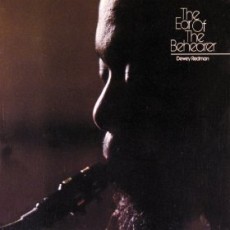
Walter Dewey Redman was born May 17, 1931 in Fort Worth, Texas. He attended I.M. Terrell High School and played saxophone in the school band with Ornette Coleman, Prince Lasha and Charles Moffett. After high school he briefly enrolled in the electrical engineering program at Tuskegee Institute in Alabama but became disillusioned with the program and returned home to Texas. In 1953, he earned a bachelor’s degree in Industrial Arts from Prairie View Agricultural and Mechanical University and while attending switched from clarinet to alto saxophone, eventually to tenor.
Following his degree, Redman served for two years in the Army and upon his discharge he began working on a master’s degree in education at the University of North Texas. While there he taught music to fifth graders in Bastrop, Texas and worked as a freelance saxophonist at night and on weekends around Austin, Texas. By 1957 he graduated in Education with a minor in Industrial Arts.
1959 saw him moving to San Francisco, California as result of an early collaboration with clarinetist Donald Rafael Garrett. He would go on to perform with Ornette Coleman, from 1968 to 1972 and recording New York Is Now!, among others. Dewey was also a part of Keith Jarrett’s American Quartet from 1971 – 1976, whose album The Survivors’ Suite was voted Jazz Album of the Year by Melody Maker in 1978.
In the mid-70s Redman formed the quartet Old And New Dreams with Coleman alumni Don Cherry, Charlie Haden and Ed Blackwell. They recorded four albums in the period to 1987. He performed and recorded as an accompanying musician with jazz musicians who performed in varying styles within the post-1950s jazz idiom, including drummer Paul Motian, Pat Metheny, Jane Bunnett, Anthony Cox, Cameron Brown, Billy Hart, Matt Wilson, Roswell Rudd, Randy Weston, Clifford Thornton, Jon Ballantyne, Michael Boclan, David Bond, Leroy Jenkins, Dane Belany and Michel Benita.
As a leader with more than a dozen recordings, Dewey established himself as one of the more prolific tenor players of his generation. Though generally associated with free jazz, he would also play standards and ballads reminiscent of the blues and post-bop mainstream and would sometimes hum into his sax while performing.
Tenor saxophonist Dewey Redman, who occasionally played alto saxophone, the Chinese suona and clarinet mainly in the free jazz genre, passed away from liver failure in Brooklyn, New York, on September 2, 2006. He was the subject of an award-winning documentary film Dewey Time and recorded two albums with his son Joshua.

Inspire A Young Mind

Daily Dose Of Jazz…
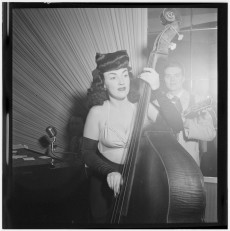
Bonnie Wetzel was born Bonnie Jean Addleman on May 15, 1926 in Vancouver, Washington. She learned violin as a child and was an autodidact on bass.
She played with Ada Leonard in an all-female ensemble and soon after worked in a trio with Marian Grange. Bonnie married trumpeter Ray Wetzel in 1949 and the pair worked in the Tommy Dorsey Orchestra in 1951.
Wetzel played in the Beryl Booker Trio with Elaine Leighton in 1953. They toured Europe in 1953-54 and recorded for Discovery Records. She also played with Herb Ellis, Charlie Shavers, Roy Eldridge and Don Byas. During the 1950s she freelanced in New York City. Double-bassist Bonnie Wetzel, who never led a recording session in her short career, passed away on February 12, 1965, at the age of 38.
Take A Dose On The Road
More Posts: bass
Daily Dose Of Jazz…
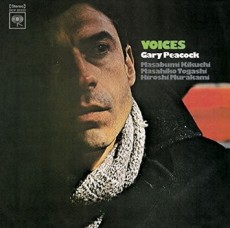
Gary Peacock was born May 12, 1935, in Burley, Idaho and studied the bass as a youth. After military service in Germany, during the early Sixties he worked on the West Coast with Barney Kessel, Bud Shank, Paul Bley and Art Pepper. Moving to New York he continued working with Bley as well as with Paul Motian in the Bill Evans Trio, and with Sunny Murray in the Albert Ayler trio. He also played some live dates with Miles Davis as a temporary substitute for Ron Carter.
In the late 1960s Peacock spent time in Japan, abandoning music temporarily to study Zen philosophy. After returning to the U. S. in 1972, he studied biology at the University of Washington, Seattle and taught music theory at Cornish College of the Arts from 1976 to 1983.
In 1983 Gary joined Keith Jarrett’s Standard Trio with Jack DeJohnette and the trio releaseded Standards Vol. 1 & 2 and Standards Live. Under Peacock’s leadership the trio recorded earlier in 1977 Tales of Another on the ECM label.
Peacock has recorded a dozen albums under his leadership, six releases as part of the group Tethered Moon and another sixty-two albums as a sideman with Bill Connors, Don Elis, Clare Fischer, Marc Copland, Marilyn Crispell, Barney Kessel, Prince Lasha, Sonny Simmons, Don Pullen, Bud Shank, Ravi Shankar, Ralph Towner, Mal Waldron, Tony Williams and Jimmy Woods to name a few.
He has composed for two film shorts, performed on three documentaries, performed as the Keith Jarrett Trio on the Most Martha soundtrack, and has appeared on television. Double bassist Gary Peacock continued to perform, tour and record until he passed away on September 4, 2020, at his home in Upstate New York. He was 85.
Uplift Someone’s World
More Posts: bass
Daily Dose Of Jazz…
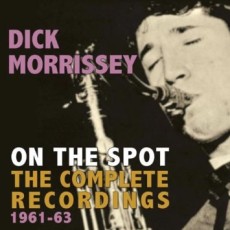
Richard Edwin Morrissey was born May 9, 1940 in Horley, England. Better known to the world as Dick Morrissey, he was self-taught and started playing clarinet in his school band, The Delta City Jazzmen, at the age of sixteen with fellow pupils Robin Mayhew, Eric Archer, Steve Pennells, Glyn Greenfield and young brother Chris on tea-chest bass. He then joined the Original Climax Jazz Band. This stint he followed with becoming a member of the Gus Galbraith Septet and was introduced to Charlie Parker by alto-sax player Peter King. This prompted him to begin specializing on tenor saxophone.
Making his name as a hard bop player, Dick appeared regularly at the Marquee Club in 1960 and recorded his first solo album for Fantana Records It’s Morrissey, Man! the next year at the age of 21. It featured pianist Stan Jones, drummer Colin Barnes, and The Jazz Couriers founding member bassist Malcolm Cecil.
Spending most of 1962 in Calcutta, India as part of the Ashley Kozak Quartet, he played three 2-hour sessions seven days a week. Returning to the UK Dick formed a quartet with Harry Smith, Phil Bates, Bill Eyden, Jackie Dougan or Phil Seamen. They recorded three albums between 1963 and 1966,played regular gigs at The Bull’s Head and Ronnie Scott’s, and played with Ian Hamer, South and
During this time he also played extensively in bands led by Ian Hamer and Harry South, The Six Sounds, performed briefly with Ted Heath’s Big Band, John Dankworth and his Orchestra, was a part of Eric Burdon and The Animals Big Band with Stan Robinson, Al Gay, Paul Carroll, Ian Carr, Kenny Wheeler and Greg Brown.
He would go on to tour and/or record with visiting musicians Brother Jack McDuff, Jimmy Witherspoon, J. J. Jackson, Sonny Stitt and Ernest Ranglin. He would win many Melody Maker Jazz Polls, toured and recorded with Average White Band, team up with guitarist Jim Mullen of Brian Auger’s Oblivion Express and released seven albums of their 16-year association.
Throughout his career as a leader of his own combos, Morrissey he was an in-demand musician playing with Tubby hayes, Bill LeSage, Roy Budd, Charlie Watts, Georgie Fame, Anie Ross, Dusty Springfield, Paul McCartney, Freddie Mack, Orange Juice, Herbie Mann, Shakatak, Peter Gabriel, David Fathead Newman, Boz Scaggs, Johnny Griffin, David Sanborn, Steve Gadd, Richard Tee, Billy Cobham, The Brecker Brothers, Sonny Fortune, Teddy Edwards and the list of players goes on and on. He is known for playing the haunting saxophone solo on the Vangelis composition Love Theme for the 1982 film Blade Runner.
Tenor saxophonist Dick Morrissey, who also played soprano saxophone and flute, passed away on November 8, 2000, aged 60, in Kent, England after many years battling various forms of cancer.
Inspire A Young Mind
Daily Dose Of Jazz…
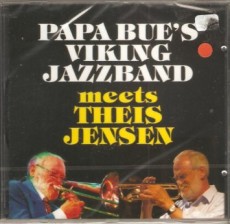
Papa Bue Jensen was born Arne Bue Jensen on May 8, 1930 in Copenhagen, Denmark, At an early age, he became fascinated with jazz, prompted by records from his brother with Harry James, Arte Shaw, Tommy Dorsey, Glenn Miller, Bert Ambrose, Bunk John and George Lewis in the stack.
After World War II, Jensen became a sailor for a few years, visiting ports all around the world, where he had an opportunity to listen to enjoy their music venues. It was around this time that he started to play jazz. He borrowed money to by a slide trombone, was taught the seven basic positions of the slide by a Royal Danish Orchestra musician, and the rest he taught himself. Soon he was playing with other young jazz musicians, performing in clubs and bars around Copenhagen.
He played in the Royal Jazzman band, that later became the Bohana Jazz Band, Henrik Johansen’s Jazz Band and recorded as a sideman with the Saint Peter Street Stompers in the 1950s. Papa Bue also worked with the Bonanza Jazz Band, Chris Barber, Adrian Bentzon and Johansen. During this period of his career he was immersed in the Nyhavn music scene jamming with other young jazz musicians. In 1956 he founded and led the New Orleans Jazz Band, and was given the nickname Papa Bue as he was the on father in the group.
In late 1957, after an article by Shel Silverstein was published in which he referred to them as the Danish Vikings, Jensen renamed the ensemble the Viking Jazz Band. They released their first album in 1958 and their sophomore project Schlafe Mein Prinzchen released in 1960, sold over one million copies, garnering them gold status.
Though bebop was in at the time he remained in the Dixieland style, but was influenced by early swing and is considered one of the most significant proponents of his genre. The group remained active into the 1990s, recording and/or performing with George Lewis, Champion Jack Dupree, Art Hodes, Wild Bill Davison, Wingy Manone, Edmond Hall, Albert Nicholas, Earl Hines, Stuff Smith and Ben Webster.
Papa Bue’s Viking Jazz Band recorded Bent Fabricius-Bjerre’s theme music for the Olsen Gang series, and was awarded the Golden Keys To The City in 1969 after performing at the 1969 New Orleans Jazz Festival. In 1989 he was awarded the Ben Webster Prize of Honor.
Trombonist Papa Bue Jensen, who released a large number of albums on Storyville, timeless and Music Mecca record labels though few are in print, passed away on November 2, 2011, at the age of 81.
Dose A Day-Blues Away
More Posts: trombone