

Hollywood On 52nd Street
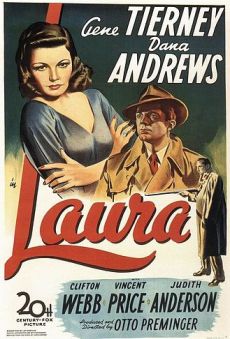
Laura is a jazz standard written for the 1944 American film noir produced and directed by Otto Preminger. The theme song was composed by Johnny Mercer nd David Raksin. The movie starred Gene Tierney, Dana Andrews and Clifton Webb with supporting cast comprised of Vincent Price, and Judith Anderson.
The Story: New York City police detective Mark McPherson (played by Andrews) is investigating the murder of beautiful and highly successful advertising executive, Laura Hunt (Tierney). A series of interviews leads McPherson to the people in Laura’s life – decadent newspaper columnist Waldo Lydecker (Webb), parasitic playboy fiancé, Shelby Carpenter (Price) and her aunt Ann Treadwell (Anderson) who has been carrying on with Carpenter and giving him money. Through the ensuing investigation McPherson falls in love with the dead woman’s image only to discover that she is alive and that another girl was murdered. He now only has to learn the identity of the murderer in order to save Laura.
Sponsored By

www.whatissuitetabu.com
Daily Dose Of Jazz…
George V. Johnson Jr. was born on December 20, 1950 in Washington, D.C. Self taught, he was first exposed to music by singing and participating regular with church and school choirs while listening and emulating records played by his parents. He attended Prince George’s Community College then went on to matriculate through Howard University School of Fine Arts.
A composer, George writes lyrics about complex things: personal experiences, love, history, family, home, heaven and jazz. Phrases turn, emotions connect and melodies soar with his natural gift of writing lyrics and poetry. Meeting pianist John Malachi was fortuitous as he helped shape and guide Johnson’s career over the next 15 years.
He met a major influence, Eddie Jefferson, and performed or recorded with Lou Donaldson and James Moody, has performed at numerous jazz festivals and tributes, played various nightclubs and toured Europe. He has penned lyrics to more than 40 Hank Mobley compositions as part of the Second Floor Music project that has single handedly kept vocalese alive.
Over a 35 year career, vocalist, lyricist, actor, playwright, producer, promoter, composer George Johnson has played with legendary jazz musicians and vocalists such as Lou Donaldson, Dr. Lonnie Smith, Shirley Horn, Dizzy Gillespie, John Hicks, Billy Higgins, Rufus Reid, Max Roach, Philly Joe Jones, Tony Williams, Kurt Lightsey and the list continues. He continues to perform, and record.

Give A Gift Of Jazz – Share
More Posts: vocal
Hollywood On 52nd Street
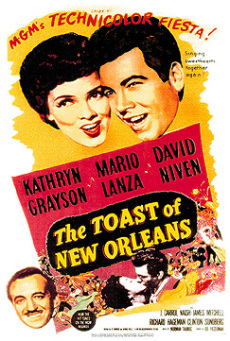
Be My Love is now a jazz standard written by Nicholas Brodszky and Sammy Cahn and was originally featured in the 1950 film The Toast Of New Orleans. Kathryn Grayson, Mario Lanza and David Niven were the stars of the movie with supporting roles by J. Carroll Naish, James Mitchell and a teenaged Rita Moreno.
The Story: The plot revolves around Pepe Abellard Duvalle, a New Orleans fisherman, who falls in love with opera star soprano Suzette Micheline.
Sponsored By
www.whatissuitetabu.com
Daily Dose Of Jazz…
Jimmy Owens was born December 9, 1943 in New York City. In the 1960s, he was a member of the hybrid classical and rock band Ars Nova, and then became a member of the New York Jazz Sextet playing with at times were Sir Roland Hanna, Ron Carter, Billy Cobham, Benny Golson, Hubert Laws, and Tom McIntosh.
Between 1969 and 1972, Jimmy was a sideman on the David Frost Show under musical director Dr. Billy Taylor. During this stint he played alongside Frank Wess, Seldon Powell Barry Galbraith and Bob Cranshaw.
As an educator Jimmy is an active member of the jazz education community, sitting on the board of the Jazz Foundation of America and the Jazz Musicians’ Emergency Fund to help individual musicians.
Over the course of his career the trumpeter, composer, arranger, lecturer and music education consultant has performed and recorded as a leader and sideman with Lionel Hampton, Charles Mingus, Archie Shepp, Joe Zawinul, Gerald Wilson, Duke Ellington, Hank Crawford, Dizzy Gillespie, Count Basie and Herbie Mann among many others. Since 1969, he has led his own group, Jimmy Owens Plus.
Give The Gift Of Knowledge
More Posts: flugelhorn,trumpet
Hollywood On 52nd Street
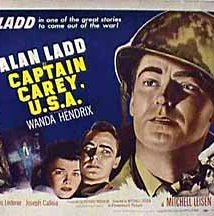
Mona Lisa, written for the 1950 film Captain Carey, U.S.A. by Ray Evans and Jay Livingston. The title and lyrics refer to the renaissance portrait of the same name painted by Leonardo da Vinci. The song won an Oscar for Best Original Song in 1950. The movie is a drama starring Alan Ladd, Wanda Hendrix and Francis Lederer.
The Story: A group of agents of the U.S. Office of Strategic Services is sent to German-occupied Italy during World War II to knock out the German-held Italian railroad system. In accomplishing this mission, most of them are killed because of an inside betrayal. After the war, one of the survivors, Captain Webster Carey (Alan Ladd), resolves to find the traitor. Captain Carey returns to Orta, near Milan, to find out who betrayed his World War II O.S.S. team and caused the deaths of several villagers. Much to his surprise, his old love Giulia whom he thought dead at the hands of the Nazis, is alive and married to a powerful Italian nobleman, Barone Rocco de Graffi.The villagers are unfriendly, but Carey persists in his clandestine efforts to flush out the traitor.
Sponsored By
www.whatissuitetabu.com