

Daily Dose Of Jazz…
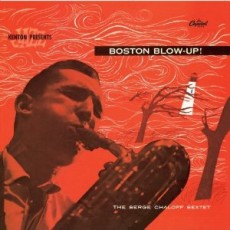
Serge Chaloff was born on November 24, 1923 in Boston, Massachusetts to noted piano teachers, Margaret and Julius. He was among the few major jazz performers on his instrument, and until his arrival on the jazz scene the only prominent baritone player was Harry Carney of the Duke Ellington Orchestra.
Originally influenced by Charlie Parker, Serge became the first major bebop baritone saxophonist, opening the way for others to follow. He first became well known as one of the “Four Brothers” reed section in Woody Herman’s Second Herd. He also played with Boyd Raeburn, Georgie Auld, Jimmy Dorsey and Count Basie.
Recording as a leader Chaloff produced five records working with Stan Kenton, Sonny Clark, Leroy Vinnegar, Philly Joe Jones and the metronome All-Stars, however, his career was greatly limited by addiction to heroin. After successfully giving up drugs, baritone saxophonist Serge Chaloff developed cancer of the spine which caused his early death on July 16, 1957 at he young age of 33.

More Posts: saxophone
Daily Dose Of Jazz…
Francy Boland was born François Boland on November 6, 1929 in Namur, Belgium. He first gained notice in 1949 and worked with Belgian jazz greats like Bobby Jaspar. In 1955 he joined Chet Baker’s quintet before moving to the US where he began arranging for Count Basie, Benny Goodman, Woody Herman and Dizzy Gillespie.
Boland set up an octet with drummer Kenny Clarke before returning to Europe and becoming Kurt Edelhagen’s chief arranger. In 1961, based around a rhythm section featuring Clarke, Jimmy Woode and himself, he founded The Kenny Clarke-Francy Boland Big Band, which rapidly became one of the most noted Big Bands assembled outside the United States. A decade later in 1972 the band broke up and he mainly concentrated on composing.
Francy primarily lived in Switzerland, from 1976 wrote musical arrangements for Sarah Vaughan among others, and played as a sideman with Johnny Griffin. He was also part of One World One Peace, an effort involving Pope John Paul II. He recorded some three-dozen albums and Carola covered his song “Just Give Me Time” in 1966,
Belgian composer and pianist Francy Boland passed away on August 12, 2005 in Geneva, Switzerland.

More Posts: piano
Daily Dose Of Jazz…
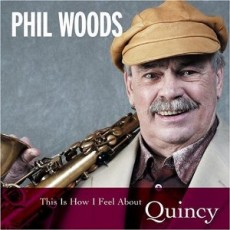
Phil Woods was born Philip Wells Woods on November 2, 1931 in Springfield, Massachusetts. He studied music with his great influence Lennie Tristano, at the Manhattan School of Music and at The Julliard School.
After moving to France in 1968, Phil led the avant-garde jazz group The European Rhythm Machine, and then returned to the United States in 1972 and unsuccessfully attempting to establish an electronic group formed a quintet, which is still performing with some changes of personnel.
Although Woods is primarily a saxophonist he is also a fine clarinet player and solos can be found scattered through his recordings. His pop credits include the alto solos on Billy Joel’s Just The Way You Are, Steely Dan’s Doctor Wu and Paul Simon’s Have A Good Time.
Phil has worked with the likes of Manny Albam, Kenny Burrell, Gary Burton, Ron Carter, Lou Donaldson, Bill Evans, Art Farmer, Dizzy Gillespie. Stephane Grappelli, Milt Jackson, Quincy Jones, Mundell Lowe, the Modern Jazz Quartet, Thelonious Monk, Oliver Nelson, Lalo Schifrin, Shirley Scott, Clark Terry and Ben Webster among others.
He has amassed 34 sessions as a sideman and nearly four-dozen albums as a leader and has been nominated for seven Grammy Awards and won one for Images: “Best Large Jazz Ensemble Performance”, and three for “Best Instrumental Jazz Performance, Individual or Group” for Live from the Show Boat, More Live, and At the Vanguard.
His 2005 documentary film “A Life in E Flat” – Portrait of a Jazz Legend” offers an intimate portrait of Woods during a recording session of the Jazzed Media album This is How I Feel About Quincy. In 2007, Phil received a “Jazz Master” award from the National Endowment of the Arts. Saxophonist, clarinetist and composer Phil Woods was married to Chan Parker, the widow of Charlie Parker, until her death in 1999. He continued to perform, record and tour until his passing on September 29, 2015 in East Stroudsburg, Pennsylvania.

Daily Dose Of Jazz…
Carmen Lundy was born November 1, 1954 in Miami, Florida and at the age of six began to study the piano. After joining her church junior choir, she decided to become a singer when she was 12 years old. While an opera major at the University of Miami she sang with a jazz band and her decision to sing vocal jazz was cemented.
Moving to New York in 1978 Carmen was hired by the Mel Lewis/Thad Jones Big Band and performed her first engagement at the Village Vanguard in Greenwich Village. Two years later she formed her own trio, performing with pianists John Hicks and Onaje Allan Gumbs. She has also performed with Walter Bishop Jr., Don Pullen, Mulgrew Miller, Terri Lyne Carrington, Courtney Pine, Bill O’Connell, Steve Berrios, Marian McPartland, Kenny Kirkland and numerous others.
Lundy recorded her first album of original compositions Good Morning Kiss in 1985 followed by her sophomore project Night and Day the next year featuring musicians Kenny Kirkland, Alex Blake, her brother Curtis Lundy, Victor Lewis, Rodney Jones and Ricky Ford.
Carmen played the lead role in the European tour of Duke Ellington’s Broadway musical, Sophisticated Ladies. Off-Broadway she portrayed Billie Holiday in Lawrence Holder’s They Were All Gardenias. She made her television debut in 1990 as the star of the CBS pilot-special Shangri-La Plaza in the role of Geneva.
A composer, arranger, producer, actress, painter, and sophisticated vocalist well known for her progressive bop and post-bop styling’s, Lundy has composed and published forty songs with favorites such as Quiet Times, Forgive Me, The Out Crowd, and Never Gonna Let You Go that have been recorded by Kenny Barron, Ernie Watts and Straight Ahead. With thirteen albums to her credit Carmen Lundy continues to focus on original material as she moves her three-decade career forward.

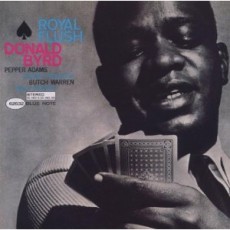
Requisites
Royal Flush: This album was recorded by jazz trumpeter Donald Byrd and is notable for introducing pianist Herbie Hancock in his first Blue Note session.
Personnel: Donald Byrd – trumpet, Pepper Adams – baritone saxophone, Herbie Hancock – piano, Butch Warren – bass, Billy Higgins – drums
Record Date: Blue Note – 1961
Songs: Hush, I’m A Fool To Want You, Jorgie’s, Shangri-La, 6M’s, Requiem

More Posts: collectible,trumpet