

Daily Dose Of Jazz…
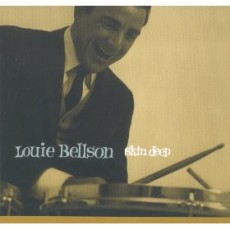
Louie Bellson was born Luigi Paulino Alfredo Francesco Antonio Balassoni on July 6, 1924 in Rock Falls, Illinois. He started playing drums at three years of age and at 15 pioneered the double-bass drum set-up. By 17 he triumphed over 40,000 drummers to win the Slingerland National Gene Krupa contest and graduated from high school in 1939.
1943 saw Bellson performing with Benny Goodman and Peggy Lee in the film “The Powers Girl” followed two more by the decade’s end. Between 1943 and 1952, he performed with Benny Goodman, Tommy Dorsey, Harry James and Duke Ellington, for whom he composed “Skin Deep” and “The Hawk Talks”. In 1952 he married Pearl Bailey, leaving Ellington to be her musical director, a union that lasted 38 years until her death in 1990.
Through the 1950s and 1960s, Louie performed with Jazz At The Philharmonic or J.A.T.P., Tommy and Jimmy Dorsey, Count Basie, again with Duke Ellington and Harry James, as well as appearing on several Ella Fitzgerald studio albums.
Equally adept as a big band or small group drummer, Bellson recorded extensively and led his own big and small bands, occasionally maintaining separate bands on each coast. His sidemen have included Blue Mitchell, Don Menza, Larry Novak, John Heard, Clark Terry, Pete and Conte Candoli and Snooky Young.
Louie Bellson, composer, arranger, bandleader and jazz educator passed away from Parkinson’ s disease on February 14, 2009.

Take A Dose On The Road
More Posts: arranger,composer,drums,educator,musical director
Daily Dose Of Jazz…
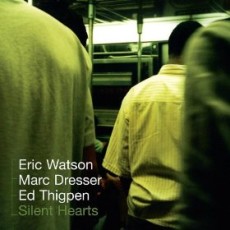
Eric Watson was born July 5, 1955 in Wellesley, Massachusetts. After graduating from Oberlin Conservatory he moved to Paris and by 1982 he recorded his first trio album with Paul Motian and Ed Schuller followed by two solo albums.
He worked in a long-time duo with double-bass player John Lindberg that became extended with Albert Mangelsdorff and Ed Thigpen. He has played and recorded with Steve Lacy, Linda Sharrock and Joelle Leandrein1991. His trio with Mark Dressler and Ed Thigpen recorded “Silent Hearts” in 1998 that became the basis for the “Full Metal Quartets” a year later with saxophonist Bennie Wallace.
Eric’s current small catalogue of seven recordings includes a solo piano project “Sketches of Solitude” in 2002 that became one of the best-selling jazz albums in France. Between 2003 and 2005 he toured Europe, Asia, and Australia with tenor saxophonist Christof Lauer.
His dance score The Peking Ballet was commissioned by Radio City Music Hall to a record summer attendance of 200,000. Watson has presented commissioned works at the Lyon Opera, the State Theatre in Poitiers, he has written for Martial Solal and the Orchestra National de Jazz and for Australian violinist Jane Peters.
In 2001, Eric Watson was appointed artistic director of La Villette Jazz Festival, is musical consultant to the director of the Cité de la Musique, and in 2003 he was appointed as a Chevalier des Arts et des Lettres.
Dose A Day – Blues Away
Daily Dose Of Jazz…
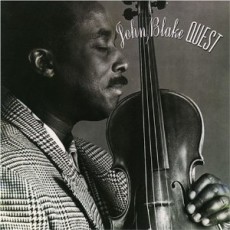
John Blake, Jr. was born in Philadelphia, Pennsylvania on July 3, 1947 and began studying violin in that city’s public school system and at the Settlement Music School. Graduating from West Virginia University, his postgraduate work was at the Institute for Advanced Studies in Montreux, Switzerland prior to receiving a grant to study studied East Indian music.
Classically trained, Blake first gained recognition on early-’70s recordings he made with Archie Shepp and in the mid-70s became established with a global audience during three years recording and touring as a member of Grover Washington, Jr.’s popular “crossover” jazz band. He then spent five years working extensively as a member of various ensembles led by pianist McCoy.
John is a four-time winner of the Down Beat Critics’ Poll Violinist Deserving Wider Recognition category he was also one of the top two jazz violinists in the 49th, 50th, and 51st Down Beat Readers’ Poll. He has performed and/or recorded with are the Duke Ellington Orchestra, Turtle Island String Quartet, Quartet Indigo, the Steve Turre Sextet, the Billy Taylor Trio, Avery Sharpe, Cecil McBee, Jay Hoggard and James Newton.
In addition to being a prominent violinist leading his own quartet, sideman and session player, John is an accomplished composer, arranger and producer as well as an author, educator and lecturer who presents hundreds of workshops annually to musicians at all levels. Violinist John Blake continues to perform, record and tour and lecture.
Give A Gift Of Jazz – Share
Daily Dose Of Jazz…
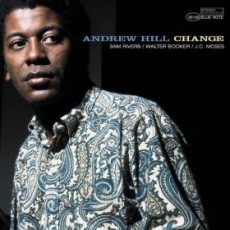
Andrew Hill was born June 30, 1931 in Chicago, Illinois and took up the piano at the age of thirteen, and was encouraged by Earl Hines. He studied informally until 1952. While a teenager he performed in rhythm and blues bands and toured with jazz musicians, including Charlie Parker and Miles Davis.
Hill first recorded as a sideman in 1954, but made his reputation recording as a leader for Blue Note from 1963 to 1970, featuring important post-bop musicians including Joe Chambers, Richard Davis, Eric Dolphy, Bobby Hutcherson, Joe Henderson, Freddie Hubbard, Elvin Jones, Woody Shaw and Tony Williams.
Hill is recognized as one of the most important innovators of jazz piano in the 1960s but rarely worked as a sideman after the 1960s, preferring to play his own compositions, which may have limited his public exposure.
As an educator he held positions at Portland State University, held residencies at Colgate University of Hamilton, Wesleyan University, University of Michigan, University of Toronto, Harvard University and Bennington College.
Returning to New York City in 1990, composer and pianist Andrew Hill, whose unique idiom of chromatic, modal and free improvisation, made his final public appearance on March 29, 2007 at Trinity Church. Suffering from lung cancer during his later years he died in his home on April 20, 2007. In May 2007, he became the first person to receive a posthumous honorary doctorate from Berklee College of Music.
Give The Gift Of Knowledge
Daily Dose Of Jazz…
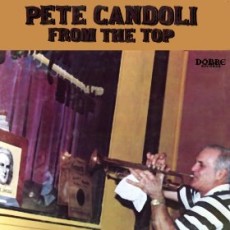
Pete Candoli was born Walter Joseph Candoli in Mishawaka, Indiana on June 28, 1923. And his professional career began 13 years later when he became a member of the American Federation of Musicians. Quickly finding a spot as lead trumpeter, by 1940 had become a member of Sonny Dunham’s band, a year later in Tommy Dorsey’s band and during this time from ’41 to ’43 he performed in three films – Las Vegas Nights, Girl Crazy and Upbeat In Music. By 1944 he was playing with the Teddy Powell and bringing his younger brother Conte into the major leagues of big band.
After 1945, Candoli worked with several bands including Stan Kenton’s, then drifted into the West Coast jazz and studio scenes. Despite his range, he rarely played lead, reserved instead for feature roles and became a sought after studio musician and favorite collaborator of many influential musicians and performers, including Peggy Lee, Henry Mancini and Frank Sinatra.
Pete was inducted into The International Jazz Hall of Fame in 1997, the “Big Band Hall of Fame” in 2003 and won the Down Beat, Metronome and Esquire “All American Band Trumpet Bronze Award”, and Look magazine named him one of the seven all-time outstanding jazz trumpet players—the others being Louis Armstrong, Bix Biederbecke, Harry James, Bunny Berigan, Dizzy Gillespie and Bobby Hackett.
Candoli’s solo work is notable for his eloquent roles, supportive of the efforts of others, was adroit in the use of staccato and had a reputation for his high-note ability, that was used in West Side Story’s Dance at the Gym sequence. Trumpeter Pete Candoli passed away from complications due to prostate cancer on January 11, 2008.
Dose A Day – Blues Away
More Posts: trumpet