Daily Dose Of Jazz…
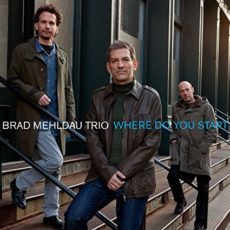
Bradford Alexander Mehldau was born August 23, 1970 in Jacksonville, Florida. His family moved to West Hartford, Connecticut, when he was 10, a move that introduced him to a new piano teacher and classical music an away from playing mostly simple pop tunes and exercises from books. By 14 he was listening more to jazz, including recordings by saxophonist John Coltrane and pianist Oscar Peterson.
Mehldau attended William H. Hall High School, played in its concert jazz band and from the age of 15 until he graduated from high school he had a weekly gig at a local club. He performed at weddings and other parties before winning the Berklee College’s Best All Round Musician Award for school students in his junior year.
Moving to New York City in 1988 he studied jazz and contemporary music at The New School, studied under pianists Fred Hersch, Junior Mance and Kenny Werner and drummer Jimmy Cobb. In 1989 Brad was part of saxophonist Christopher Hollyday’s band that toured for several months and a result assimilated the music of his principle influences Wynton Kelly and McCoy Tyner, and began to develop his own sound. By 20 he was playing in Cobb’s band with fellow student guitarist Peter Bernstein.
During the 1990s Mehldau first recorded on Hollyday’s The Natural Moment and toured of Europe with him, developed his left-hand playing, led his own trio and played at New York’s Village Gate. As a sideman he performed with saxophonist Perico Sambeat on tour and released his debut recordings as co-leader from a May concert in Barcelona, Spain. He went on tour with saxophonist Joshua Redman
Mehldau graduated from The New School in 1993 and formed his first long-term trio in 1994, with bassist Larry Grenadier and drummer Jorge Rossy. He recorded his debut as a leader Introducing Brad Mehldau for Warner Brothers. He went on to work with Lee Konitz, Charlie Haden, contribute to the soundtrack recorded for Midnight in the Garden of Good and Evil, release a compilation of standards on Live at the Village Vanguard: The Art of the Trio Volume Two followed by Songs: The Art of the Trio Volume Three. Not shying away from recording he ultimately has released 33 albums as a leader and has been a sideman on another 61 as well as nie soundtracks. He has performed and recorded with Pat Metheny, Dayna Stevens, Warren Wolf, Michael Brecker, Kurt Rosenwinkel, Joel Frahm, Wayne Shorter, Petra Haden, Vinicius Cantuária, John Patitucci, Charles Lloyd, Fleurine, Willie Nelson, Avishai Cohen, Anthony Wilson, Grant Stewart and Jesse Davis on the short list.
He has won Down Beat’s Readers Poll piano award in 1999, 2000, 2002, 2004, 2007, 2011, and 2012, was the 2006 winner of the Miles Davis Prize, awarded by the Montreal International Jazz Festival, received the Wigmore Medal and has been nominated for seven Grammy Awards. Pianist Brad Mehldau continues to perform, record and tour.
More Posts: piano
Daily Dose Of Jazz…
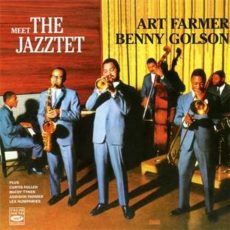
Addison Farmer was born August 21, 1928 an hour after his twin brother, in Council Bluffs, Iowa reportedly at 2201 Fourth Avenue. Their parents divorced when the boys were four, and their steelworker father was killed in a work accident not long after this. He moved with his grandfather, grandmother, mother, brother and sister to Phoenix, Arizona when he was four.
Addison and his brother moved to Los Angeles, California in 1945 and attended the music-oriented Jefferson High School, where they got music instruction and met other developing musicians such as Sonny Criss, Ernie Andrews, Big Jay McNeely, and Ed Thigpen. They brothers earned money by working in a cold-storage warehouse and by playing professionally. He went on to take bass lessons from Fred Zimmermann, and studied at Juilliard and the Manhattan School of Music.
By late 1945, Farmer was with Johnny Alston and His Orchestra recording for the Bihari Brothers’ Modern Music label, backing Jeanne De Metz. Shortly afterwards he recorded on the Blue Moon label with Al “Cake” Wichard and King Fleming and worked with Teddy Edwards’s band. He played and recorded in several groups with his brother and in ensembles led by Benny Golson, Gigi Gryce, Mose Allison, Jay McShann, Charlie Parker, Gene Ammons, Bob Brookmeyer, curtis Fuller, Hampton Hawes, Curtis Fuller, Stan Getz, Teo Macero, Sahib Shihab, Mal Waldron and Miles Davis.
Bassist Addison Farmer recorded extensively for the jazz label Prestige before passing away suddenly from bed death on February, 20, 1963 in New York City at the age of 34.
More Posts: bass
Daily Dose Of jazz…
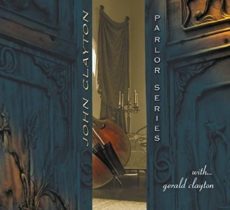
John Lee Clayton Jr. was born on August 20, 1952 in Venice, California. He began seriously undertaking the study of double bass at age 16, studying with bassist Ray Brown. By age 19, he had become a bassist on Henry Mancini’s television series The Mancini Generation. He later graduated in 1975 from Indiana University’s Jacobs School of Music with a degree in bass performance.
He toured with the Monty Alexander Trio and the Count Basie Orchestra before becoming the principal bass in the Amsterdam Philharmonic Orchestra in the Netherlands. Returning to the States after five years and moved towards jazz and jazz composition. Shortly after his return he founded the Clayton-Hamilton Jazz Orchestra with his saxophonist brother Jeff Clayton and drummer Jeff Hamilton. He and his brother also founded The Clayton Brothers which has featured instrumentalists such as Bill Cunliffe and Terell Stafford.
Clayton has composed and/or arranged for The Count Basie Orchestra, Diana Krall, Whitney Houston, Carmen McRae, Nancy Wilson, Joe Williams, Ernestine Anderson, Quincy Jones, Dee Dee Bridgewater, Natalie Cole, Till Bronner, and The Tonight Show Band. He won a Grammy for Instrumental Arrangement Accompanying Vocalist(s): “I’m Gonna Live Till I Die” (Queen Latifah) and was nominated for Best Jazz Instrumental Album, Individual or Group for Brother To Brother by The Clayton Brothers.
From 1999 to 2001 he served as Artistic Director of the Jazz for the Los Angeles Philharmonic program at the Hollywood Bowl, has conducted the All-Alaska Jazz Band and and has been president over the International Society of Bassists. In addition to performing, bassist John Clayton currently serves as Artistic Director for the Lionel Hampton Jazz Festival, Sarasota Jazz Festival, Santa Fe Jazz Party, Jazz Port Townsend Summer Workshop, and Vail Jazz Workshop. He is also an educator, teaching at the University of Southern California Thornton School of Music.

More Posts: bass
Daily Dose Of Jazz…
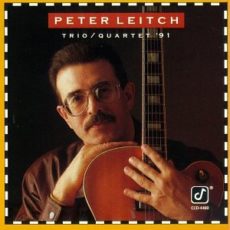
Peter Leitch was born August 19, 1944 in Montreal, Canada. He has recorded seventeen albums as a leader and was a sideman with Oscar Peterson, Woody Shaw and Dominique Eade. He performed with Kirk Lightsey, Rufus Reid, Al Grey, Jeri Brown, Pepper Adams and Pete Yellin.
During his career he was nominated for a Juno Award for Best Traditional Jazz Album of the Year. He has written an autobiography, Off the Books, giving a real, raw, look at the life of a musician playing creative music. In addition to his music he became a very talented photographer with a number of exhibitions of his work.
Prior to his retirement due to medical issues on July 21, 2015, guitarist Peter Leitch was an educator who taught privately for a number of years.
More Posts: guitar
Daily Dose Of Jazz…
Bill Dowdy was born August 15, 1932 in Osceola, Arkansas but his family moved to Benton Harbor, Michigan when he was six months old. At a young age he would beat on things as if he were playing the drums, an indication of his future musical career. It was in high school that he learned to play the piano and the drums and in 1949 had a group called Club 49 Trio that group played on the radio in Chicago.
After Dowdy started his own music group, he moved to Battle Creek, Michigan and joined a band before being drafted by the Army. After his discharge he landed in Chicago and took private lessons to improve his musical skills. Over time he became a professional drummer, playing with many blues bands. He continued traveling from New York City to Los Angeles, California to Canada and the South.
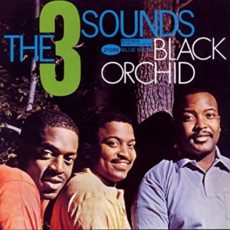
Bill joined the jazz trio, The Three Sounds and recorded over ten jazz albums from the 1950s through the early 1970s. He also played with Lester Young, Lou Donaldson, Nat Adderley, Johnny Griffin, Anita O’Day and Sonny Stitt among others.
Drummer, bandleader and teacher Bill Dowdy, whose idols included Gene Krupa, Max Roach, Roy Haynes, and Tony Williams, passed away on May 12, 2017.